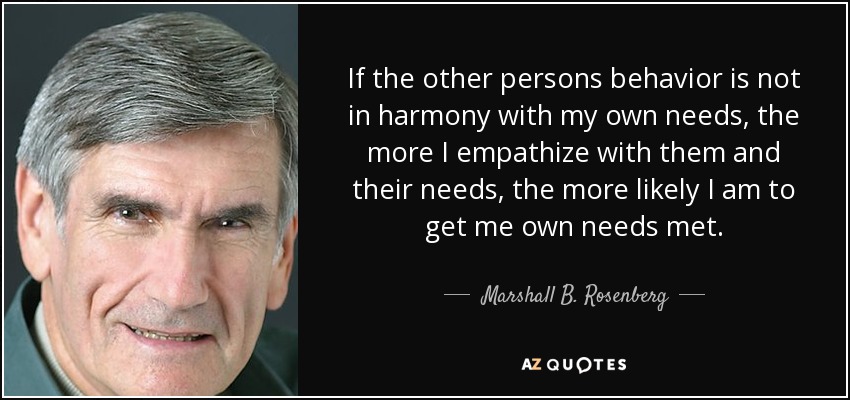
If the other persons behavior is not in harmony with my own needs, the more I empathize with them and their needs, the more likely I am to get me own needs met.
The best way I can get understanding from another person is to give this person the understanding, too. If I want them to hear my needs and feelings, I first need to empathize.
NVC enhances inner communication by helping us translate negative internal messages into feelings and needs. Our ability to distinguish our own feelings and needs and to empathize with them can free us from depression.
Our ability to offer empathy can allow us to stay vulnerable, defuse potential violence, help us hear the word 'no' without taking it as a rejection, revive lifeless conversation, and even hear the feelings and needs expressed through silence.
Life-Enriching Education: an education that prepares children to learn throughout their lives, relate well to others, and themselves, be creative, flexible, and venturesome, and have empathy not only for their immediate kin but for all of humankind.
In nonviolent communication, no matter what words others may use to express themselves, we simply listen for their observations, feelings, needs, and requests. Then we may wish to reflect back, paraphrasing what we have understood. We stay with empathy, allowing others the opportunity to fully express themselves before we turn our attention to solutions or requests for relief.
When you ride the wave, the thrill is so exhilarating that you forget everything else. You live in the moment where nothing else matters, so intent on riding the wave perfectly that you and the wave become one. Pain and worry disappear, replaced by euphoria, akin to flow. Similarly, when giving empathy, you want to strive for this kind of total presence for the person you are listening to.
I just realized that we're facing here is an empathy gap. And this was just another way to generate conversation about something that nobody wanted to look at.
The realization that you're not always standing down there on the field merely to win, to be successful, was very liberating. One can be successful by helping the team, the other players. All of a sudden I felt the kind of empathy for people that I hadn't felt before.
Maybe the biggest problem is that there's no empathy. Nobody puts themselves in the place of others. Everyone thinks they are the only one to suffer. Or that they're the only ones who like ice cream or take their kids on vacation.
If you have this deep feeling of empathy for the natural world, you feel it so profoundly. It's almost a religious experience. I feel that I could never really say the depth of feeling or connection I feel to the natural world, which has made me.
I don't want people to write programmatic environmental poems, but I think sustainability should become deeply a part of the consciousness of poetry - an impulse toward compassion, empathy, and social justice.
You can have compassion for someone who is suffering and try to help this person but if your relationship with mankind is only one of compassion, it is only another form of contempt and it prevents feelings like admiration, empathy which to my mind are much more positive.
Funny bones, to me, are more important than funny lines. If a comedian is just not likable and doing the lines, you could read them yourself. Whereas if someone [you like] shambles out, and they tell you what a bad day they've had, they don't have to say anything. I love them. I want to hug them because they've been through something. And it comes back to empathy, always empathy.
I know Bret Easton Ellis has said he has some amount of empathy for every character he has written about, though, so maybe I am similar to him in terms of that. I'm not sure what he thinks exactly.
I see Lord Buddha in the 21st Century across national borders, across faith systems, across political ideologies, playing the role of a bridge to promote understanding to counsel patience and to enlighten us with tolerance and empathy.
Empathy and fellow feeling form the very basis of morality. The capacities for empathy, for feeling responsibility toward others and for reaching out to help them can be stunted or undermined early on, depending on a child's experiences in the home and neighborhood. It becomes too easy to turn our backs on fellow human beings... to have 'compassion fatigue.' Technology, we are learning, is not neutral.
So long as the people do not care to exercise their freedom, those who wish to tyrannize will do so; for tyrants are active and ardent, and will devote themselves in the name of any number of gods, religious and otherwise, to put shackles upon sleeping men.
The emotions of the spectator will still be very apt to fall short of the violence of what is felt by the sufferer. Mankind, though naturally sympathetic, never conceive, for what has befallen another, that degree of passion which naturally animates the person principally concerned.
I hope they're present in their lives and feel some kind of empathy. I think a lot of the mistakes that have been made in the world have been through a lack of empathy. If you can identify with someone else and empathise with someone else, then activism is a short step away, she explained in an interview with Parade.
Empathy is one of our highest human skills and holds families and societies together. Feeling connected to other people is probably the deepest satisfaction we will ever know. How terrible for children who are being brought up without that capacity.
There's a gap somehow between empathy and activism. Dr. Martin Luther King Jr. spoke of 'soul force' - something that emanates from a deep truth inside of us and empowers us to act. Once you identify your inner genius, you will be able to take action, whether it's writing a check or digging a well.
Reconciliation is a deep practice that we can do with our listening and our mindful speech. To reconcile means to bring peace and happiness to nations, people, and members of our family.... In order to reconcile, you have to possess the art of deep listening.
Altruism itself depends on a recognition of the reality of other persons, and on the equivalent capacity to regard oneself as merely one individual among many.
In all people I see myself - none more, and not one a barleycorn less; And the good or bad I say of myself, I say of them.
Follow AzQuotes on Facebook, Twitter and Google+. Every day we present the best quotes! Improve yourself, find your inspiration, share with friends
or simply: