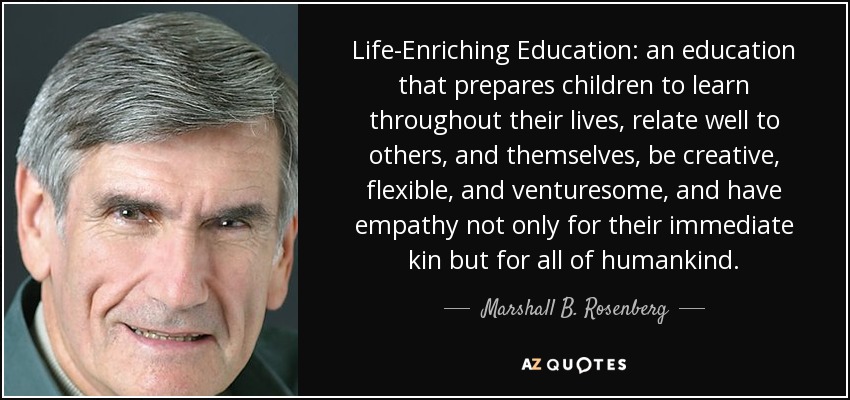
Life-Enriching Education: an education that prepares children to learn throughout their lives, relate well to others, and themselves, be creative, flexible, and venturesome, and have empathy not only for their immediate kin but for all of humankind.
In nonviolent communication, no matter what words others may use to express themselves, we simply listen for their observations, feelings, needs, and requests. Then we may wish to reflect back, paraphrasing what we have understood. We stay with empathy, allowing others the opportunity to fully express themselves before we turn our attention to solutions or requests for relief.
When you ride the wave, the thrill is so exhilarating that you forget everything else. You live in the moment where nothing else matters, so intent on riding the wave perfectly that you and the wave become one. Pain and worry disappear, replaced by euphoria, akin to flow. Similarly, when giving empathy, you want to strive for this kind of total presence for the person you are listening to.
If you take the time to listen to an upset child's story with empathy, and guide the child toward figuring out the root of the problem, then the result is often that the child not only calms down, but also in the future is less likely to get so upset.
I grew up with a lot of compassion and empathy. I notice when I meet other friends of mine that were raised Christian sometimes we have similar model of sensitivity, whether to our advantage or disadvantage.
To listen with empathy is the most important human skill.
Mercy is compassion, kindness, empathy, forgiveness. While grace might be described as blessings and favor from God that we do not necessarily deserve, mercy represents not receiving what we do deserve because of the patience, love, and atonement of the Master.
I identify with other women because of my gender, and I identify with other women if they are mothers because I'm a mother, too. It's very simple. It's nothing complicated, it's not rocket science. It's about empathy. It's about understanding that what happens with one person is potentially what happens to you, and seeing yourself in someone else's shoes. Fundamentally, we are all in the same place: we're born, we live, and we're going to die. In between, we'll have joy and we'll have sadness.
I'm not making excuses for the missed opportunities of the Israelis, or the lack of generosity, the lack of empathy that I think goes hand-in-hand with the suspicion. So, yes, there is more that the Israelis need to do to really demonstrate that they do understand the pain of an oppressed people in their minds, and they want to figure out, within the bounds of security and a Jewish democratic state, what can be accomplished.
There is something human about the way people react to and identify with suffering. There's a lot more empathy in the world than we perhaps realize.
I hope they're present in their lives and feel some kind of empathy. I think a lot of the mistakes that have been made in the world have been through a lack of empathy. If you can identify with someone else and empathise with someone else, then activism is a short step away, she explained in an interview with Parade.
Empathy is one of our highest human skills and holds families and societies together. Feeling connected to other people is probably the deepest satisfaction we will ever know. How terrible for children who are being brought up without that capacity.
There's a gap somehow between empathy and activism. Dr. Martin Luther King Jr. spoke of 'soul force' - something that emanates from a deep truth inside of us and empowers us to act. Once you identify your inner genius, you will be able to take action, whether it's writing a check or digging a well.
Reconciliation is a deep practice that we can do with our listening and our mindful speech. To reconcile means to bring peace and happiness to nations, people, and members of our family.... In order to reconcile, you have to possess the art of deep listening.
Altruism itself depends on a recognition of the reality of other persons, and on the equivalent capacity to regard oneself as merely one individual among many.
In all people I see myself - none more, and not one a barleycorn less; And the good or bad I say of myself, I say of them.
The mother condemned for a witch and burnt with dry wood, and her children gazing on; The hounded slave that flags in the race and leans by the fence, blowing and covered with sweat, The twinges that sting like needles his legs and neck, The murderous buckshot and the bullets, All these I feel or am.
The ability to infer the specific content of another person's thoughts and feelings.
Each side has legitimate aspirations - and that's part of what makes peace so hard. And the deadlock will only be broken when each side learns to stand in the other's shoes; each side can see the world through the other's eyes. That's what we should be encouraging. That's what we should be promoting.
Let us join together across denominations, religions and cultures to make a habit of empathy and reach out to those most in need. To share the blessings we enjoy and to advance the cause of peace in all corners of our world.
As you travel through the Middle East what keeps on striking home to me is how similar everyone is, and yet the degree to which we can find differences to fight wars over. It requires a great deal of empathy, I think, between various sides to overcome this history and live in peace.
But it will depend on young people like you being open to new ideas and new possibilities. And it will require young people like you never to stereotype or assume the worst about other people.
In the Muslim world, this notion that somehow everything is the fault of the Israelis lacks balance - because there's two sides to every question. That doesn't mean that sometimes one side has done something wrong and should not be condemned. But it does mean there's always two sides to an issue. I say the same thing to my Jewish friends, which is you have to see the perspective of the Palestinians. Learning to stand in somebody else's shoes to see through their eyes, that's how peace begins. And it's up to you to make that happen.
It is very important for I think those of us who desperately want peace, who see war as, at some level, a break-down, a manifestation of human weakness, to understand that sometimes it’s also necessary – and you know, to – to be able to balance two ideas at the same time; that we are constantly striving for peace, we are doubling up on our diplomacy, we are going to actively engage, we are going to try to see the world through other people’s eyes and not just our own.
That's where peace begins - not just in the plans of leaders, but in the hearts of people. Not just in some carefully designed process, but in the daily connections - that sense of empathy that takes place among those who live together in this land and in this sacred city of Jerusalem.
Follow AzQuotes on Facebook, Twitter and Google+. Every day we present the best quotes! Improve yourself, find your inspiration, share with friends
or simply: