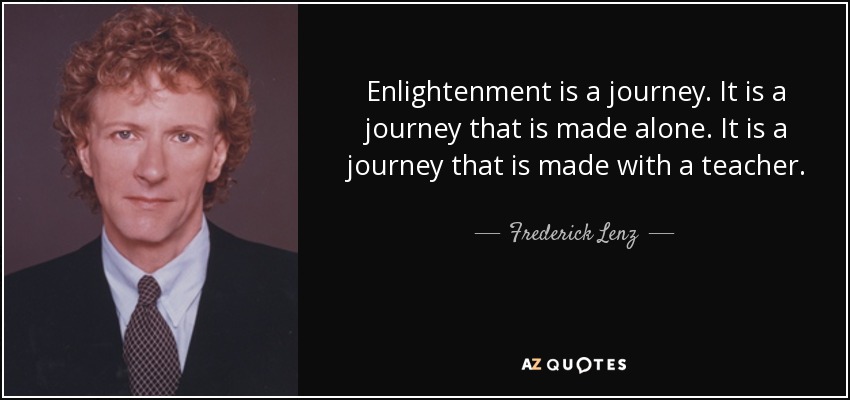
Enlightenment is a journey. It is a journey that is made alone. It is a journey that is made with a teacher.
What makes a difference is when we take our mind and put it into the scriptures, when we read the Buddhist Canon, the Pali Canon, when we read the Tibetan books, when we read anything inspiring - somebody else's journey into the world of enlightenment.
So in the world of Enlightenment, things are just things, except they're not things. We're in nirvana. There is no debating team.
On the pathway that leads to enlightenment, only your heart can tell you what is right.
Enlightenment is not about being political. It is not a social club. Ashrams often turn into that, I know. Societies of enlightenment often just become cliques.
Zen is a very quick path. Zen is the path of meditation. The word Zen means emptiness or fullness, meditation. Meditation is the quickest path to enlightenment.
Zen was an attempt to get back to the purest teachings of the Buddha -enlightenment without strings.
Each of the small enlightenments that a Zen practitioner has, which are known in Zen as "Satori experiences," provides deeper insights into the nature of existence and helps a person prepare for complete enlightenment.
In Zen the emphasis is on meditation and developing your body, mind and spirit to find inner peace, strength, clarity and enlightenment.
From the highest state of mind you have a window whereby you could perhaps move beyond all states of mind, to enlightenment.
By god the Buddhist means that from which the universe was born, the unborn of the Buddhist scriptures, and by soul that factor in the thing called man which moves towards enlightenment. Why need more be said of it, at any rate those who are not content with scholarship, but strive to attain that same enlightenment?
In the most general terms, the Enlightenment goes back to Plato's belief that truth and beauty and goodness are connected; that truth and beauty, disseminated widely, will sooner or later lead to goodness. (While we're making at effort at truth and goodness, beauty reminds us what we're hold out for.)
You must continue to go back to the beginning, to the foundation, and question the foundation. Even once you‘ve reached Samadhi you must go back so you can create it at will. Samadhi is the beginning of spiritual growth, not the end. You must always be questioning. Enlightenment comes as an accident at first, then you have to learn to recreate it.
When prayer, rituals and ascetic life are just a means of self-indulgence, they are harmful rather than beneficial. This is quite obvious to people nowadays, when it is widely recognised that fixations are not the same as valuable and laudable observances. One should not pray if that prayer is vanity; rituals are wrong when they provide lower satisfactions, like emotional stimulus instead of enlightenment; he or she should not be an ascetic who is only enjoying it.
Christianity has held back any further advances in human consciousness for the past thousand years. And for the past century it's been in direct conflict with its illegitimate offspring, Communism (again with a capital C). Both ask the individual to sacrifice his self-interest to the higher goals of the organization. (Which is okay by me as long as it's voluntary; but as soon as either becomes too big - and takes on that damned capital C - they stop asking for cooperation and start demanding it.) Any higher states of human enlightenment have been sacrificed between these two monoliths.
Elegance is a small price to pay for enlightenment, and I was glad to pay it.
The role of the artist is like that of an explorer and a teacher - a teacher of seeing. No one is more capable of conveying this enlightenment than the artist.
Self-interest is hostile to the common good, but enlightened self-interest is not. And this is the best key to the meaning of enlightenment.
The courage to be as oneself within the atmosphere of Enlightenment is the courage to affirm oneself as a bridge from a lower to a higher state of rationality. It is obvious that this kind of courage to be must become conformist the moment its revolutionary attack on that which contradicts reason has ceased, namely in the victorious bourgeoisie.
The world had seen so many Ages: the Age of Enlightenment; of Reformation; of Reason. Now, at last, the Age of Desire. And after this, an end to Ages; an end, perhaps, to everything.
Bourgeois society is ruled by equivalence. It makes the dissimilar comparable by reducing it to abstract quantities. To the enlightenment, that which does not reduce to numbers, and ultimately to the one, becomes illusion.
I am who I am who I am who am I Requesting some enlightenment Could I have been anyone other than me?
If we really prefer basic sanity or enlightenment, it's irritatingly possible to get into it.
September 11 was a day of de-Enlightenment. Politics stood revealed as a veritable Walpurgis Night of the irrational. And such old, old stuff. The conflicts we now face or fear involve opposed geographical arenas, but also opposed centuries or even millennia. It is a landscape of ferocious anachronisms: nuclear jihad in the Indian subcontinent; the medieval agonism of Islam; the Bronze Age blunderings of the Middle East.
We must therefore turn to history for enlightenment; here we find that none of the proclaimed anarchist groups correspond to the libertarian position, that even the best of them have unrealistic and socialistic elements in their doctrines. Furthermore, we find that all of the current anarchists are irrational collectivists, and therefore at opposite poles from our position. We must therefore conclude that we are not anarchists, and that those who call us anarchists are not on firm etymological ground, and are being completely unhistorical.
Follow AzQuotes on Facebook, Twitter and Google+. Every day we present the best quotes! Improve yourself, find your inspiration, share with friends
or simply: