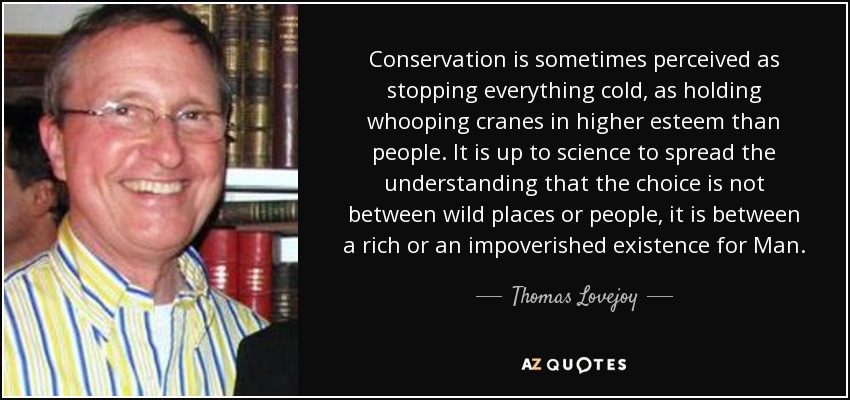
Conservation is sometimes perceived as stopping everything cold, as holding whooping cranes in higher esteem than people. It is up to science to spread the understanding that the choice is not between wild places or people, it is between a rich or an impoverished existence for Man.
Despite its protests to the contrary, modern Christianity has become willy-nilly the religion of the state and the economic status quo. Because it has been so exclusively dedicated to incanting anemic souls into Heaven, it has been made the tool of much earthly villainy. It has, for the most part, stood silently by while a predatory economy has ravaged the world, destroyed its natural beauty and health, divided and plundered its human communities and households.
Now comes the threat of climate crisis - a threat that is real, rising, imminent, and universal. Once again, it is the 11th hour. The penalties for ignoring this challenge are immense and growing, and at some near point would be unsustainable and unrecoverable. For now we still have the power to choose our fate, and the remaining question is only this: Have we the will to act vigorously and in time, or will we remain imprisoned by a dangerous illusion?
One effect of benefit-cost analysis is to give any respectable engineer or economist a means for justifying almost any kind of project the national government wants to justify... Exclusive reliance on benefit-cost analysis has been one of the greatest threats to wise decisions in water development.
If humanity today succeeds in combining the new scientific capacities with a strong ethical dimension, it will certainly be able to promote the environment as a home and a resource for...all...and will be able to eliminate the causes of pollution and to guarantee adequate conditions of hygiene and health for small groups as well as for vast human settlements.
Humans, like all other creatures, must make a difference; otherwise, they cannot live. But unlike other creatures, humans must make a choice as to the kind and scale of difference they make. If they choose to make too small a difference, they diminish their humanity. If they choose to make too great a difference, they diminish nature, and narrow their subsequent choices; ultimately, they diminish or destroy themselves. Nature, then, is not only our source but also our limit and measure.
In the past we could afford a long gestation period before undertaking major environmental policy initiatives. Today the time for a well-planned transition to a sustainable system is running out. We may be moving in the right direction, but we are moving too slowly. We are failing in our responsibility to future generations and even the present one.
I want to think I deserve what I get. I don't want to consider how vastly I am overly rewarded. I don't want to consider the injustices around me. I don't want any encounters with the disenfranchised. I want to say it's not my fault. But it is, it's yours and mine, and ours. We'd better figure out ways to spread some equity around if we want to go on living in a society that is at least semi-functional. It's a fundamental responsibility, to ourselves.
Technology that pollutes can also cleanse, production that amasses can also distribute justly, on condition that the ethic of respect for life and human dignity, for the rights of today's generations and those to come, prevails.
If the life-supporting ecosystems of the planet are to survive for future generations, the consumer society will have to dramatically curtail its use of resources - partly by shifting to high-quality, low-input durable goods and partly by seeking fulfillment through leisure, human relationships, and other nonmaterial avenues. We in the consumer society will have to live a technologically sophisticated version of the life-style currently practiced lower on the economic ladder.
If we do not serve what coheres and endures, we serve what disintegrates and destroys.
The capitalist system only allows us to heap up waste. I would like to propose that the trillions of money earmarked for war should be channeled to make good the damage to the environment, to make reparations to the earth.
Love in truth-caritas in veritate-is a great challenge for the Church in a world that is becoming progressively and pervasively globalized. The risk for our time is that the de facto interdependence of people and nations is not matched by ethical interaction of consciences and minds that would give rise to truly human development. Only in charity, illumined by the light of reason and faith, is it possible to pursue development goals that possess a more humane and humanizing value.
It is therefore absurd to approach the subject of health piecemeal with a departmentalized band of specialists. A medical doctor uninterested in nutrition, in agriculture, in the wholesomeness of mind and spirit is as absurd as a farmer who is uninterested in health. Our fragmentation of this subject cannot be our cure, because it is our disease. The body cannot be whole alone. Persons cannot be whole alone. It is wrong to think that bodily health is compatible with spiritual confusion or cultural disorder, or with polluted air and water or impoverished soil.
Let us protect our children; and let us not allow them to grow up into emptiness and nothingness, to the avoidance of good hard work, to introspection and analysis without deeds, or to mechanical actions without thought and consideration. Let us steer them away from the harmful chase after material things and the damaging passion for distractions... Let us educate them to stand with their feet rooted in God's earth, but with their heads reaching even into heaven, there to behold truth.
Perhaps a good resolution for the new year would be to keep asking what world we want to pass on to the next generation. Indeed to ask whether we have a real and vivid sense of that next generation.
Nuclear man is the man who realizes that his creative powers hold the potential for self-destruction. He sees that in this nuclear age vast new industrial complexes enable man to produce in one hour that which he labored over for years in the past, but he also realizes that these same industries have disturbed the ecological balance and, through air and noise pollution, have contaminated his own milieu.
No institutions in modern society are better equipped to catalyze the necessary transition to a sustainable world than colleges and universities. They have access to the leaders of tomorrow and the leaders of today. What they do matters to the wider public.
I often quote an African proverb that says: "The world is not ours, the earth is not ours, It's a treasure we hold in trust for future generations." And I often hope we will be worthy of that trust.
But we can do nothing for the human future that we will not do for the human present. For the amelioration of the future condition of our kind we must look, not to the wealth or the genius of the coming generations, but to the quality of the disciplines and attitudes that we are preparing now for their use.
It is really important to solve the problem of rational utilization and distribution of wate supplies. I dare say, the shortage of fresh water is the major ecological problem of this moment.
Let me say this before rain becomes a utility that they can plan and distribute for money. By "they" I mean the people who cannot understand that rain is a festival, who do not appreciate its gratuity, who think that what has no price has no value, that what cannot be sold is not real, so that the only way to make something actual is to place it on the market. The time will come when they will sell you even your rain. At the moment it is still free, and I am in it. I celebrate its gratuity and its meaninglessness.
The roots of the grass strain, Tighten, the earth is rigid, waits-he is waiting- And suddenly, and all at once, the rain!
The sea-shore is a sort of neutral ground, a most advantageous point from which to contemplate the world....There is naked Nature, inhumanly sincere, wasting no thought on man, nibbling at the cliffy shore where gulls wheel amid the spray.
The trouble with water-and there is trouble with water-is that they're not making any more of it. They're not making any less, mind, but no more either. There is the same amount of water in the planet now as there was in prehistoric times.
Follow AzQuotes on Facebook, Twitter and Google+. Every day we present the best quotes! Improve yourself, find your inspiration, share with friends
or simply: