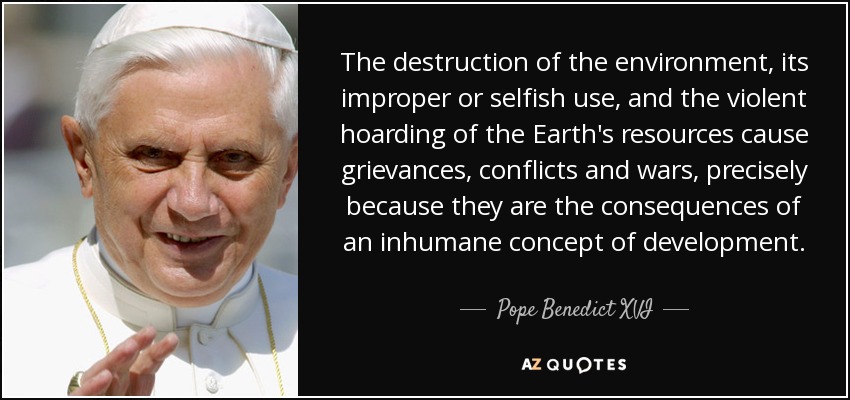
The destruction of the environment, its improper or selfish use, and the violent hoarding of the Earth's resources cause grievances, conflicts and wars, precisely because they are the consequences of an inhumane concept of development.
The dialogue about sustainability is about a change in the human trajectory that will require us to rethink old assumptions and engage the large questions of the human condition that some presume to have been solved once and for all.
The gains made by better management and technology are still being outpaced by the environmental impacts of population and economic growth. We are on an unsustainable course.
The goods of creation belong to humanity as a whole. Yet the current pace of environmental exploitation is seriously endangering the supply of certain natural resources not only for the present generation, but above all for generations to come.
The planetary emergency unfolding around us is, first and foremost...a crisis of thought, values, perceptions, ideas and judgments. In other words, it is a crisis of mind, which makes it a crisis of those institutions which purport to improve minds.
A person who has been seduced by the consumer value system, whose identity is dissolved in an amalgam of the accouterments trappings of mass civilization, and who has no roots in the order of being, no sense of responsibility for anything higher than his own personal survival, is a demoralized person. The system depends on this demoralization, deepens it, is in fact a projection of it into society.
Responsibility is something higher than my family, my country, my firm, my success. Responsibility to the order of Being, where, and only where, they will be properly judged.
There can be no solution to the challenge of climate change that is not global. But if we can come together in partnership, we can transform today's challenge into tomorrow's opportunity - an opportunity for green growth and sustainable prosperity... we also need a strong bottom-up push from academics and opinion-shapers such as you. Universities such as yours are founts of ideas and innovation. They are furnaces of innovation and entrepreneurship. So, send forth this word.
Unrestrained automobility, hedonism, individualism, and conspicuous consumption cannot be sustained because they take more than they give back. A spiritually impoverished world cannot be sustained because meaninglessness, anomie, and despair will corrode the desire to be sustained and the belief that humanity is worth sustaining. But these are the very things that distinguish the modern age from its predecessors, Genuine sustainability, in other words, will come not from superficial changes but from a deeper process akin to humankind growing up to a fuller stature.
We are challenged to develop a world perspective. No individual can live alone, no nation can live alone, and anyone who feels that he can live alone is sleeping through a revolution. The world in which we live is geographically one.
We are now, measurably, reducing the availability of these life-supporting goods which we can think of (though only on the conditions of good health and good care) as self-renewing or "sustainable." We are also destroying rapidly the supplies of the fossil fuels, which are limited and not renewable, and on which we have become totally dependent.
We continually make decisions in private which affect the commonweal, as the ecologists (to take but one example) have shown us. When I keep my house warmer than it needs to be, I consume fuel which might help someone else keep warm, or keep a job. When the food I eat is high on the protein chain I contribute to a maldistribution of protein around the world. When I teach my children to be primarily concerned with private gain, I diminish the ranks of public leadership in the rising generation.
We can just as easily have an economy that is based on healing the future instead of stealing it. We can either create assets for the future or take the assets of the future. One is called restoration and the other exploitation. And whenever we exploit the earth we exploit people and cause untold suffering. Working for the earth is not a way to get rich, it is a way to be rich.
We know what we have to do. And we know how to do it. If we fail to convert our self-destructing economy into one that is environmentally sustainable, future generations will be overwhelmed by environmental degradation and social disintegration. Simply stated, if our generation does not turn things around, our children may not have the option of doing so.
We must act now and wake up to our moral obligations. The poor and vulnerable are members of God's family and are the most severely affected by droughts, high temperatures, the flooding of coastal cities, and more severe and unpredictable weather events resulting from climate change. We, who should have been responsible stewards preserving our vulnerable, fragile planet home, have been wantonly wasteful through our reckless consumerism, devouring irreplaceable natural resources.
We need to be accountable to God's family. Once we start living in a way that is people-friendly to all of God's family, we will also be environment-friendly.
We will instead have to measure our economy by the health of the ecosystems and human communities where we do our work.
What does our generation owe to generations yet unborn? ...there is an order in the universe which must be respected, and... the human person, endowed with the capability of choosing freely, has a grave responsibility to preserve this order for the well-being of future generations.
What is urgently needed is a bold new move from a consumer economy to a conserver economy in all of the developed countries, and particularly in the United States.
It is better to buy from a small, privately owned local store than from a chain store. It is better to buy a good product than a bad one. Do not buy anything you don't need. Do as much as you can for yourself. If you cannot do something for yourself, see if you have a neighbor who can do it for you. Do everything you can to see that your money stays as long as possible in the local community.
When we talk about global crisis, or a crisis of humanity, we cannot blame a few politicians, a few fanatics, or a few troublemakers. The whole of humanity has a responsibility because it is our business, human business. I call this a sense of universal responsibility. That is a crucial point.
Yes, the South-becoming always poorer-and the North-becoming always richer ...Richer, too in the resources of weapons with which the superpowers and blocs can mutually threaten each other. In the light of Christ's words (Mt. 25), this poor South will judge the rich North. And the poor people and poor nations-poor in different ways, not only lacking food, but also deprived of freedom and other human right-will judge those people who take these goods away from them, amassing to themselves the imperialist monopoly and political supremacy at the expense of others.
The character of a whole society is the cumulative result of the countless small actions, day in and day out, of millions of persons. Who we are as a society, is the synergistic accumulation of who we are as individuals... Small changes that seem insignificant in isolation can be great contributions when they are simultaneously undertaken by many others.
... these are the two factors that lead to the destruction of our environment: money and time-or to say it another way, greed and haste. The question is, or seems to be, are we going to have an immediate profit and an immediate saving of time, or are we going to do what we really should do as God's children?
To a large degree, we are still bound to the modern scientific spirit, that characterizes reality merely by its material and mechanic aspects, without including life, consciousness and the intimate communion with that which poets, musicians and artists bring us in their magnificent works.
Follow AzQuotes on Facebook, Twitter and Google+. Every day we present the best quotes! Improve yourself, find your inspiration, share with friends
or simply: