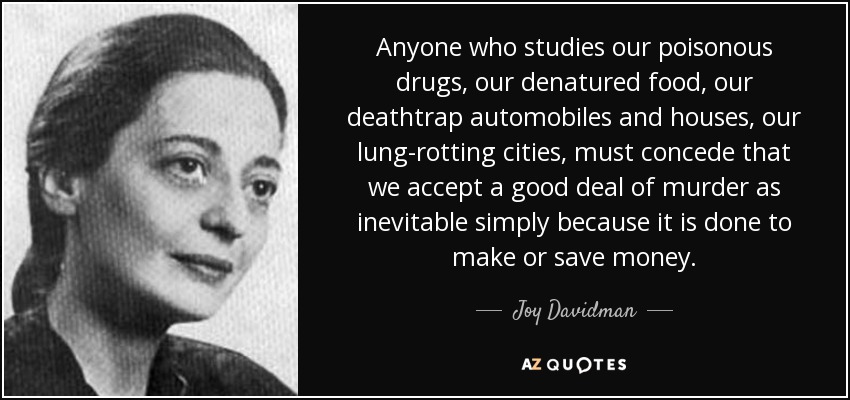
Anyone who studies our poisonous drugs, our denatured food, our deathtrap automobiles and houses, our lung-rotting cities, must concede that we accept a good deal of murder as inevitable simply because it is done to make or save money.
The insecticides kill the black flies, but also destroy much of the food chain for the bird, fish, and animal life which also inhabit those regions. The fish of the Great Lakes are laced with mercury from industrial plants, and fluoride from aluminum plants poisons the land and the people. Sewage from the population centers is mixed with PCBs and PBS in the watershed of the great lakes and the Finger Lakes, and the water is virtually nowhere safe for any living creatures.
Indeed, the quantity of PCBs still in use plus the quantity still languishing in waste dumps exceeds the total amount that has already escaped into the general environment. Without a program to recall and contain them, semivolatile PCBs will continue to insinuate themselves into the food chain for decades.
By 1990, the EPA had tallied up 32,645 sites of past chemical waste dumping in need of cleanup. Some of these are actual waste landfills, but many are former manufacturing sites where drums full of chemicals have been simply abandoned. The names of the most notorious appear on the EPS's National Priorities List. These are the so-called Superfund sites, names for the super fund of money put together by Congress in 1980 to clean them up. In 2009, the Superfund list contained 1,331 sites.
Ecological devastation is the excrement, so to speak, of man's power worship.
How would you describe the difference between modern war and modern industry-between say, bombing and strip mining, or between chemical warfare and chemical manufacturing? The difference seems to be only that in war the victimization of humans is directly intentional and in industry it is "accepted" as a "trade-off." Were the catastrophes of Love Canal, Bhopal, Chernobyl, and the Exxon Valdez episodes of war or of peace? They were in fact, peacetime acts of aggression, intentional to the extent that the risks were known and ignored.
I find man utterly unaware of what his wealth is or his fundamental capability is. He says time and again, "We can't afford it." For instance, we are saying now that we can't afford to do anything about pollution but after the costs of not doing something about pollution have multiplied many fold beyond what it would cost to correct it now, we will spend many fold what it would cost us now to correct it.
Man, especially in our time, has without hesitation devastated wooded plains and valleys, polluted waters, disfigured the earth's habitat, made the air unbreathable, disturbed the hydro-geological and atmospheric systems, turned luxuriant areas into deserts and undertaken forms of unrestrained industrialization, degrading that 'flower bed'-which is the earth, our dwelling place.
Between the late 1950s and the late 1980s, more than 750 million tons of chemical wastes were discarded.
The study of how substances alter gene expression is part of the field of epigenetics. Some chemical exposures appear to turn on and turn off genes in ways that disregulate cell growth and predispose for cancer. From this perspective, our genes are less the command-and-control masters of our cells and more like the keys of piano, with the environment as the hands of the pianist.
The military is the largest polluter in the country, and so you have a lot of military waste contaminating reservations - as, for example, on the Skull Valley Goshute Reservation, where 5,000 sheep died in some kind of experimental military nerve gas test 10 years ago. Many of our communities are dealing with that kind of waste, and an absence of political will to clean them up.
Uranium mining in northern Canada has left over 120 million tons of radioactive waste. This amount represents enough material to cover the Trans-Canada Highway two meters deep across the country. Present production of uranium waste from Saskatchewan alone occurs at the rate of over 1 million tons annually. Since 1975, hospitalization for cancer, birth defects and circulatory illnesses in that area have increased dramatically - between 123 and 600 percent in that region.
We can break the mountains apart; we can drain the rivers and flood the valleys. We can turn the most luxuriant forests into throw-away paper products. We can tear apart the great grass cover of the western plains and pour toxic chemicals into the soil and pesticides onto the fields until the soil is dead and blows away in the wind. We can pollute the air with acids, the rivers with sewage, the seas with oil - all this in a kind of intoxication with our power for devastation at an order of magnitude beyond all reckoning.
We can decide that the presence of cancer-causing substances in our air, water, and food is too expensive. A 2009 study, for example, has found that coal miners in Appalachia costs the region five times more in premature deaths, including from cancer, than it provides to the region in jobs, taxes, and economic benefits. In California, the production and use of hazardous chemicals cost the state $2.6 billion in 2004 alone in lost wages and health-care expenses to treat workers and children with pollution-linked diseases.
We know that to wage a nuclear war today, for example, would be a form of suicide; or that to pollute the air or the oceans in order to achieve some short-term benefit would be to destroy the very basis for our survival.
What can be done? Well, the governments of the world can undertake what amounts to a vast clean-up campaign and a vast campaign of organic renewal. The problem is the cost of an effective operation, which is enormous, and thus must be paid by someone via some form of taxes.
What, then, is the effect of pesticides? Pesticides have created a legacy of pain, and misery, and death for farm workers and consumers alike. The crop which poses the greatest danger, and the focus of our struggle, is the table grape crop. These pesticides soak the fields. Drift with the wind, pollute the water, and are eaten by unwitting consumers. These poisons are designed to kill, and pose a very real threat to consumers and farm workers alike.
When it comes to acid rain or oil spills or depleted fisheries or tainted groundwater or fluorocarbon propellants or radiation leaks or sexually transmitted diseases, national frontiers are simple irrelevant. Toxins don't stop for customs inspections and microbes don't carry passports. North America became a water and free-trade zone long before NAFTA loosened up the market in goods.
While the rich reap most of the benefits of technological development, the poor bear an unequal burden of dealing with the consequences of the resulting increased pollution. The poor continue to live in greatest proximity to the sources of pollution, the infrastructure and machinery of industry. They work in the most polluted and physically dangerous workplaces. And these same individuals, living and working closest to the sources of environmental catastrophe, are also the ones most lacking decent health care.
Asbestos, EMFs, and CFCs have given us a degree of humility. When yesterday's "triumph of modern chemistry" turns out instead to be today's deadly threat to the global environment, it is legitimate to ask what else we don't know.
Before Alar, there was EDB, a potent human carcinogen allowed in the grain supply and other food for more than a decade after it was known to be dangerous. There was heptachlor, linked to leukemia, and aldicarb, which poisoned thousands of California watermelons, yet is still allowed in potatoes and bananas at levels exposing up to 80,000 children a day to what EPA itself says are unacceptable high risks. Trust the government? Why should we?
Corporate polluters, their phony think tanks and political toadies like to marginalize environmentalists as tree huggers, or radicals. But there is nothing radical about clean air or water.
Draconian limits on economic growth and on the use of the automobile should not be necessary in order to give Americans clean air at levels they are willing to pay for, but it will require significant Federal, State, and local leadership and innovative approaches from government and industry.
Finally, since human beings are uniquely capable of producing materials not found in nature, environmental degradation may be due to the resultant intrusion into an ecosystem of a substance wholly foreign to it.
The wrecking ball is characteristic of our way with materials. We 'cannot afford' to log a forest selectively, to mine without destroying topography, or to farm without catastrophic soil erosion. A production-oriented economy can indeed live in this way, but only so long as production lasts.
Follow AzQuotes on Facebook, Twitter and Google+. Every day we present the best quotes! Improve yourself, find your inspiration, share with friends
or simply: