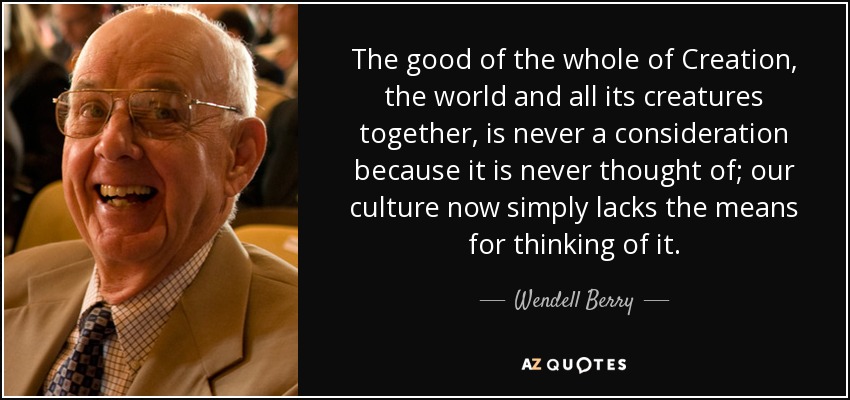
The good of the whole of Creation, the world and all its creatures together, is never a consideration because it is never thought of; our culture now simply lacks the means for thinking of it.
But we can do nothing for the human future that we will not do for the human present. For the amelioration of the future condition of our kind we must look, not to the wealth or the genius of the coming generations, but to the quality of the disciplines and attitudes that we are preparing now for their use.
Can we disregard the growing phenomenon of "environmental refugees", people who are forced by the degradation of their natural habitat to forsake it - and often their possessions as well - in order to face the dangers and uncertainties of forced displacement? Can we remain impassive in the face of actual and potential conflicts involving access to natural resources? All these are issues with a profound impact on the exercise of human rights, such as the right to life, food, health and development.
Certain elements of today's ecological crisis reveal its moral character. First among these is the indiscriminate application of advances in science and technology. Many recent discoveries have brought undeniable benefits to humanity. Indeed, they demonstrate the nobility of the human vocation to participate responsibly in God's creative action in the world. Unfortunately, it is now clear that the application of these discoveries in the fields of industry and agriculture have produced harmful long-term effects.
The gradual depletion of the ozone layer and the related "greenhouse effect" has now reached crisis proportions as a consequence of industrial growth, massive urban concentrations and vastly increased energy needs. Industrial waste, the burning of fossil fuels, unrestricted deforestation, the use of certain types of herbicides, coolants and propellants: all of these are known to harm the atmosphere and environment.
Conservation is sometimes perceived as stopping everything cold, as holding whooping cranes in higher esteem than people. It is up to science to spread the understanding that the choice is not between wild places or people, it is between a rich or an impoverished existence for Man.
Despite its protests to the contrary, modern Christianity has become willy-nilly the religion of the state and the economic status quo. Because it has been so exclusively dedicated to incanting anemic souls into Heaven, it has been made the tool of much earthly villainy. It has, for the most part, stood silently by while a predatory economy has ravaged the world, destroyed its natural beauty and health, divided and plundered its human communities and households.
For three decades and longer we have been developing the ideas, science, and technological wherewithal to build a sustainable society. The public knows of these things only in fragments, but not as a coherent and practical agenda indeed the only practical course available. That is our fault and we should start now to put a positive agenda before the public that includes the human and economic advantages of better technology, integrated planning, coherent purposes, and foresight.
Graciousness, courtesy, compassion-this is hesed. Hesed is a quality that extends even to the animals and the land. The sabbath rest principle of Hebrew law included the needs of the livestock (Exod. 23:12). After seven years of planting and harvesting, the land itself needed "a year of complete rest" (Lev. 25:5). Even the soil of the vineyards was not to be overtaxed by planting other crops between the rows (Deut. 22:9). The oxen that trod out the grain were not to be muzzled so that they could eat while they worked (Deut. 25:4). And so on.
Humans, like all other creatures, must make a difference; otherwise, they cannot live. But unlike other creatures, humans must make a choice as to the kind and scale of difference they make. If they choose to make too small a difference, they diminish their humanity. If they choose to make too great a difference, they diminish nature, and narrow their subsequent choices; ultimately, they diminish or destroy themselves. Nature, then, is not only our source but also our limit and measure.
I am not fighting machinery as such, but the madness of thinking that machinery saves labor. Men save labor until thousands of them are without work and die of hunger on the streets. I want to secure employment and livelihood not only to part of the human race, but for all. I will not have the enrichment of a few at the expense of the community. At present the machine is helping a small minority to live on the exploitation of the masses. The motive force of this minority is not humanity or love of their kind, but greed and avarice.
I want to think I deserve what I get. I don't want to consider how vastly I am overly rewarded. I don't want to consider the injustices around me. I don't want any encounters with the disenfranchised. I want to say it's not my fault. But it is, it's yours and mine, and ours. We'd better figure out ways to spread some equity around if we want to go on living in a society that is at least semi-functional. It's a fundamental responsibility, to ourselves.
If humanity today succeeds in combining the new scientific capacities with a strong ethical dimension, it will certainly be able to promote the environment as a home and a resource for...all...and will be able to eliminate the causes of pollution and to guarantee adequate conditions of hygiene and health for small groups as well as for vast human settlements.
If the life-supporting ecosystems of the planet are to survive for future generations, the consumer society will have to dramatically curtail its use of resources - partly by shifting to high-quality, low-input durable goods and partly by seeking fulfillment through leisure, human relationships, and other nonmaterial avenues. We in the consumer society will have to live a technologically sophisticated version of the life-style currently practiced lower on the economic ladder.
If we do not serve what coheres and endures, we serve what disintegrates and destroys.
Real security, in other words, is inseparable from issues of energy policy; education; public health; preservation of soils, forests, and waters; and broadly based, sustainable prosperity.
It is much easier to make intellectual messes than it is to clarify complicated issues, especially when real solutions would challenge the status quo and require much careful thought across many fields of knowledge. Problems of climatic change, biotic impoverishment, population growth, and the choices to be made by various technologies and the transition to a sustainable and decent society with an economy that works over the long-term are difficult, complex, and intertwined problems with many possible answers.
It is our duty to preserve huge tracts of land in something resembling its native condition. The biological interactions necessary to insure the continuities of life are astonishingly complex, and cannot take place in islands of semiwilderness like the national parks.
It is so important not to let ourselves off the hook or to become apathetic or cynical by telling ourselves that nothing works or makes a difference. Every day, light your small candle.... The inaction and actions of many human beings over a long time contributed to the crises our children face, and it is the action and struggle of many human beings over time that will solve them-with God's help. So every day, light your small candle.
It would be rash to conclude that, on balance, the environment of the globe as a whole is either deteriorating or improving, or that the survival of the societies we know depends upon filling a simple set of prescriptions. It is all too complex and dynamic, whether it involves managing greenhouse gases or Nile snails... The future condition of the globe's interlocking natural and social systems depends more on human behavior than on the further investigation of natural processes, however desirable that may be.
Let us protect our children; and let us not allow them to grow up into emptiness and nothingness, to the avoidance of good hard work, to introspection and analysis without deeds, or to mechanical actions without thought and consideration. Let us steer them away from the harmful chase after material things and the damaging passion for distractions... Let us educate them to stand with their feet rooted in God's earth, but with their heads reaching even into heaven, there to behold truth.
The sharing of goods and resources, from which authentic development proceeds, is not guaranteed by merely technical progress and relationships of utility, but by the potential of love that overcomes evil with good.
No individual life is an end in itself. One can live fully only by participating fully in the succession of the generations, in death as well as in life. Some would say (and I am one of them) that we can live fully only by making ourselves answerable to the claims of eternity as to those of time.
But the improvements will happen faster and last longer if we can channel market forces, including innovation that's tailored to the needs of the poorest, to complement what governments and nonprofits do. We need a system that draws in innovators and businesses in a far better way than we do today.
Perhaps a good resolution for the new year would be to keep asking what world we want to pass on to the next generation. Indeed to ask whether we have a real and vivid sense of that next generation.
Follow AzQuotes on Facebook, Twitter and Google+. Every day we present the best quotes! Improve yourself, find your inspiration, share with friends
or simply: