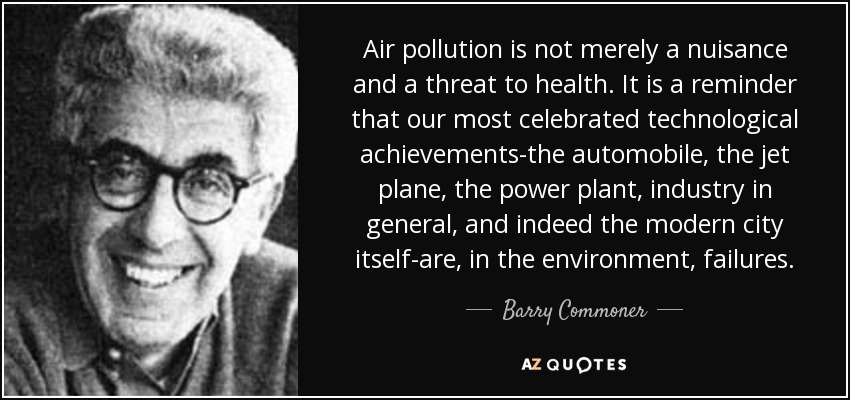
Air pollution is not merely a nuisance and a threat to health. It is a reminder that our most celebrated technological achievements-the automobile, the jet plane, the power plant, industry in general, and indeed the modern city itself-are, in the environment, failures.
Poor communities, frequently communities of color but not exclusively, suffer disproportionately. If you look at where our industrialized facilities tend to be located, they're not in the upper middle class neighborhoods.
An unfolding technology has increased our economic strength and added to the convenience of our lives. But that same technology-we know now-carries danger with it. From the great smoke stacks of industry and from the exhausts of motors and machines, 130 million tons of soot, carbon and grime settle over the people and shroud the Nation's cities each year. From towns, factories, and stockyards, wastes pollute our rivers and streams, endangering the waters we drink and use.
Anyone who studies our poisonous drugs, our denatured food, our deathtrap automobiles and houses, our lung-rotting cities, must concede that we accept a good deal of murder as inevitable simply because it is done to make or save money.
As currently written, the laws require certain manufacturers and users of such chemicals to report any and all environmental releases-either accidental or routine-to air, water, or soil. The Toxics Release Inventory is the main registry of such events, and it is available to the public through the Environmental Protection Agency. It is hardly comprehensive. Toxic emissions reported to the federal government are thought to account for only 5 percent of all chemical releases.
It is essential that we take steps to prevent chemical substances from becoming environmental hazards. Unless we develop better methods to assure adequate testing of chemicals, we will be inviting the environmental crisis of the future.
Brothers and Sisters: Our ancient homeland is spotted today with an array of chemical dumps. Along the Niagara River, dioxin, a particularly deadly substance, threatens the remaining life there and in the waters which flow from there. Forestry departments spray the surviving forests with powerful insecticides to encourage tourism by people seeking a few days or weeks away from the cities where the air hangs heavy with sulphur and carbon oxides.
Indeed, the quantity of PCBs still in use plus the quantity still languishing in waste dumps exceeds the total amount that has already escaped into the general environment. Without a program to recall and contain them, semivolatile PCBs will continue to insinuate themselves into the food chain for decades.
By 1990, the EPA had tallied up 32,645 sites of past chemical waste dumping in need of cleanup. Some of these are actual waste landfills, but many are former manufacturing sites where drums full of chemicals have been simply abandoned. The names of the most notorious appear on the EPS's National Priorities List. These are the so-called Superfund sites, names for the super fund of money put together by Congress in 1980 to clean them up. In 2009, the Superfund list contained 1,331 sites.
Ecological devastation is the excrement, so to speak, of man's power worship.
God then makes people whom he puts right in the middle of all this loaded creation. Commanding them to care for creation, to manage it, to lovingly use it, to creatively order it... They are environmentalists. Being deeply connected with their environment is who they are. For them to be anything else or to deny their divine responsibility to care for all that God has made would be to deny something that is at the core of their existence. This is why litter and pollution are spiritual issues.
Here in the United States, a study of nearly 700 women in California showed an increased risk of fetal death among babies whose mothers lived near crops when certain pesticides were sprayed. The largest risks were found among pregnant women exposed during the critical first trimester and among those who lived in the same square mile where pesticides were used.
Industrialized countries have disproportionately more cancers than countries with little or no industry (after adjusting for age and population size). One half of all the world's cancers occur in people living in industrialized countries, even though we are only one-fifth of the world's population. Closely tracking industrialization are breast cancer rates, which are highest in North America and northern Europe, intermediate in southern Europe and Latin America, and lowest in Asia and Africa.
Man was the outlaw, the rebel, the distorted shape that scarred the earth, the voice that silenced the music of Eden, the hand that raised up obscenities and blasphemies. Man was the pariah-dog, the moral leper in this translucent mirror of Heaven. He was the muddier of crystal waters, the despoiler of forests, the murderer of the innocent, the challenger against God. He was the assassin of the saints and the prophets, for they spoke of what he WOULD NOT HEAR, in the darkness of his spirit!
Man, especially in our time, has without hesitation devastated wooded plains and valleys, polluted waters, disfigured the earth's habitat, made the air unbreathable, disturbed the hydro-geological and atmospheric systems, turned luxuriant areas into deserts and undertaken forms of unrestrained industrialization, degrading that 'flower bed'-which is the earth, our dwelling place.
The study of how substances alter gene expression is part of the field of epigenetics. Some chemical exposures appear to turn on and turn off genes in ways that disregulate cell growth and predispose for cancer. From this perspective, our genes are less the command-and-control masters of our cells and more like the keys of piano, with the environment as the hands of the pianist.
The military is the largest polluter in the country, and so you have a lot of military waste contaminating reservations - as, for example, on the Skull Valley Goshute Reservation, where 5,000 sheep died in some kind of experimental military nerve gas test 10 years ago. Many of our communities are dealing with that kind of waste, and an absence of political will to clean them up.
Uranium mining in northern Canada has left over 120 million tons of radioactive waste. This amount represents enough material to cover the Trans-Canada Highway two meters deep across the country. Present production of uranium waste from Saskatchewan alone occurs at the rate of over 1 million tons annually. Since 1975, hospitalization for cancer, birth defects and circulatory illnesses in that area have increased dramatically - between 123 and 600 percent in that region.
Very few people would choose to have even the most fabled assortment of goods if it meant getting cancer within the year. But the choice involves not the certainty of cancer very soon but an increased probability of cancer at some time in the future. The cancers are no less real; millions will die painfully and prematurely because of what we do to our environment. But the choice is not an easily visualizable one, and our capacity of denial comes strongly into play - as it tends to whenever we must weigh future costs against immediate benefits.
We know that to wage a nuclear war today, for example, would be a form of suicide; or that to pollute the air or the oceans in order to achieve some short-term benefit would be to destroy the very basis for our survival.
We must recognize that the goal of a cleaner environment will not be achieved by rhetoric or moral dedication alone. It will not be cheap or easy and the costs will have to be borne by each citizen, consumer and taxpayer. How clean is clean enough can only be answered in terms of how much we are willing to pay and how soon we seek success... It is simplistic to seek ecological perfection at the cost of bankrupting the very tax-paying enterprises which must pay for the social advances we seek.
What can be done? Well, the governments of the world can undertake what amounts to a vast clean-up campaign and a vast campaign of organic renewal. The problem is the cost of an effective operation, which is enormous, and thus must be paid by someone via some form of taxes.
What, then, is the effect of pesticides? Pesticides have created a legacy of pain, and misery, and death for farm workers and consumers alike. The crop which poses the greatest danger, and the focus of our struggle, is the table grape crop. These pesticides soak the fields. Drift with the wind, pollute the water, and are eaten by unwitting consumers. These poisons are designed to kill, and pose a very real threat to consumers and farm workers alike.
While the rich reap most of the benefits of technological development, the poor bear an unequal burden of dealing with the consequences of the resulting increased pollution. The poor continue to live in greatest proximity to the sources of pollution, the infrastructure and machinery of industry. They work in the most polluted and physically dangerous workplaces. And these same individuals, living and working closest to the sources of environmental catastrophe, are also the ones most lacking decent health care.
Who would have predicted a century ago that the richest civilizations in history would be made up of polluted tracts of suburban development dominated by the private automobile, shopping malls, and a throwaway economy? Surely, this is not the ultimate fulfillment of our destiny.
Follow AzQuotes on Facebook, Twitter and Google+. Every day we present the best quotes! Improve yourself, find your inspiration, share with friends
or simply: