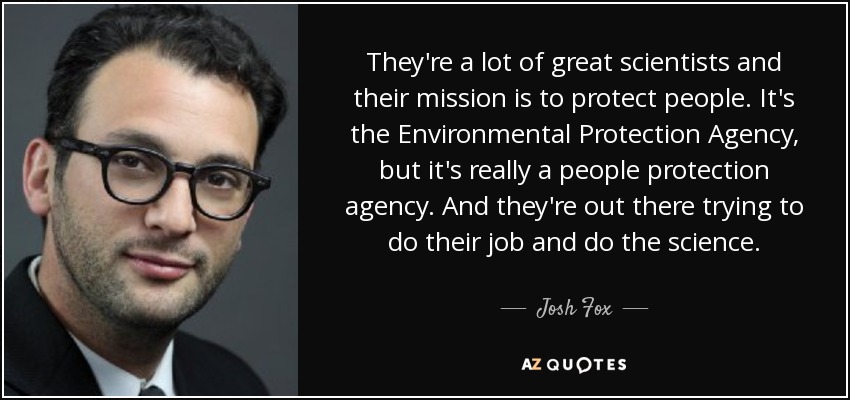
They're a lot of great scientists and their mission is to protect people. It's the Environmental Protection Agency, but it's really a people protection agency. And they're out there trying to do their job and do the science.
Because past environmental destruction was the result of ignorance, we can easily forgive it. Today, we are better informed. Therefore, it's essential that we make an ethical examination of what we have inherited, what we are responsible for, and what we will pass on to coming generations. Ours is clearly a pivotal generation. We have global communication and yet confrontation is more common than dialogue.
Humankind has no option but to protect and live in harmony with its natural environment. However, it would be regrettable if in putting an end to revolutionary extremism, we should then come to environmental extremism. We should not forget that all extremes are the same.
The aspects of global warming that matter most to people - how rapidly will the seas rise? Are hurricanes already getting stronger? How strong will they get as a result of warming? Those are still immersed in complexity. So in those realms that catch people's attention most, or that get used as symbols by environmental campaigners, those facets really do come with significant back-and-forthing.
I can tell you many reasons why environmental stories don't get adequate attention in conventional media. Basically, environmental risks don't fit the norms of journalism. They're incremental. We hate incremental.
Another thing I like about German cities - and it's an advantage which they haven't sufficiently exploited yet - is that they are pioneers when it comes to environmental technologies. And green solutions are becoming more and more important.
We want to encourage investors to target businesses that focus on achieving more than just profits - by placing their money into businesses that also positively contribute to social or environmental benefits in Ontario. Angel investors can help social enterprises grow and succeed, and through our partnership with the Network of Angel Organizations and the Impact Angel Alliance, we are making it easier for social ventures and angel investors to connect, contribute, and make our society a better place to live.
You can cruise the world's millions of omega-3 Web sites without encountering any reflections about where these prized fatty acids are coming from and at what social or environmental cost. For some people, what goes into their bodies has become an overriding obsession. Perhaps we are witnessing a successor to the Me Generation--namely, the Don't Care About the Rest of the World as Long as I Have a Spa and Some Omega-3 Fatty Acids Generation. Let's call it the Omega-3 Generation for short. Or is that thought just too depressing?
In a nuclear age, and in an age of serious environmental degradation, apocalyptic belief creates a serious second order danger. The precarious logic of self-interest that saw us through the Cold War would collapse if the leaders of one nuclear state came to welcome, or ceased to fear mass death.
Many of us regard ourselves as mildly liberal or centrist politically, voice fairly pleasant sentiments about our poor children, contribute money to send poor kids to summer camp, feel benevolent. We're not nazis; we're nice people. We read sophisticated books. We go to church. We go to synagogue. Meanwhile, we put other people's children into an economic and environmental death zone. We make it hard for them to get out. We strip the place bare of amenities. And we sit back and say to ourselves, "Well, I hope that they don't kill each other off. But if they do, it's not my fault.
An economy that adds value through information, ideas, and intelligence-the Three I Economy-offers a way out of the apparent clash between material growth and environmental resources.
The environmental crisis is a signal of this approaching catastrophe.
Environmentalism needs to be absolutely based in objective and verifiable science, it needs to be rational, and it needs to be flexible. And it needs to be apolitical. To mix environmental concerns with the frantic fantasies that people have about one political party or another is to miss the cold truth - that there is very little difference between the parties, except a difference in pandering rhetoric.
The second reason to abandon environmental religion is more pressing. Religions think they know it all, but the unhappy truth of the environment is that we are dealing with incredibly complex, evolving systems, and we usually are not certain how best to proceed. Those who are certain are demonstrating their personality type, or their belief system, not the state of their knowledge.
Success is not a function of individual talent. It's the steady accumulation of advantages. It's bound up in so many other broader circumstantial, environmental, historical, and cultural factors.
The environmental crisis has deep spiritual, philosophical, and religious roots and causes. It is not merely the result of bad engineering.
I felt strong around and always been around people who have very strong environmental convictions.
I'm sure that many people who are involved in an environmental effort ... they will be pretty much encouraged by this recognition.
There's a worldwide linking of environmental activists, developmental experts and human rights advocates. And they're using the two frameworks, in particular environmental standards and human rights.
What's now urgently needed [to stop environmental disaster] is the international political commitment to take action to avoid dangerous climate change.
The choices and decisions we make in terms of how we use the land ultimately affect our very DNA. Environmental issues are life issues.
Face the facts, all these environmental organizations are thirty, forty, fifty years old. They have big buildings, big obligations, big staffs. They may trade on their youthful dreams, but the truth is, they're now part of the establishment. And the establishment works to preserve the status quo. It just does.
If I had to catalog all the moronic plot turns in The Day After Tomorrow, we'd be here until the next ice age. It's just so very bad. You can have a pretty good time snickering at it-unless, like me, you think there's something to this global warming thing, and you shudder at the irony of a movie meant to warn people about a dangerous environmental trend that completely discredits it. Is it possible that the film is a plot to make environmental activists look as wacko as anti-environmentalists always claim they are?
No segment of the population has lost more by the agendas of the liberal constituencies of the Democratic Party than the black population. The teachers' unions, environmental fanatics and the ACLU are just some of the groups to whose interests blacks have been sacrificed wholesale. Lousy education and high crime rates in the ghettos, and unaffordable housing elsewhere with building restrictions, are devastating prices to pay for liberalism.
Were I to stop oil production, we`d have to import it from Iraq and from Caracas, Venezuela or from North Dakota where the environmental standards are much lower, on trains that have already proven themselves unsafe, or by more ships that are causing significant pollution in the world. It`s just really dumb.
Follow AzQuotes on Facebook, Twitter and Google+. Every day we present the best quotes! Improve yourself, find your inspiration, share with friends
or simply: