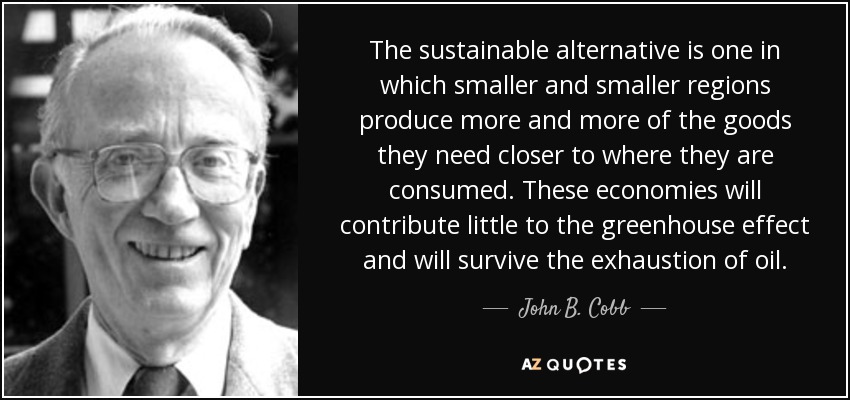
The sustainable alternative is one in which smaller and smaller regions produce more and more of the goods they need closer to where they are consumed. These economies will contribute little to the greenhouse effect and will survive the exhaustion of oil.
Every one of you sitting here today is carrying at least 500 measurable chemicals in your body that were never in anybody's body before the 1920s... We have dusted the globe with man-made chemicals that can undermine the development of the brain and behavior, and the endocrine, immune and reproductive systems, vital systems that assure perpetuity... Everyone is exposed.
You are not exposed to one chemical at a time, but a complex mixture of chemicals that changes day by day, hour by hour, depending on where you are and the environment you are in... In the United States alone it is estimated that over 72,000 different chemicals are used regularly. Two thousand five hundred new chemicals are introduced annually-and of these, only 15 are partially tested for their safety. Not one of the chemicals in use today has been adequately tested for these intergenerational effects that are initiated in the womb.
I am beginning to understand that the stream the scientists are studying is not just a little creek. It's a river of energy that moves across regions in great geographic cycles. Here, life and death are only different points on a continuum. The stream flows in a circle through time and space, turning death into life across coastal ecosystems, as it has for more than a million years. But such streams no longer flow in the places where most of us live.
When we talk about genes for anything, like a gene for being gay or a gene for being aggressive or something of that sort, that a gene for anything may not have been a gene for that thing under different environmental conditions.
Letting the perfect be the enemy of the good is one of the reasons we have a coal-dependent infrastructure, with the resulting environmental impact that all of us can see. I suspect environmentalists, through their opposition of nuclear power, have caused more coal plants to be built than anybody. And those coal plants have emitted more radioactive material from the coal than any nuclear accident would have.
Few if any political philosophers have had the courage of tackling the Cold War. Even the best of them have kept silent or have stated some bromides glossing over the serious shortcomings of "our" side, such as racism, social injustice, extreme income disparities, the exploitation of the Third World, and environmental degradation.
I don't want people to write programmatic environmental poems, but I think sustainability should become deeply a part of the consciousness of poetry - an impulse toward compassion, empathy, and social justice.
As poets, we don't accept oppression; we are about a freedom of spirit, or whatever you want to call it. I think environmental concerns have to go to the deep place, so we speak from a place of great empathy for the planet - for the disadvantaged people, animals, places, cultures.
If people see how we're all interconnected and connected with Nature, we wouldn't have an environmental crisis, we wouldn't have two dozen wars all over the world.
The favorite statistic is that the U.S. contains 6 to 7% of the world population but consumes more than half the world's resources and is responsible for that fraction of the total environmental pollution. But this statistic hides another vital fact: that not everyone in the U.S. is so affluent.
As far as I'm concerned, it is clear that the concept of premium will be increasingly defined through sustainability in the future. BMW, like no other brand, will still stand for vitality and driving pleasure in the future. But it will also represent efficiency and environmental friendliness.
I don't think there's any evidence to support that kind of criticism. I think that what we have attempted to do is to say that environmental concerns should certainly be addressed. We're not suggesting that any kind of development trample upon the existing laws that are there to insure that we maintain as high a quality of environment as possible.
I believe that capitalism, at least how it's used by major corporations, and environmental concerns are in opposition. To be ecologically aware, productivity of many things would slow down at least for awhile. Stockholders don't want to hear about the saving of the whales or some stream in Kentucky. They want a return on their investment.
Nuclear power will be the Vietnam issue of the 1980s.
Farmers...can no longer keep up with rising demand; thus the outlook is for chronic scarcities and rising prices.
There have been so many articles written in the papers that want to just eliminate the environmental values business and just build aluminum factories now. But there have been an equal amount of articles of people saying listen, you just went on a money binge, are you gonna go on another binge now?
Population growth is exceeding farmers' ability to keep up...Our oldest enemy, hunger, is again at the door.
I have no doubt that we will be successful in harnessing the sun's energy... If sunbeams were weapons of war, we would have had solar energy centuries ago.
There is no way to re-enchant our lives in a disenchanted culture except by becoming renegades from that culture and planting the seeds for a new one.
We accept it as normal that people who have never been on the land, who have no history or connection to the country, may legally secure the right to come in and, by the very nature of their enterprises, leave in their wake a cultural and physical landscape utterly transformed and desecrated. What's more, in granting such mining concessions, often initially for trivial sums to speculators from distant cities, companies cobbled together with less history than my dog, the government places no cultural or market value on the land itself.
I had never been able to get a car that said how much I cared about the environment until I drove electric.
For me, going vegan was an ethical and environmental decision. I'm doing the right thing by the animals.
If you really want to define civilization it should be a culture that doesn't destroy its environment. If you burn down the kitchen one day and expect to eat the next, it is not even intelligent, let alone civilized.
Like most problems with technology, pollution is a problem of scale. The biosphere might have been able to tolerate our dirty old friends coal and oil if we burned them gradually, but how long can it withstand a blaze of consumption so frenzied that the dark size of this planet glows like a fanned ember in the night of space.
Follow AzQuotes on Facebook, Twitter and Google+. Every day we present the best quotes! Improve yourself, find your inspiration, share with friends
or simply: