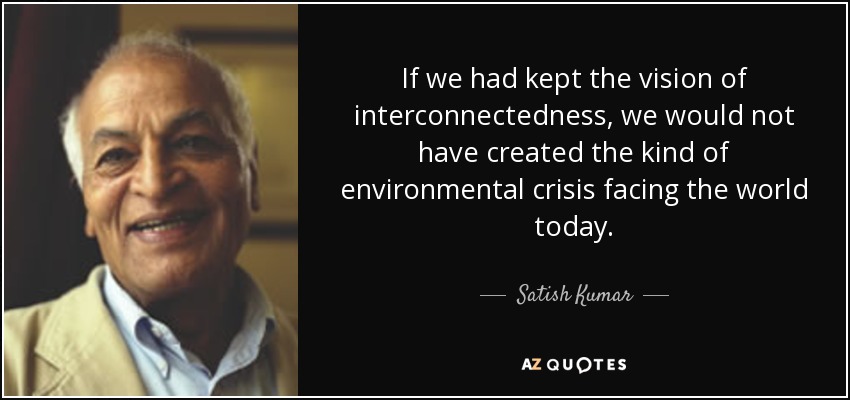
If we had kept the vision of interconnectedness, we would not have created the kind of environmental crisis facing the world today.
I didn't want to hear the usual answers about what's wrong because I believe these are symptoms: global warming, genocide, hunger, poverty, war, environmental crisis. If we can identify the root cause, we can change our ways.
In fact, the environmental crisis is related to the crisis of aesthetics, crisis of social cohesion and the crisis of spiritual values.
We know taxes slow down economic growth, so if you add a carbon tax you have to also minus other taxes. You can't take more money out of people's pockets. I don't think you can build a consensus in this country about environmental policy if you're going to make people poor.
For me, the term "psychotherapy" is limiting. It implies that we work with mind and emotions, but excludes the body and pays scant attention to the spirit, soul, and broader environmental issues.
At the population level, making the world more just and less unequal, while trying to figure out the toxic aspects of the urban environmental will probably help prevent a lot of psychosis.
That, to me, is a kind of brilliant environmental ju-jitsu - using the energy of the market and the profit-motive to get businesses to invest in preserving and improving natural systems.
On almost every environmental issue I care about, in fact, I've been wrong at one point or another. I used to think that climate change was no big deal, that most environmental problems were massive exaggerations, that oil reserves were effectively unlimited, and more.
Musicians always want to sacrifice our creativity to get involved in environmental issues or political activism of some sort - to reduce it to something more populist in terms of sing-alongs or guitar songs with a message.
I believe that climate change is the great global crisis that we face, environmental crisis. I believe that if you're serious about climate change, you don't encourage the excavation and transportation of very dirty oil.
The only way you can estimate environmental influences is by measuring them.
I've had it for about 13 years, and I don't see any reason to change, I find that the violin just keeps responding really well. It changes itself every year; it ages, it goes through all these different environmental changes, and of course, the travelling...It develops on its own, just as any performer does. It's a very stable instrument, so I can rely on it, but at the same time it always shows me a different side of things than I expect.
The control man has secured over nature has far outrun his control over himself.
Plasticity is an intrinsic property of the human brain and represents evolution's invention to enable the nervous system to escape the restrictions of its own genome and thus adapt to environmental pressures, physiologic changes, and experiences.
Despite one or two minority appeals our society is not outraged at man's unremitting use of the animal world. Ecologists and environmentalists may talk of "ecological consciousness" or "environmental responsibility" but seldom, if ever, is this responsibility articulated towards other non-human species in particular.
Many people who live in big countries like ours thought that we had resources that would work for us for many, many years, but that was a mistake. Our natural wealth corrupted us. In this country, you were among the first to raise environmental issues. In Russia, despite all of its problems today, people are concerned about the environment, and it's become a central issue on the agenda.
We're talking about should we increase taxes? Why not put a tax on carbon emissions. It would raise a lot of money, it would reduce the environmental damages in the future, it would solve so many problems, and it would be a much more constructive thing to do than to think about raising the income tax.
When the forest is destroyed, when the river is dammed, when the biodiversity is stolen, when fields are waterlogged or turned saline because of economic activities, it is a question of survival for these people. So our environmental movements have been justice movements.
It is a written fact that our people had warned of all these consequences of wrongful environmental behavior since our very first contact with the non-Indians. There was a time when our elders used to say to us, "You can't function with one foot in the white man's canoe and one foot in the Indian's canoe." With these extreme environmental concerns taking place on the earth, mankind is all in the same boat. Or better be.
I started out in nuclear physics. But after I became more sensitized to the environmental and health implications of the nuclear system - I was being trained to be the first women in the fast-breeder reactor in India (and was in it when it first went critical) - I didn't feel comfortable with it. So I went into theoretical physics.
I am afraid that I think both the near future environmental reality and political landscape are not looking good - and they are connected. The best tool we have for advancing environmental solutions is our democracy, and we can't currently access it because it has been so thoroughly hijacked by big corporate interests.
Her [Jurdge Sandra Day O'Connor] judgment has also been critical in protecting our environmental rights. She joined in 5-4 majorities affirming reproductive freedom and religious freedom and the Voting Rights Act.
I think we have reached a stage now where we need to find solutions to economic injustice in the same place and in the same ways that we find solutions to sustainability. Sustainability on environmental grounds and justice in terms of everyone having a place in the production and consumption system - these are two aspects of the same issue. They have been artificially separated and have to be put back again in the Western way of thinking.
For decades, I thought that scientific truth, solid economic case studies, and common sense were enough to bring about change on the environmental front. After all, the data is so compelling! I thought that if people just understood the severity of today's environmental threats and knew about available solutions, those solutions would happen. Not so.
The environmental movement could do a better job incorporating the message about the connection between poverty and environmental degradation, and building that message at the grassroots level.
Follow AzQuotes on Facebook, Twitter and Google+. Every day we present the best quotes! Improve yourself, find your inspiration, share with friends
or simply: