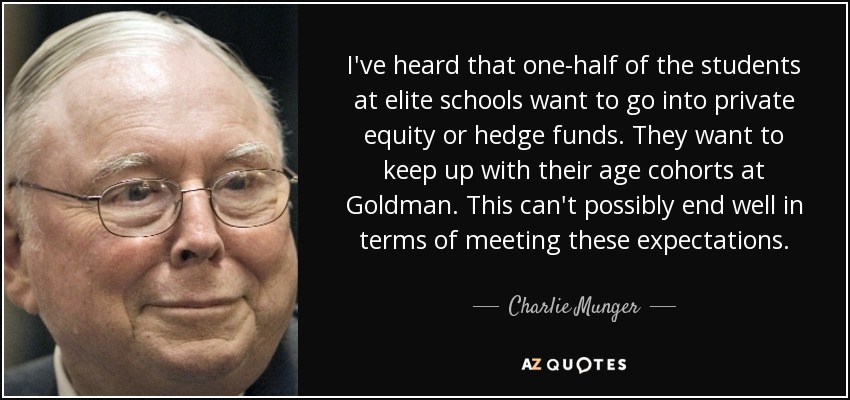
I've heard that one-half of the students at elite schools want to go into private equity or hedge funds. They want to keep up with their age cohorts at Goldman. This can't possibly end well in terms of meeting these expectations.
Now the Japanese companies are more focused on that. To have two independent directors - I think it's good to have outside people look at you and think of what you could be doing better. Those are voluntary, but most of the companies told me they're going to do it. And I think it's good for them to say our returns on equity, for example, should be higher. Also, I think some could be more ambitious.
In the LBO field there is a buried "covariance" with marketable equities, toward disaster in generally bad business conditions, and competition is now extremely intense.
All the equity investors, in total, will surely bear a performance disadvantage per annum equal to the total croupiers' costs they have jointly elected to bear. This is an inescapable fact of life. And it is also inescapable that exactly half of the investors will get a result below the median result after the croupiers' take, which median result may well be somewhere between unexciting and lousy.
Never risk more than 1% of total account equity on any one trade. By risking 1%, I am indifferent to any individual trade. Keeping your risk small and constant is absolutely critical.
Actors can make five movies a year. A director can make one movie, every two years. It's a whole different level of commitment and of sweat equity, and therefore there's a direct correlation to passion.
If buying equities seem the most hazardous and foolish thing you could possibly do, then you are near the bottom that will end the bear market.
Generally, an indie film in the U.K. is put together much like in the states. We got a tax credit. You sell the domestic rights, which can be quite low, but it's enough to push you over the line. And you get a tax credit on top of that, and then you cobble it together with private equity or gap financing and things like that.
When you consider the sheer magnitude of investable equities to choose from in the world's emerging markets, you realize that finding one that looks attractive enough to warrant investing your faith and assets in is as formidable a task as finding a needle in a haystack. Fortunately, researching investment opportunities is a lot more interesting than digging for needles in haystacks.
A low-cost index fund is the most sensible equity investment for the great majority of investors. My mentor, Ben Graham, took this position many years ago, and everything I have seen since convinces me of its truth.
Whenever I buy a painting, someone invariably says, "Oh, what a great investment." And I hate that reaction. To me, it's a matter of love and not an exchange of equity.
We know there's a clear gap in fairness. There just is in equity. In a lot of ways, economically, racially, blah, blah, blah. It just is. Not blaming anybody, it just is. So then you say, that can be interpreted and misinterpreted and used by a lot of different people. Some people run for office; some people try to gain influence. I generally believe all that's true. It's just, which one is the person who is accurately turning that dial and which one is using it as bullshit and lies? So, this is a tricky area to step into.
The private equity world is a relatively small one. There are currently probably a few thousand professional jobs worldwide. In private equity, that's probably about all there is. So in the scheme of things, the firms are all relatively small.
I still believe that for good business analysts a concentrated portfolio is a good strategy combined with a long term horizon. Once again, the secret to success in following the formula strategy is patience, a quality in short supply for both professionals and individual investors alike. I think investors should have a large portion of their assets in equities over time.
Many LBOs are man-made disasters. When the price paid is excessive, the equity portion of an LBO is really an out-of-the-money call option. Many fiduciaries placed large amounts of the capital under their stewardship into such options in 2006 and 2007.
War challenges virtually every other institution of society - the justice and equity of its economy, the adequacy of its political systems, the energy of its productive plant, the bases, wisdom and purposes of its foreign policy.
You have a lot more freedom to explore and improvise in a Canadian film, which you might not have when there's 13 different production companies that all have serious equity investments.
An irresistable footnote: in 1971, pension fund managers invested a record 122% of net funds available in equities - at full prices they couldn't buy enough of them. In 1974, after the bottom had fallen out, they committed a then record low of 21% to stocks.
The universe is eight billion years old, the last two billion of which have produced intelligent life. During this time not one hour of absolute equity has prevailed.
... the loss of public confidence in the financial community growing out of its own conduct in recent years. I insist that more damage has been done to stock values and to the future of equities from inside Wall Street than from outside Wall Street.
If you want to make better theory, you've got to use the best that's available and look through the lens of another discipline to see if you can uncover more anomalies. By looking at the phenomena of failure from the perspective of sales, marketing, finance, general management, and the equity markets, I was able to see things that Rebecca [Henderson] hadn't.
California, because of their Equity Funding Formula, moves a step in that direction by sending more resources to communities and students that face greater levels of poverty. But California is doing that from a greater position of real weakness, because they were already so far behind other states in funding per student. It’s a step, but many more steps need to be taken.
That's at the core of equity: understanding who your kids are and how to meet their needs. You are still focused on outcomes, but the path to get there may not be the same for each one.
One has to be realistic. Ones concern for equity and justice in the world must not carry one into the alien territory of unreasoned belief. Thats very important.
Banks don't want certain asset classes, and that's created opportunities for private equity, hedge funds, Silicon Valley. In this case I think he was referring to some of the European banks shedding assets, and the big buyers are probably not going to be big American banks. Someone like Blackstone may have a very good chance to buy those assets, leverage them, borrow up a little bit, and do something good there.
Follow AzQuotes on Facebook, Twitter and Google+. Every day we present the best quotes! Improve yourself, find your inspiration, share with friends
or simply: