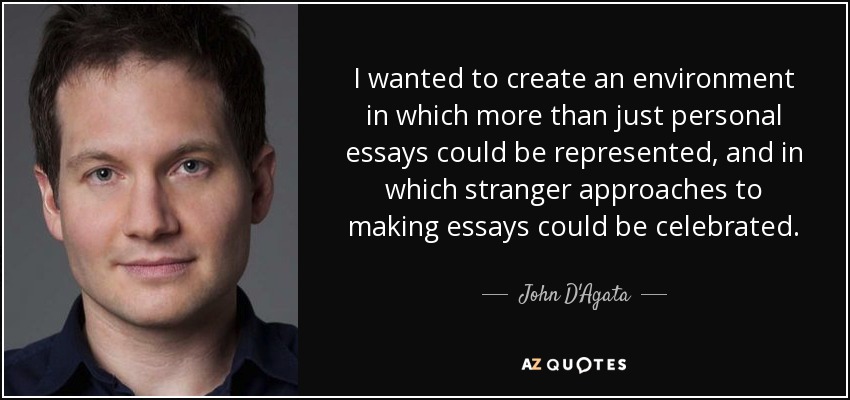
I wanted to create an environment in which more than just personal essays could be represented, and in which stranger approaches to making essays could be celebrated.
The essay community should have hundreds of anthologies from hundreds of different perspectives that are constantly introducing us to new writers, new work, and new visions for our genre. The whole spirit of these anthologies is that there should never be a last word in how essays are interpreted or what they can be.
I think that in a lot of readers' minds the essay is a lot more utilitarian than it is art.
Of course it's possible for political essays to be artful. I just want to call into question the dominance of content over form in the history of the essay. I want us to recognize that there's art involved in making this stuff, because we still don't approach the constructed nature of the essay with the same appreciation that we do poetry or fiction.
In the morning I'd write these essays, anything that I'd feel like writing, and in the afternoon, I'd spend time with my guitar. I had decided after listening to my last four or five albums that my biggest weakness musically was melody. the reason I had been singing in a monotone over the chord patterns in my songs was that I never practiced doing melodies.
When I got to college, I planned to be a math major, and, in addition to signing up for some math courses, I decided to take some philosophy. Quite by chance, I took a philosophy of science course in which the entire semester was devoted to reading Locke's Essay. I was hooked. For the next few semesters, I took nothing but philosophy and math courses, and it wasn't long before I realised that it was the philosophy that really moved me.
I grew up treating a life as a writer as a career in letters, one devoted to many kinds of writing. And so it seemed normal to study both fiction writing and the literary essay as an undergrad.
At first I was blogging everyday, but I don't do that anymore. It varies; sometimes I'll write these little essays and other times political commentaries. Other times it'll just be new work that I'm doing.
If one writing contributed more than any other to the framework in which this work Sowell's Knowledge and Decisions developed, it would be an essay entitled 'The Use of Knowledge in Society,' published in the American Economic Review of September 1945, and written by F. A. Hayek . . In this plain and apparently simple essay was a deeply penetrating insight into the way societies function and malfunction, and clues as to why they are so often and so profoundly misunderstood.
I always did well on the essay questions. Just put everything you know on there, maybe you'll hit it.
Sometimes the essay is where we end up when everything that we know must change.
My stuff is direct. Critics have compared my writing style with boxing all the way back to 1978 when my first book of essays appeared: it was compared to Muhammad Ali's style.
What triggers a poem for me is not the same as what triggers an essay. My mind is geared now to looking for, or to watching out for, the image that attracts my attention or the phrase or the strange juxtaposition that strikes me bodily, or an odd question or supposition.
As far as I can tell, writing the essays didn't change the way I wrote poetry. Although the essays contain scattered passages that might be called lyrical, they often contain closed statements of what is only suggested in the poetry.
Ordering is very important with essays, even if a reader doesn't read the essays or the poems in order through the book...
Autobiographical writings, essays, interviews, various other things... All the non-fiction prose I wanted to keep, that was the idea behind this collected volume, which came out about few years ago. I didn't think of Winter Journal, for example, as an autobiography, or a memoir. What it is is a literary work, composed of autobiographical fragments, but trying to attain, I hope, the effect of music.
In essay writing, I'm trying to push the form of expository writing. I'm trying to remember, trying to reckon, trying to find connections with the world, the nation and me, but I'm always trying to push the form, too, without being too obvious that I'm trying to push the form.
The "How to Slowly Kill Yourself and Others" essay was so hard to write because of the memories, the sensory stuff, but also because it didn't follow the form of any essay that I've ever read. And the truth that I was exploring necessitated that obliteration of traditional form, I think.
Like when you pick up a book and you don't realize what type of text it is - it could be an essay, a novel, a biography - and at one point you realize you don't know where, as a reader, you want to be. Where are you going with this text? What is the goal? How are you supposed to interpret what you're reading? And people's responses vary - some dislike it, and are put off by the confusion, the lack of comprehension.
Whereas if you were writing an op-ed piece or an essay, somebody would be asking, "What's your point?" With poetry you can stay in a moment for as long as you want. Poetry is about metaphor, about a thing standing in for something else. It's the thing that opens out to something else. What that something else is changes for readers. So what's on the page - it falls away.
I feel that I'm an essayist and that my best work gets done in that form. I wanted to do a book where the essays could exist on their own terms. A book that was neither a book of essays that were shoehorned into a memoir, nor [one where] the essays had been published elsewhere first, [because] then they would kind of bear the marks of those publications.
Although the point of blogging is that it doesn't pay, I often steal from my blog for paid publication. I've based several magazine essays on blog posts, as well as an entire book.
Another benefit is that the more I blog, the more I maintain and develop a first-person voice, which translates into a much greater ease with writing personal essays.
The ingredients that make a good poem often differ from those that make a good essay and from those that make a good novel.
Maybe someone's who's a different kind of writer [would think otherwise] - someone who'd be just as comfortable writing essays on what their novels are about. Sometimes you feel like certain novelists are like that.
Follow AzQuotes on Facebook, Twitter and Google+. Every day we present the best quotes! Improve yourself, find your inspiration, share with friends
or simply: