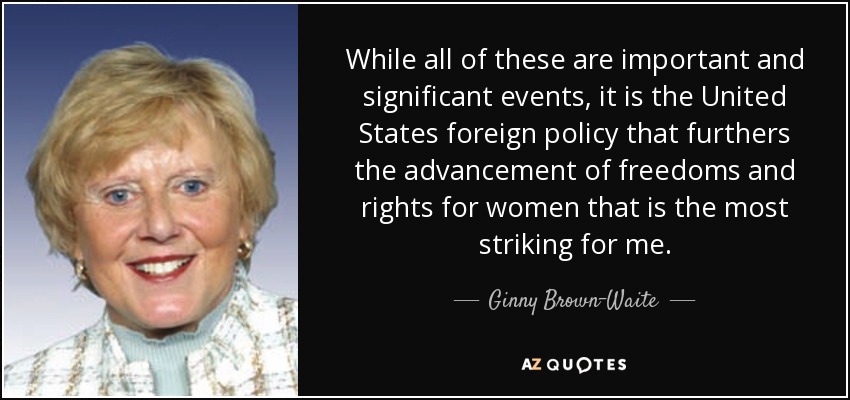
While all of these are important and significant events, it is the United States foreign policy that furthers the advancement of freedoms and rights for women that is the most striking for me.
My manager got the script for Under the Dome, and I read it and just fell in love with the character. I grew up on Stephen King, and I love his whole aesthetic of the classic American story with supernatural events happening, so it just made sense.
A curious thing about atrocity stories is that they mirror, instead of the events they purport to describe, the extent of the hatred of the people that tell them. Still, you can't listen unmoved to tales of misery and murder.
Seth can get irritated/frustrated with Jane and me. This exerpt is from the private session of November 11, 1979: "... the same kind of reaction, however, are involved in all activities, and it is sometimes frustrating for me that you cannot perceive the fascinating facets of any event. You still - and I do not simply mean you two alone - do not feel the unsurpassable force that thoughts have. You do not understand that they do form events, that to change events you must first change thoughts. You get what you concentrate on."
The Christian is the person who sees every time and every situation, however dreary and repetitive, as God sees it - a fresh creation from his hand, demanding its own response in perhaps a wholly new and creative way. Under God he is free over it. He has won through to a purchase over events; he has risen with Christ.
We can shape events in each other's brains with exquisite precision.
Huge events like the Ukraine famine of 1933, involving the deaths of millions of people, have actually escaped the attention of the majority of English russophiles.
Working with Woody Allen is like filming Howard Hughes's will. It's a very mysterious and strange event. You never get a peek at the whole will.
To say it another way, thinking, however abstract, originates in an embodied subjectivity, at once overdetermined and permeable to contingent events.
I'd been reading Daniel Defoe's Journal of the Plague Year when the [1992 Los Angeles] riots broke out and I began to see them both - L.A. and the London plague - as the same event. A time of crisis. A time when rich and poor get thrown together - and, suddenly one sees alternatives. I began to think about what happens when the containment of a presumed danger through the regimentation of space breaks down, such as when South-Central L.A. began to invade Beverly Hills.
I want to seduce the audience. If they can go along for a ride they wouldn't ordinarily take, or don't even know they're taking, then they might see highly charged political issues in a new and unexpected way. . . . The theatre is now so afraid to face its social demons that we've given that responsibility over to film. But it will always be harder to deal with certain issues in the theatre. The live event - being watched by people as we watch - makes it seem all the more dangerous.
. . . I do think that deep down, a lot of my work is about people trying to make reasonable accommodations of situations that are insane or absurd. . . . At first I thought the events had power in themselves, that I would just present them. I really wasn't aware of the things that finally became central issues to me - the shifting alliances, the way people hardly even know they've shifted. That part of [A QUESTION OF MERCY] is very familiar to me in terms of my other plays.
Fate, they say, fate- the clay that molds the events of your life, and it was the same fate that had thrown the stone of her heart on the building of his expectations. But then wasn't it his fault that he had constructed the building of glass? Hadn't he failed to cement the bricks of his love with trust and colour them with security? There was no insurance for broken hearts, no ointment for wounded souls and there would never be one, he knew.
The psychiatric interviewer is supposed to be doing three things: considering what the patient could mean by what he says; considering how he himself can best phrase what he wishes to communicate to the patient; and, at the same time, observing the general pattern of the events being communicated. In addition to that, to make notes which will be of more than evocative value, or come anywhere near being a verbatim record of what is said, in my opinion is beyond the capacity of most human beings.
Throughout the 64-day campaign, events and activities for peace and nonviolence take place all around the world, highlighting existing peacebuilding initiatives and inspiring new year-round activities for a more peaceful, nonviolent, just and sustainable world.
The Universe forces those who live in it to understand it. Those creatures who find everyday experience a muddled jumble of events with no predictability, no regularity, are in grave peril. The Universe belongs to those who, at least to some degree, have figured it out.
Grandmother walked up over the bare granite and thought about birds in general. It seemed to her no other creature had the same dramatic capacity to underline and perfect events - the shifts in the seasons and the weather, the changes that run through people themselves.
Tell the story, gather the events, repeat them. Pattern is a matter of upkeep. Otherwise the weave relaxes back to threads picked up by birds to make their nests. Repeat, or the story will fall and all the king's horses and all the king's men. . . . Repeat, and cradle the pieces carefully, or events will scatter like marbles on a wooden floor.
A good person dyes events with his own color . . . and turns whatever happens to his own benefit.
So - our readiness to meet and defeat this kind of possible attack is forced upon us, both as a potent preventive of actual war and to insure survival in event of attack. This alertness to danger has to be translated into specific policies and activities in the several parts of the world where our rights - our way of life - can be seriously damaged. Work of this kind occupies my days and nights.
The ability to see our lives as stories rather than unrelated, random events increases the possibility for significant and purposeful action.
Technique isn't important. Technique is in the blood. Events and mood are more important than good light and the happening is what is important
Plate glass... has no beauty of its own. Ideally, you ought not to be able to see it at all, but through it you can see all that is happening outside. That is the equivalent of writing that is plain and unadorned. Ideally, in reading such writing, you are not even aware that you are reading. Ideas and events seem merely to flow from the mind of the writer into that of the reader without any barrier between. I hope that is what is happening when you read this book
Aging and its evidence remain lifes most predictable events, yet they also remain matters we prefer to leave unmentioned, unexplored.
I must perish in this deplorable folly. Thus, thus, and not otherwise, shall I be lost. I dread the events of the future, not in themselves, but in their results. I shudder at the thought of any, even the most trivial, incident, which may operate upon this intolerable agitation of soul. I have, indeed, no abhorrence of danger, except in its absolute effect-in terror. In this unnerved-in this pitiable condition-I feel that the period will sooner or later arrive when I must abandon life and reason together, in some struggle with the grim phantasm, FEAR.
Follow AzQuotes on Facebook, Twitter and Google+. Every day we present the best quotes! Improve yourself, find your inspiration, share with friends
or simply: