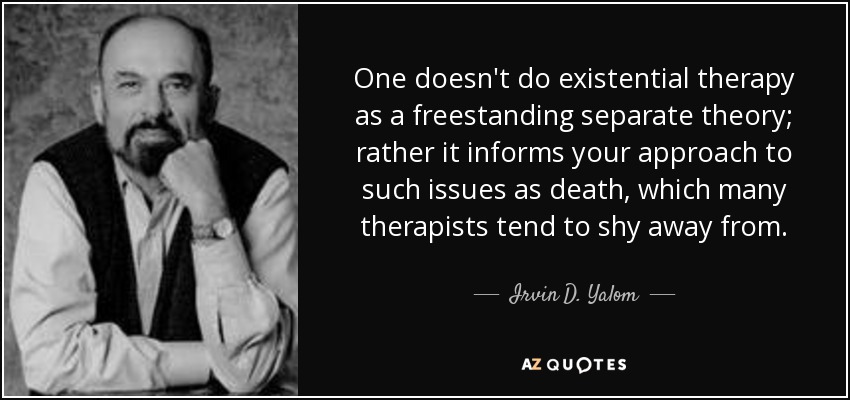
One doesn't do existential therapy as a freestanding separate theory; rather it informs your approach to such issues as death, which many therapists tend to shy away from.
In a study we did of bereavement, we found that rather impressive numbers of widows and widowers had not simply gone back to their pre-loss functioning, but grown. This was due to a kind of increased existential awareness that resulted from this confrontation with the death of another. And I think it brought them in touch with their own death, so they began to experience a kind of preciousness to life that comes with an experience of its transiency.
If literature is to transcend political interference and return to being a testimony of man and his existential predicament, it needs first to break away from ideology. To be without "isms," is to return to the individual and to return to viewing the world through the eyes of the writer, an individual who relies on his own perceptions and does not act as a spokesman for the people. The people already have rulers and election campaigners speaking in their name.
For it is in the field where meaning is constitutive that man's freedom reaches its highest point. There too his responsibility is greatest. There there occurs the emergence of his existential subject, finding out for himself that he has to decide for himself what he is to make of himself.
The Internet is really our meeting place. We have this amazing listserv. Every time I log onto it I feel a sense of pride, because if you log on and say, "Oh I was just in San Diego and I was in a park and I saw a lion," the flurry of replies on average is just like--wow! All these existential questions about what it means to be an African, and never having seen a lion at home, but having seen a lion here. Everything you say turns into this real philosophical debate--it's incredible in so many ways. And it's an invigorating place to be.
Whether arrived at through reason or revelation, natural law is the highest law known to man. It is anchored in the very existential nature of man and is therefore a priori just.
I can never be an atheist, because God is our celestial hope for our existential worries, our cosmic chance against absurdity!" MMI
When I talk about the pain and hardship of a scientist's life, I'm speaking of more than existential angst. Galileo's work was condemned by the Church; Madame Curie paid with her life, a victim of leukemia wrought by radiation poisoning. Too many of us develop cataracts. None of us gets enough sleep. Most of what we know about the universe we know thanks to a lot of guys (and ladies) who stayed up late at night.
[Having] appropriated to itself all conscious intelligence in the universe ...Man faces the existential crisis of being a solitary and mortal conscious ego thrown into an ultimately meaningless and unknowable universe ...and the psychological and biological crisis of living in a world that has come to be shaped in such a way that it precisely matches his world view-i.e., in a man-made environment that is increasingly mechanistic, atomized, soulless, and self-destructive.
I'm really enjoying growing up. I feel like so much of my life was in an existential crisis when I was young, and I don't feel as bogged down by that anymore.
Start a 'Stop Doing' list. I'll leave it as an existential dilemma on whether to put that task on your To Do list
There's so much going on in Andrei [Bolkonsky]. He's wrangling with these big existential conundrums, and he tries out different routes to fulfillment. He tries falling in love, that doesn't work. He goes to war and searches for military glory, that doesn't work. He does the quiet life of a farmer. He's always active. That's what I loved about him, he's always looking, searching. He's really inquisitive.
I've changed over my writing life. If I can generalize, I would say that the more recent poems - believe it or not - are more pointedly political; although, if the earlier poems were more existential, they were still political; though, in their own way, had a complicated presence.
If I wrote about "being [abstraction]" I would be ignoring existential issues (such as death, limited-time, the arbitrary nature of the universe, the mystery of consciousness) that I feel affect me most in my life and think about most of the time. Another reason is that it doesn't seem specific or accurate, to me, to write about "being [abstraction]." I think there are some other reasons.
I feel connected with people because of their sense of humor, worldview, and what they think and feel about certain existential issues (things not affected, in my view, by if someone rides a horse or drives a car or talks only IRL or only by typing), not how old they are, what they use to convey what they think and feel about certain existential issues, or if we have both watched the same TV shows or looked at the same websites.
I think for a woman, getting older can help, through personal experience, although of course older women are then rendered invisible in our society, another existential crisis.
I really like that homosexuality is a little bit of an existential puzzle.
I seem to have come out of the womb with existential angst and wasn't a happy kid, so I've been on a lifelong search trying to discover how to live the best life possible. I committed my life to doing what I could to experience greater happiness, which ultimately led me to write a book on the subject called Happy for No Reason.
A lot of the day-to-day, minute-to-minute struggles are a bit more taken care of, so it allows you to start asking more existential questions like, "What do I want in life? What's going to make me happy?"
Once you're alienated, you're on your own. That takes you to the world of the existential, where things just kind of float.
The horrors have made the legend of Mandelstam and are inevitably the lens through which we read his work and life. But if there had been no Stalin and no purge, Mandelstam still would have been a poet of severe emotional and existential extremity.
There's this existential crisis in America and in the West of, like - who am I? - based on this searching for individual fulfillment, which you don't necessarily have in the East in the same way because you're kind of told what to do. I'm not saying one is better than the other, I'm just saying that's just, like, the reality.
I will not sleep fine if Donald Trump wins and I will not sleep fine is Hillary Clinton wins. Whether you are looking at nuclear weapons, whether you are looking at expanding wars and their blowback, which will not stop as long as those wars continue to expand, or whether you're looking at the climate, in my view, we have no choice. This is an existential moment. We are deciding not only what kind of world we will have, but whether we will have a world or not. I think it's very important to get outside this box that tells us we are powerless, when in fact, we are powerful.
I have a very simple mantra and it's this: I want to make black cinema with the power, beauty, and alienation of black music. That's my big goal. The larger preoccupation is how do we force cinema to respond to the existential, political, and spiritual dimensions of who we are as a people.
There's existential fears I have - losing passion and creativity and just kind of floating through life. When I feel a little lost - pulled away by the noise of what you're supposed to be doing and what your social following is - I go back to the things that inspire me.
Follow AzQuotes on Facebook, Twitter and Google+. Every day we present the best quotes! Improve yourself, find your inspiration, share with friends
or simply: