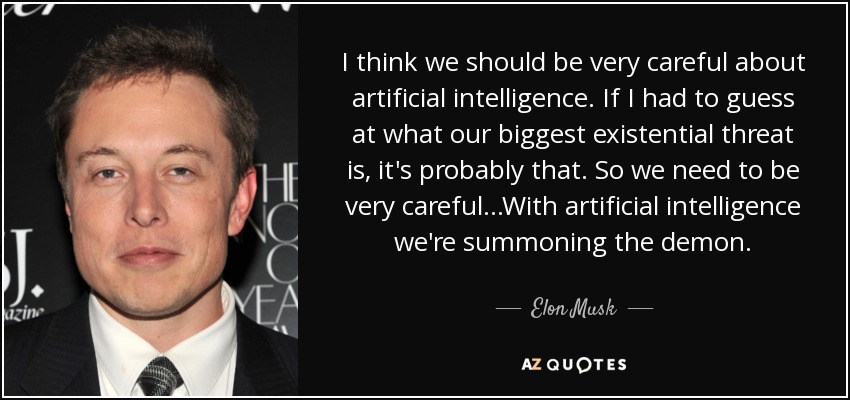
I think we should be very careful about artificial intelligence. If I had to guess at what our biggest existential threat is, it's probably that. So we need to be very careful...With artificial intelligence we're summoning the demon.
I consulted a therapist at Mass. General. After about 20 minutes, he stopped me and said, 'You're just a big existential garbage pail. Go home and relax.'
We, the great American nation, decided that we've got 138 military bases around the world and we've now figured out that we can buy these drones from the Israelis, and we've decided that the way to proceed is to use this new technology to go and kill anybody that we don't like or who disagrees with us or who we might perceive as making an existential threat.
All gradients of reality, all existential distinctions, have finally been annihilated.
A poverty learned with the humble, the poor, the sick and all those who are on the existential outskirts of life. A theoretical poverty is no use to us. Poverty is learned by touching the flesh of the poor Christ, in the humble, in the poor, in the sick and in children.
Though love is instinctive, it cannot develop without a certain stimulus and use.
But anyone who thinks themselves genuinely unbiased is bound to be taken in.
All who have read a few old books have picked up the old tactics of considering every new idea a 'heresy' which must be rooted out.
True, we must dare look things in the face before we dare think, speak, act, or assume responsibility. If we dare not even look, what else are we good for?
The world is changing from day to day; it is high time for our writers to take off their masks, look frankly, keenly, and boldly at life, and write about real flesh and blood. It is high time for a brand-new arena for literature, high time for some bold fighters to charge headlong into battle!
Why should young people look for guides who hang out gided placards to advertise themselves? They would do better to look for friends, unite with them, and advance together towards some quarter where it seems possible to survive.
I could not blot out hope, for hope belongs to the future.
When I was in college, I remember fearing that the dreary grind of adulthood would feature infinitely more existential dread than frat parties had, but the opposite has been true for me. I'm much less likely to feel that gnawing fear of aimlessness and nihilism than I used to be and that's partly because education gave me job opportunities, but it's mostly because education gave me perspective and context.
Sometimes my poetry is an attempt to keep off existential terror; sometimes it is a grappling with philosophical problems; sometimes just fun.
Error ... is less an intellectual problem than an existential one - a crisis not in what we know, but in who we are. We hear something of that identity crisis in the questions we ask ourselves in the aftemath of error: What was I thinking? How could I have done that?
Failure to summon forth the courage to risk a nondogmatic and nonevasive stance on such crucial existential matters can also blur our ethical vision. If our actions in the world are to stem from an encounter with what is central in life, they must be unclouded by either dogma or prevarication. Agnosticism is no excuse for indecision. If anything, it is a catalyst for action; for in shifting concern away from a future life and back to the present, it demands an ethics of empathy rather than a metaphysics of fear and hope.
My understanding of life is very existential. I think that we are our bodies. There's nothing else, and when we die, that's it. No afterlife.
Zen is not “attained” by mirror-wiping mediation, but by “self-forgetfulness in the existential 'present' of life here and now.” We do not “come”, we “are.” Don't strive to become, but be.
When the Negro musician or dancer swings the blues, he is fulfilling the same fundamental existential requirement that determines the mission of the poet, the priest and the medicine man.
Our approach to existential risks cannot be one of trial-and-error. There is no opportunity to learn from errors. The reactive approach - see what happens, limit damages, and learn from experience - is unworkable. Rather, we must take a proactive approach. This requires foresight to anticipate new types of threats and a willingness to take decisive preventive action and to bear the costs (moral and economic) of such actions.
Nihilism is not an existential quandary but a speculative opportunity.
Philosophy would do well to desist from issuing any further injunctions about the need to re-establish the meaningfulness of existence, the purposefulness of life, or mend the shattered concord between man and nature. It should strive to be more than a sop to the pathetic twinge of human self-esteem. Nihilism is not an existential quandary but a speculative opportunity.
Hezbollah, Hamas, Al-Qaeda, they all have ties to Iranian money. I think they are the biggest exist - existential threat... Russia could be up there, but I think it would probably be to one of our NATO allies rather than the homeland.
Of course, the surest way to free yourself from an existential crisis is through comedy.
There is certainly a part of my filmmaking that harkens to a more simpler commercial kind of taste, but then with this theres certainly a kind of avant-garde, abstract, existential element to it.
Follow AzQuotes on Facebook, Twitter and Google+. Every day we present the best quotes! Improve yourself, find your inspiration, share with friends
or simply: