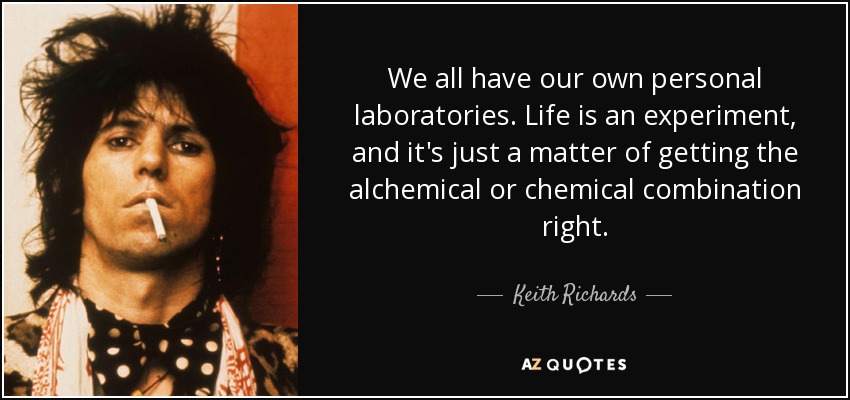
We all have our own personal laboratories. Life is an experiment, and it's just a matter of getting the alchemical or chemical combination right.
Just who has imposed on the suffering human race poison gas, barbed wire, high explosives, experiments in eugenics, the formula for zyklon b, heavy artillery, pseudo-scientific justifications for mass murder, cluster bombs, attack submarines, napalm, intercontinental missiles , military space platforms and nuclear weapons? If memory serves it was not the Vatican.
Tips for aspiring writers: don't be afraid of writing rubbish. It's very easy to become hypnotised by an empty page or screen. It's tempting to abandon a half-finished work because you can't make it perfect. I hereby give you permission to write things that aren't perfect, make mistakes, try things that don't work, experiment with styles you're not used to and generally throw words around. You'll learn much faster that way.
The western world, the free world, loses what it cherishes most, and that is freedom and liberty we've seen for a couple of hundred years in this grand experiment that we call democracy.
That's it. With equal parts regret and relief, the Jane's Addiction experiment is at an end.
I would say to any artist: Don't be repressed in your work, dare to experiment, consider any urge, if in a new direction all the better.
I'm convinced that a controlled disrespect for authority is essential to a scientist. All the good experimental physicists I have known have had an intense curiosity that no Keep Out sign could mute. Physicists do, of course, show a healthy respect for High Voltage, Radiation, and Liquid Hydrogen signs. They are not reckless. I can think of only six who have been killed on the job.
If we can possibly avoid wrecking this little planet of ours, we will, But-there must be risks! There must be. In experimental work there always are!
In experimental philosophy, propositions gathered from phenomena by induction should be considered either exactly or very nearly true notwithstanding any contrary hypotheses, until yet other phenomena make such propositions either more exact or liable to exceptions.
In going on with these Experiments, how many pretty systems do we build, which we soon find ourselves oblig'd to destroy! If there is no other Use discover'd of Electricity, this, however, is something considerable, that it may help to make a vain Man humble.
In recent weeks we learned that scientists have created human embryos in test tubes solely to experiment on them. This is deeply troubling, and a warning sign that should prompt all of us to think through these issues very carefully.
It is madness and a contradiction to expect that things which were never yet performed should be effected, except by means hitherto untried.
It is very different to make a practical system and to introduce it. A few experiments in the laboratory would prove the practicability of system long before it could be brought into general use. You can take a pipe and put a little coal in it, close it up, heat it and light the gas that comes out of the stem, but that is not introducing gas lighting. I'll bet that if it were discovered to-morrow in New York that gas could be made out of coal it would be at least five years before the system would be in general use.
It was a great step in science when men became convinced that, in order to understand the nature of things, they must begin by asking, not whether a thing is good or bad, noxious or beneficial, but of what kind it is? And how much is there of it? Quality and Quantity were then first recognised as the primary features to be observed in scientific inquiry.
Let the experiment be made.
My Design in this Book is not to explain the Properties of Light by Hypotheses, but to propose and prove them by Reason and Experiments: In order to which, I shall premise the following Definitions and Axioms.
Natural science is founded on minute critical views of the general order of events taking place upon our globe, corrected, enlarged, or exalted by experiments, in which the agents concerned are placed under new circumstances, and their diversified properties separately examined. The body of natural science, then, consists of facts; is analogy,-the relation of resemblance of facts by which its different parts are connected, arranged, and employed, either for popular use, or for new speculative improvements.
No isolated experiment, however significant in itself, can suffice for the experimental demonstration of any natural phenomenon; for the "one chance in a million" will undoubtedly occur, with no less and no more than its appropriate frequency, however surprised we may be that it should occur to us.
Now I know what the atom looks like.
Of course, Behaviourism 'works'. So does torture. Give me a no-nonsense, down-to-earth behaviourist, a few drugs, and simple electrical appliances, and in six months I will have him reciting the Athanasian Creed in public.
Only by following out the injunction of our great predecessor [William Harvey] to search out and study the secrets of Nature by way of experiment, can we hope to attain to a comprehension of 'the wisdom of the body and the understanding of the heart,' and thereby to the mastery of disease and pain, which will enable us to relieve the burden of mankind.
Reason has so many forms that we do not know which to choose-Experiment has no fewer.
Salt water when it turns into vapour becomes sweet, and the vapour does not form salt water when it condenses again. This I know by experiment. The same thing is true in every case of the kind: wine and all fluids that evaporate and condense back into a liquid state become water. They all are water modified by a certain admixture, the nature of which determines their flavour.
Someday someone will write a pathology of experimental physics and bring to light all those swindles which subvert our reason, beguile our judgement and, what is worse, stand in the way of any practical progress. The phenomena must be freed once and for all from their grim torture chamber of empiricism, mechanism, and dogmatism; they must be brought before the jury of man's common sense.
The artist does not illustrate science; ... [but] he frequently responds to the same interests that a scientist does, and expresses by a visual synthesis what the scientist converts into analytical formulae or experimental demonstrations.
Follow AzQuotes on Facebook, Twitter and Google+. Every day we present the best quotes! Improve yourself, find your inspiration, share with friends
or simply: