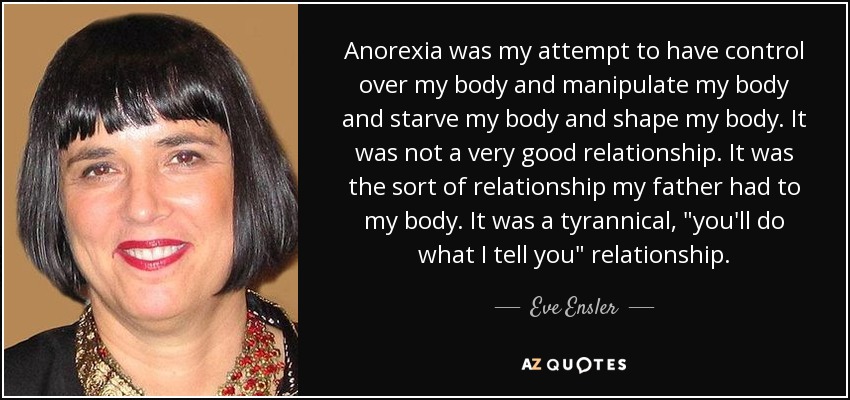
Anorexia was my attempt to have control over my body and manipulate my body and starve my body and shape my body. It was not a very good relationship. It was the sort of relationship my father had to my body. It was a tyrannical, "you'll do what I tell you" relationship.
Singularity theory is something that I do believe will come to pass, sooner or later, although whether or not in our lifetime I don't know, and I'm not sitting around waiting for my father to be resurrected. Readers probably have the impression from the book that I'm a lot more a of a techno kook than I actually am. It became a convenient fulcrum in the story, sort of a kaleidoscope through which to address religious and spiritual questions.
I think the typical way is that usually Holocaust survivors are known to be very quiet and full of anxiety, many of them don't like life, don't trust people. But my parents were children during the Holocaust. And my father was very optimistic.
My father - I once asked him what was his greatest achievement. He said his greatest achievement was that he fought in five wars in the infantry, always on the front line, and never hurt anybody.
In my real life I had to confront the sins of the father, but it's also a symbolic journey - a social, psychological, sexual journey for women and minorities who must pass through patriarchy and the symbolic order in order to claim a self.
My father, who was a sergeant in the RAF during the Second World War, was killed in a hitchhiking accident while returning home on compassionate leave. As a result, my mother had to get work, as a nurse, and at seven the RAF put me into a boarding school and ex-orphanage called the Royal Wolverhampton School.
Men always liked me, because I was very damaged and unpredictable, my children's father claims that I have multiple personalities, but I don't.
I'm not talking about my children's father'he's a wonderful black man, the hero of my life, and he's never disrespected or betrayed me. But I'm talking about what I see in the streets and in the media, this naked hatred that black men have towards the authentic black woman'which is really an indication of black men's hatred for blackness itself.
Becoming a father has definitely heightened my discomfort with uncertainty. I want to be able to say, I know what will happen, when, why. But most of the time, we just don't know.
After my parents divorced, my father remarried and my brothers were born when I was twelve and sixteen. I was thunderstruck at these kids. The "baby-ness" of them. Their toes. I had never been around babies before.
There were the fairy tales my father told to me at bedtime. All the standards. I thought my father invented wolves.
My mother was a housewife. Both from - well, my father was from a farming family, agricultural family in the north of England. And my mother came from a very working class.
Eleanor Marx was her father's first biographer. All subsequent biographies of Karl Marx, and most of Engels, draw on her work as their primary sources for the family history, often without knowing it. I think if she'd been a son, she would have been referenced more.
I didn't major in anthropology in college, but I do feel I had an education in different cultures very early on. My parents divorced when I was eleven, and my father immediately married a woman with three children and was with her for five years. When they got divorced, he immediately married a woman with four children. In the meantime, my mother married a man who had seven children. So I was going from one family to another between the ages of eleven and eighteen.
One may not be able to fulfill a fatherly role with one's own child, but on the other hand, and this goes for me as well, one might still be a "father of choice" to someone else out there in the world. Fatherhood is something that can be shared worldwide. Meaning that in terms of the substance of a father's role, perhaps we are all pseudo-fathers.
My grandfather is Portuguese. He betrayed what was expected of him and married my grandmother of African descent on my father's side.
I try to think as little as possible, at least while working. I look at some of my early stories and can see the machination behind them, like a gear slowly moving. For example, sticking a dead father into the story to explain a character's sadness and bad decisions, or trying to impress myself with my own cleverness.
Before my book, the most common assessment of Eleanor Marx is "Yes, she's great but basically she's in the shadow of her father." Absolute bollocks. She fought him, she resisted, and she was not a kind of trocadateur of his ideas.
You don't need a dead father to explain a character's sadness. And impressing yourself with wit/cleverness often feels like what it is - authorial intrusion.
There's a kind of mystery to our being and from my point of view, regarding my own parents and their parents, I'd as soon let it lie than find out who my mother's father was.
You see things really different when your father is so intimately, so indisputably in charge of your continued existence on the planet.
If upon this earth we ever have a glimpse of heaven,it is when we pass a home in winter, at night,and through the windows, the curtains drawn aside,we see the family about the pleasant hearth; the old lady knitting; the cat playing with the yarn;the children wishing they had as many dolls or dollars or knivesor somethings, as there are sparks going out to join the roaring blast;the father reading and smoking, and the clouds rising like incense from the altar of domestic joy.I never passed such a house without feeling thatI had received a benediction.
You don't know how people are going to respond. But I would add to that, that getting your heart broken is not the worst thing and it's actually quite unavoidable. I think in some ways I had to break my father's heart and then face that in order to have a real relationship with him.
My father was raised by a violent alcoholic. There was alcoholism in my mother's family. I'm half-adopted, and my birth father was a drug addict and alcoholic. So, I think they very consciously made decisions and parented me in a way that was aimed to help save me from that. So, I knew it would be particularly painful and it was, especially for my father.
I'd always wanted to write something about the Korean War because of my heritage. My father lost his brother during the war, and I fictionalized that episode, which was told to me very briefly without much detail.
Follow AzQuotes on Facebook, Twitter and Google+. Every day we present the best quotes! Improve yourself, find your inspiration, share with friends
or simply: