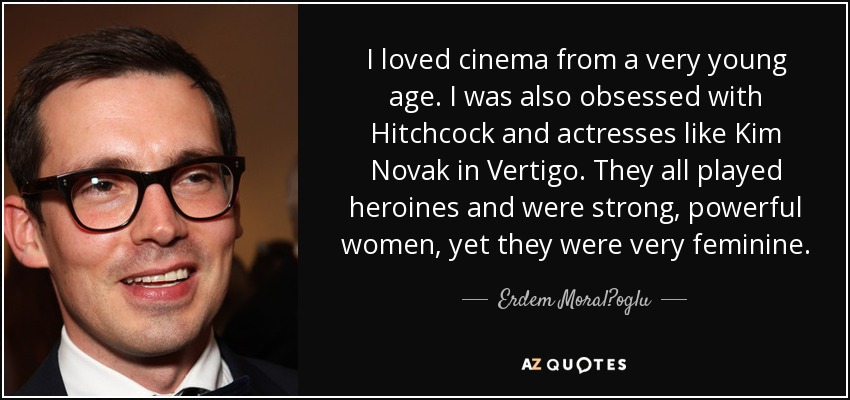
I loved cinema from a very young age. I was also obsessed with Hitchcock and actresses like Kim Novak in Vertigo. They all played heroines and were strong, powerful women, yet they were very feminine.
I got to draw shapes. I really like to draw funky, geometric shapes. And I got to use just different fonts and make a joke of how feminine it was, but it didn't even have people in it. To me, it was so exciting and interesting to do that for a while.
I would probably say David Bowie and Prince are the perfect people. They dress feminine/masculine and they're really sexy. Not many people can wear high heels and look sexier than a woman!
Ayahuasca is a brew that's made from the vine, which is the hallucinogenic element. And then there's also this leaf from a bush. And the vine is supposed to be the masculine and the bush is supposed to be the feminine, and this female shaman did a tea drinking ceremony with us, where we drank Wyoosa. And the intention was to go and find pieces of your soul that were missing and bring them back to your body so you could live more fully with yourself and it's called soul retrieval.
I admire Joyce Maynard a lot, specifically her memoir "At Home in the World." Her writing is beautiful and fascinating and seemed to give me validation to the idea that I could write validly in earnest about my life with (my) very feminine point of view, and also that I could unapologetically explore the bad traits of my character (which I find to be more interesting to explore than the good traits), as well as explore other concepts that interest me like private vs public personas, age gap relationships, etc.
I love the silhouettes of the '50s that were feminine and womanly without being too revealing. I've always gravitated towards that kind of sense of style and fashion.
Traditionally, women didn't have much a role in Buddhism. The books were all written by monks, for other monks. So the general view of the feminine was rather misogynistic, with women playing the role of the forbidden other, waiting to pounce on innocent little monks! In that society, it was hard for women to become educated and get the deeper teachings and really become accomplished.
Look, "Gender trouble" includes a critique of the idea that there are two ideal bodily forms, two ideal morphologies: the masculine and the feminine. I want to suggest that today the intersex movement is very engaged with criticizing that idea.
I think maybe it's more important to know the traditional concepts we have for thinking about how bodies are feminine or masculine or how sexuality is, straight or gay. These categories very often fail to describe the complexity of who we are.
You're an evolving and transforming person, right? And how do we capture that dynamics of sexuality in that complex sense? There may be times when someone feels oneself more overly masculine or maybe more feminine, or where the terms themselves become confused, where passivity and activity also don't maintain their usual meaning.
No matter how brilliant or accomplished they are, there is something emasculating for men in being pitted against a woman. It is even more true in creative fields already considered to be "squishy" and feminine, and it's a big problem because great women have been left off the record.
Our individual wholeness includes a masculine and a feminine side, which are slowly (or not so slowly) wrung out of us, depending on which gender you are.
Men at an earlier age, get the feminine aspects of them wrung out in a variety of ways.
I've come from a very masculine country to a feminine country. England was very masculine; people went from England to abroad, and they landed from above and they said "These are the gods you will worship, these are the crops you will grow, now go away and do it." Which is a manly attitude. Americans go abroad and they say, "Try not to quarrel so much", which is a feminine attitude.
Vertical attention is not the same as, and doesn't evolve from nor imply, hierarchy. We could say that hierarchy is associated with power, and vertical attention with longing for the Divine Feminine, for the Divine Masculine, for what the Sufis call 'wine.'
I tend to keep my style very classic. I like very girly, retro inspired, feminine floral things. I'm not very edgy.
There is something false in this search for a purely feminine writing style. Language, such as it is, is inherited from a masculine society, and it contains many male prejudices. We must rid language of all that. Still, a language is not something created artificially; the proletariat can't use a different language from the bourgeoisie, even if they use it differently, even if from time to time they invent something, technical words or even a kind of worker's slang, which can be very beautiful and very rich. Women can do that as well, enrich their language, clean it up.
To create a language all of a piece which would be a women's language, that I find quite insane. There does not exist a mathematics which is only a women's mathematics, or a feminine science.
I consider it almost antifeminist to say that there is a feminine nature which expresses itself differently, that a woman speaks her body more than a man, because after all, men also speak their bodies when they write. Everything is implicated in the work of a writer.
There is a kind of universality in the human condition, masculine or feminine. That's one thing I continue to believe.
Can one say that there is a way of crying out, of speaking, which is properly feminine? Personally, I don't think so. In the end, I find this is another way of putting women in a kind of singularity, a ghetto, which is not what I want. I want them to be singular and universal at the same time.
Virginia Woolf thought a lot about her own sex when she wrote. In the best sense of the word, her writing is very feminine, and by that I mean that women are supposed to be very sensitive to all the sensations of nature, much more so than men, much more contemplative. It's this quality that marks her best works.
Jewelry is incredibly feminine, and reflects the grace and beauty of a women's style like nothing else.
As long as women and the "feminine" such as caring and caregiving are devalued, we cannot realistically expect more caring economic policies. Young people have a major role to play in creating a caring economics.
Basically what Salomé did with Rilke as a mentor was direct him toward the Russian Orthodox Church, so he could project his love of the divine feminine onto the Virgin Mary. She wanted him to stop the cycle of being disappointed by the ultimate humanity of women. She was like, "You don't want me, you want the Virgin Mary." It's kind of a mystical concept! She also changed Freud's opinion, a little bit too late, about the female psyche, which he had so wrong. If it had been better publicized, it would have changed Western society's perception of the female psyche, too.
Follow AzQuotes on Facebook, Twitter and Google+. Every day we present the best quotes! Improve yourself, find your inspiration, share with friends
or simply: