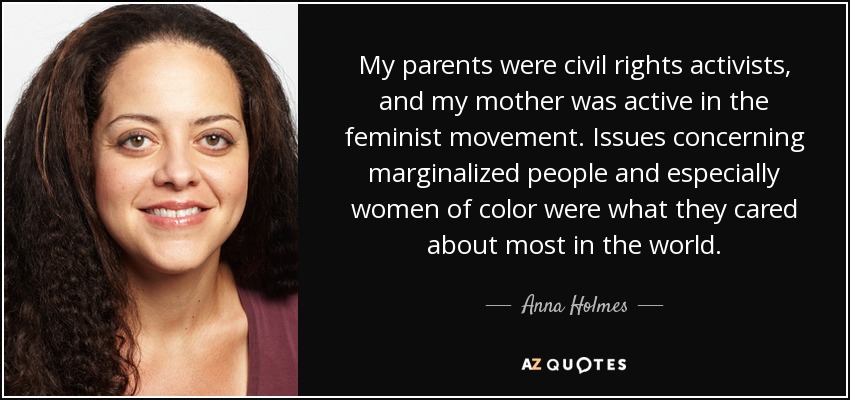
My parents were civil rights activists, and my mother was active in the feminist movement. Issues concerning marginalized people and especially women of color were what they cared about most in the world.
If we are ever to construct a feminist movement that is not based on the premise that men and women are always at war with one another, then we must be willing to acknowledge the appropriateness of complex critical responses to writing by men even if it is sexist. Clearly women can learn from writers whose work is sexist, even be inspired by it, because sexism may be simply one dimension of that work. Concurrently fiercely critiquing the sexism does not mean that one does not value the work.
My parents demonstrated against the Vietnam war, they were into the civil rights movement, the feminist movement, they started the first vegetarian restaurant in Pittsburgh.
There is a true feminist movement in Buddhism that relates to the goddess Tārā. Following her cultivation of bodhicitta, the bodhisattva's motivation, she looked upon the situation of those striving towards full awakening and she felt that there were too few people who attained Buddhahood as women. So she vowed, 'I have developed bodhicitta as a woman. For all my lifetimes along the path I vow to be born as a woman, and in my final lifetime when I attain Buddhahood, then, too, I will be a woman.'
Maybe I'm a bad feminist, but I am deeply committed to the issues important to the feminist movement. I have strong opinions about misogyny, institutional sexism that consistently places women at a disadvantage, the inequity in pay, the cult of beauty and thinness, the repeated attacks on reproductive freedom, violence against women, and on and on. I am as committed to fighting fiercely for equality as I am committed to disrupting the notion that there is an essential feminism.
women's entry into the public sphere can be seen not merely as the result of contemporary economic pressures, the high rate of divorce, or the success of the feminist movement, but rather as a profound evolutionary response to a pervasive cultural crisis. Feminine principles are entering the public realm because we can no longer afford to restrict them to the private domestic sphere, nor allow a public culture obsessed with Warrior values to control human destiny if we are to survive.
There will be no mass-based feminist movement as long as feminist ideas are understood only by a well-educated few.
The feminist movement has far more anger for men than it has love for women.
It used to be, if you wanted to have a strong, influential voice in the feminist movement, you really needed to be part of this New York/D.C. elite group of feminists, or part of a mainstream feminist organization. And now it's kind of an amazing thing that you can just start a blog and put your voice out there and build your readership.
There's a lot of women that wanted no part of this feminist movement way back in the late sixties. The modern era can be traced back to then. See, that's the thing. They portray it as though something every woman in America is part of and believes in. And it's not.
The feminist movement has not made it to the Gulf of Mexico. Never seen that movement.
When I was growing up in the '50s, I had never heard of a "woman film director," so I did not consider it as an option. But I was fortunate that in the late-'60s and '70s, because of the feminist movement, women were stepping into all sorts of careers that had been closed to them in the past and film was one of them.
Pat Robertson said the feminist movement was just a bunch of lesbians who wanted to leave their husbands and kill their children. I quoted him in my book. It's a fantastic statement.
The feminist movement is often clouded with Gloria Steinem's perspective, but I feel like denying women their sexuality is just as chauvinistic.
There's always been a way in which capitalism has been able to almost get in on the ground floor of feminist movements and use them for their own ends.
I think that blogging and the Internet has completely changed feminism for ever, I think. You know, it used to be, 10 years ago, if you wanted to have a strong, influential voice in the feminist movement, you really needed to be part of this New York/D.C. elite group of feminists, or part of a mainstream feminist organization. And now it's kind of an amazing thing that you can just start a blog and put your voice out there and build your readership.
The generation I grew up in was the beginning of "stand up for yourself," whether being a singer-songwriter or a feminist. In my college years, the feminist movement was really coming to fore, so we wouldn't have put up with guys treating us less than equal.
It's true that in a lot of western feminist movements, you see women working singularly from men. Suffragettes and the women's rights movement in the 60s here, but when I think of the Islamic feminist movement, I think of a lot of men who are very much standing with the women. It really feels like in equal numbers. Women are catching up in the field because we were not given access to knowledge and encouraged into these studies and so these men are helping us and empowering us. They are men of conscience who are fed up with this assumption that they're entitled.
You want to be a corporate success; you want to be an entrepreneurial success. That's the beginnings of the feminist movement which sought to emulate men.
When the feminist movement was at its zenith in the late 60's and early 70's, there was a lot of moving away from the idea of the person. It was: let's talk about the ideas behind the work, and the people matter less. It was kind of a gimmicky thing, but lots of feminist women were doing it. Many of us took the names of our female ancestors - bell hooks is my maternal great grandmother - to honor them and debunk the notion that we were these unique, exceptional women. We wanted to say, actually, we were the products of the women who'd gone before us.
The feminist movement has been important to me because it's made me feel less odd and also because it has made me understand some of the pressures on women which I was lucky enough to have escaped, perhaps because of my eccentricity or the oddness of my upbringing.
People who are invested in feminist movements are going to be talking about it regardless. Because we have such powerful tools to disseminate information and share resources, especially via social media.
I was influenced by the hippie movement in San Francisco and by the feminist movement, which had arrived in Paris.
The life before '68 was very different from the life after '68. Before '68, our days were full of authoritarian moments. There were authorities everywhere. In fact, the movement of '68 was young people against their authorities, children against their parents. And that remained. The most important thing of all, the thing that lasted, was the first feminist movement and the position of women in society. That completely changed and that was very, very important.
the last decade has seen a powerful counterassault on women's rights, a backlash, an attempt to retract the handful of small and hard-won victories that the feminist movement did manage to win for women. This counterassault is largely insidious: in a kind of pop-culture version of the Big Lie, it stands the truth boldly on its head and proclaims that the very steps that have elevated women's position have actually led to their downfall.
Follow AzQuotes on Facebook, Twitter and Google+. Every day we present the best quotes! Improve yourself, find your inspiration, share with friends
or simply: