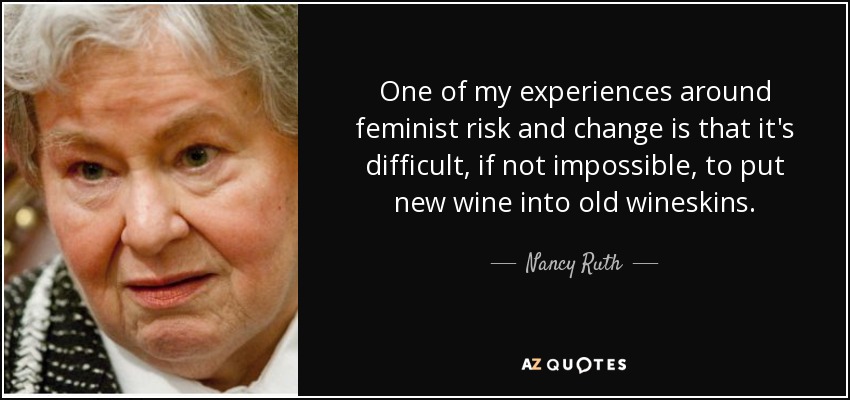
One of my experiences around feminist risk and change is that it's difficult, if not impossible, to put new wine into old wineskins.
As a woman and as a feminist, I am very well aware of how women have been oppressed and segregated for a thousand of years and I bristle at the fact in 21 century Australia women are still being kept out of public life and I'm sorry, when you wear a burqa you cannot attribute to society as much as you can without it.
We all know what feminists are. They are shrill, overly aggressive, man-hating, ball-busting, selfish, hairy, extremist, deliberately unattractive women with absolutely no sense of humor who see sexism at every turn. They make men's testicles shrivel up to the size of peas, they detest the family and think all children should be deported or drowned.
Feminists are those who cannot stand female characteristics.
I had a total revelation with the feminist moment, with Carolee Scheeman and Marina Abromovic and of course Joan Jonas; that was a big breakthrough with me. And through them, I was introduced to Chris Burden and Bruce Nauman and Vito Acconci. You can almost call it a gang, because the works are always talking together. That stuff had a huge impact on me, but other than that, my interest had always been old paintings.
In academic circles, especially, I was criticized for lacking morals, values, and ethics. I'm feeding that angry feminist reading of my work.
In those days one advantage of being a woman was that there was a basic courtesy towards us on which we could draw - something which today's feminists have largely dissipated.
I just don't know any other word than "feminist" that describes a person who believes women are people.
I just see a lot of people who are really terrified of the "f-word." A lot of women these days, a lot of young women don't want to call themselves feminists.
Creating a portrait of a female point of view in an environment that we've pretty much exclusively understood through a male perspective - "Wall Street," "Wolf of Wall Street," "Arbitrage" - etc. was beyond exciting for me. It felt downright necessary. And I felt really inspired by Alysia Reiner and Sarah Megan Thomas' agenda in telling these types of unique, feminist stories. [Both of them produced and acted in "Equity."]
Eros is a unique experience but it is not love itself. It bridges the gap between sexuality and love; it spans the chasm between two people.
Many feminists in the academy and in the major women's groups are knocking down open doors. It's 2016, not 1950. But you wouldn't know that if you looked through a typical women's studies textbook or website.
You are educated equally to boys. You're expected to go into equal employment with boys. In a marriage, you are legally equal. So, you know, you cannot deny we live in a feminist world.
There's really educated women out there who are feminists and they have read up on their stuff. They can talk to me right now, and school me on some things I've never known, and that's amazing, you are a scholar, you are wise, you are educated. But the unfortunate thing is also the reality, and the fact is, millions of people might not even know who these educated feminists are - hundreds will, thousands maybe.
I've always considered myself a feminist, I always considered myself somebody who is a reproductive rights activist, and I've spent the past 25 years of my life speaking truth to power. And using humor to do that.
No, not a feminist. I'm a humanist. I'm neither one side nor the other.
My mom wasn't, like, she was reading all these historical romance novels the majority of the time. She read a feminist book and then my dad would sit down and explain it to her like she was an idiot.
The old lessons of submissiveness and fragility made us victims. Women are so much more than that. You can be a businesswoman, a mother, an artist, and a feminist - whatever you want to be - and still be a sexual being. It's not mutually exclusive.
I'm not suggesting that all men are beautiful, vulnerable boys, but we all started out that way. What happened to us? How did we become monsters of feminist nightmares? The answer, of course, is that we underwent a careful and deliberate process of gender training, sometimes brutal, always dehumanizing, cutting away large chunks of ourselves. Little girls went through something similarly crippling. If the gender training was successful, we each ended up being half a person.
Some feminists feel that a woman should never be wrong. We have a right to be wrong.
The war gave women like her opportunities, not a feminist movement, and if the opportunities dwindled after the war, she feels that it was because women didn't want them.
Monarchs not only fashion their age, but are fashioned by it, so that they can become a sort of personification of the age. If Elizabeth I, independent, strong, represents the age of Shakespeare's heroines, a woman's heyday, Victoria represents another image of womanhood, predominant in the nineteenth century: a woman who, although queen in her own right, leaned on her husband, looked up to him, and went into perpetual mourning after his death. The feminist movement filled her with shocked horror and outrage.
[There is a] depth and urgency of the search of Jewish and Christian women for connection to the Divine, which found expression in more than 1000 years of feminist Bible criticism and religious re-visioning.
...feminism never harmed anybody unless it was some feminists. The danger is that the study and contemplation of "ourselves" may become so absorbing that it builds by slow degrees a high wall that shuts out the great world of thought.
Life is a big battle for the complete feminist.
Follow AzQuotes on Facebook, Twitter and Google+. Every day we present the best quotes! Improve yourself, find your inspiration, share with friends
or simply: