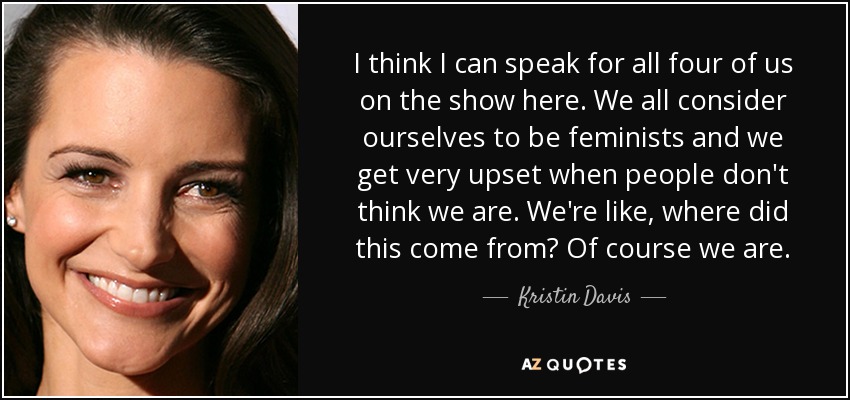
I think I can speak for all four of us on the show here. We all consider ourselves to be feminists and we get very upset when people don't think we are. We're like, where did this come from? Of course we are.
I've always wanted to be independent and answer for myself. That probably is the part of me I would class to be feminist. I'd like to have children; marriage I have a bit of an issue with.
Women have that weird way of trying to be feminist. You know, like 'hear me roar.' But what they really want is a man to open the door for them.
I've always been a strong feminist and felt that the image of models was detrimental to women. That whole thing really bothered me. I would think about quitting about once a week.
The liberal feminist movement never imagined that women would take seriously the encouragement to become our own heroes and claim life for ourselves, on our terms, no matter who we are. Pro-choice and pro-life, Christian and not, poor and rich, black, white, gay and straight. It is a dream we all hold dear, and it's called the Tea Party.
I wish that I had bridged the feminist movement and the anti-war movement better than I did.
I consider myself a rampant feminist.
I deplore the shying away that can go on, within women, from the term 'feminist.' I am, absolutely, all about being a feminist.
I'm not at all an active feminist. On the contrary, I'm a bourgeois. I love family life, I love doing the same thing every day.
I don't belong to any clubs, and I dislike club mentality of any kind, even feminism - although I do relate to the purpose and point of feminism. More in the work of older feminists, really, like Germaine Greer.
I want to put any number of assorted 'ists' - such as relativists, deconstructionists, destructivists, postmodernists, the more maudlin kind of pacifists and feminists - firmly in their place.
I do consider myself to be a feminist.
I'm not a feminist at all.
I'm a feminist, yes! Very strongly.
I think for a long time it seemed like working in an art form and being a feminist meant portraying women in a perfect, angelic light. And there's nothing feminist about that.
I call myself a feminist, not a feminist filmmaker. If somebody asked me if I had a feminist sensibility it would be pretty hard to deny, but is it the theme of my work? Not necessarily. I'm interested in a lot of things.
My first hero, as a teenager, was James Connolly. I remember discovering that he was a feminist, and that was an eye-opener, coming from a man of such poverty.
I try to be feminist in, like, I love myself and I don't need someone else's approval.
Certainly there's a huge appeal to the '60s, because it was such a big turning point to everyone. It was the era of change, the boiling point. People rebelled against things - the hippies, the feminists, the protesters. All these things just built up and boiled over. I think people can relate to that today.
Since 1996, the Feminist Majority Foundation has been immersed in a campaign to support Afghan women and girls in their fight against the brutal oppression of the Taliban.
I'm more often confronted by women who come from religious traditions and don't feel that they have a place in the feminist movement. I've felt pressure when reporters asked me, "Do you believe in God?" I do say, "No. I believe in people."
I think I was a feminist before the word was invented.
The reason I made women's issues central to American foreign policy, was not because I was a feminist, but because we know that societies are more stable if women are politically and economically empowered.
The feminist movement as at present instituted is Inadequate.
I strongly believe that no one can be a true feminist without being an atheist. All religions are anti-women. No one can be pro-woman while supporting anti-woman dogmas.
Follow AzQuotes on Facebook, Twitter and Google+. Every day we present the best quotes! Improve yourself, find your inspiration, share with friends
or simply: