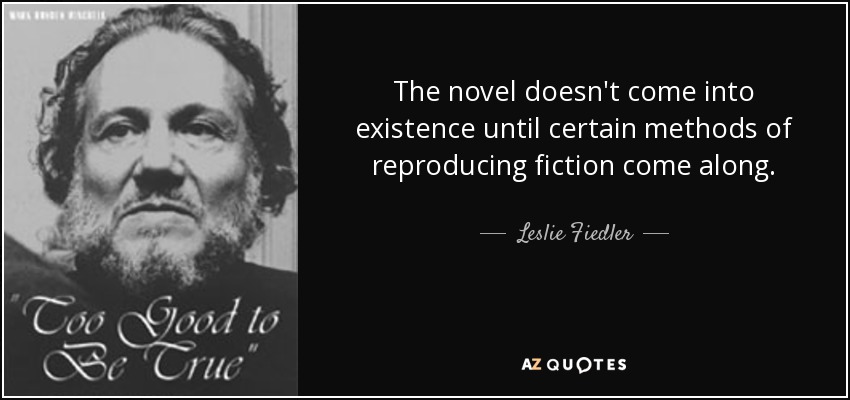
The novel doesn't come into existence until certain methods of reproducing fiction come along.
As with all other aspects of fiction, the key to writing good dialogue is honesty.
In the meantime, I just have to create those realistic goals about the fact that I don't have a ton of options as an actor who's been on a science fiction show for 8 years.
I think if I'm going to do a science fiction, I'm going to go down a new path that I want to do.
I first read science fiction in the old British Chum annual when I was about 12 years old.
I understand that postmodern literature probably means people like DeLillo, The Fiction Collective, but I don't get it that those writers are really influenced by postmodern theorists.
For after my marriage I had made various attempts to write fiction. They were clearly failures.
Science fiction is very healthy in its form.
All novels are experimental.
The idea that I'm going to have to sit down to write some fiction where I'm going to have to think of a plot would really scare me, because it would come out a mess.
You learn a lot, writing fiction.
I'm writing another novel and I know what I'm going to do after, which may be something more like this again, maybe some strange mixture of fiction and non-fiction.
Science fiction readers probably have the gene for novelty, and seem to enjoy a cascade of invention as much as a writer enjoys providing one.
As a child, I read science fiction, but from the very beginnings of my reading for pleasure, I read a lot of non-fictional history, particularly historical biography.
Against the sustained tick of a watch, fiction takes the measure of a life, a season, a look exchanged, the turning point, desire as brief as a dream, the grief and terror that after childhood we cease to express.
The older I've got the less I find myself going back and re-reading or really reading new fiction or poetry.
I don't read fiction at all.
No one was going to stop me from writing and no one had to really guide me towards science fiction. It was natural, really, that I would take that interest.
People as me how I do research for my science fiction. The answer is, I never do any research.
As you see, I bear some resentment and some scars from the years of anti-genre bigotry. My own fiction, which moves freely around among realism, magical realism, science fiction, fantasy of various kinds, historical fiction, young adult fiction, parable, and other subgenres, to the point where much of it is ungenrifiable, all got shoved into the Sci Fi wastebasket or labeled as kiddilit - subliterature.
Life is stranger than fiction. It's nice to have stuff that people don't know about. And it helps when you read a bad review. You can go, "This guy doesn't have me figured out." There's more mystery to you than they understand.
I hate the whole übermensch, superman temptation that pervades science fiction. I believe no protagonist should be so competent, so awe-inspiring, that a committee of 20 really hard-working, intelligent people couldn't do the same thing.
The symmetry of form attainable in pure fiction can not so readily be achieved in a narration essentially having less to do with fable than with fact. Truth uncompromisingly told will always have its ragged edges.
Poetry, far more than fiction, reveals the soul of humanity.
Fiction writers, at least in their braver moments, do desire the truth: to know it, speak it, serve it. But they go about it in a peculiar and devious way, which consists in inventing persons, places, and events which never did and never will exist or occur, and telling about these fictions in detail and at length and with a great deal of emotion, and then when they are done writing down this pack of lies, they say, There! That's the truth!
Follow AzQuotes on Facebook, Twitter and Google+. Every day we present the best quotes! Improve yourself, find your inspiration, share with friends
or simply: