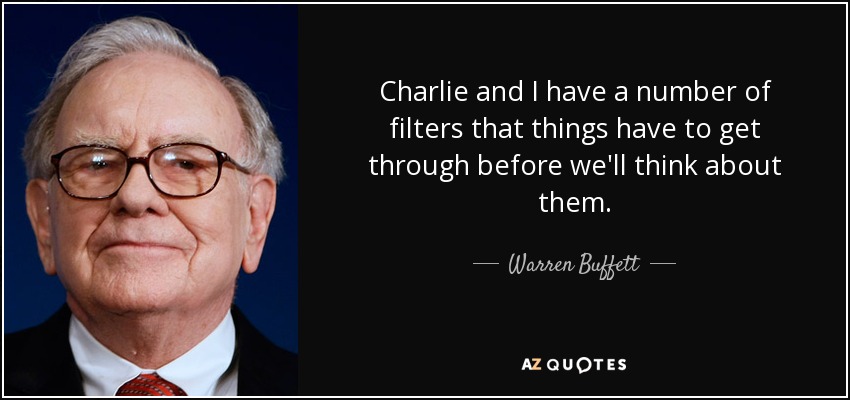
Charlie and I have a number of filters that things have to get through before we'll think about them.
I feel like I missed my era, because I remember the time when black people uplifted each other and looked for the positives. I feel sorry for the people who live their lives in the negative default setting because they filter out what's good, and that's no way to live.
Judaism calls for us to honor the rhythm of human life, the demands of the human community around us, the call of the divine order as the filter and scale for the decisions that drive our own small lives. We do not rule the universe, Judaism reminds us. God does. We are not its standard or its norms. We are only its keepers, its agents, its stewards. To do right by the universe at large is the measure of a happiness framed with the entire cosmos in mind but lived in microcosms across time.
Industrial vomit...fills our skies and seas. Pesticides and herbicides filter into our foods. Twisted automobile carcasses, aluminum cans, non-returnable glass bottles and synthetic plastics form immense middens in our midst as more and more of our detritus resists decay. We do not even begin to know what to do with our radioactive wastes - whether to pump them into the earth, shoot them into outer space, or pour them into the oceans. Our technological powers increase, but the side effects and potential hazards also escalate.
Phonogram is the memory of a long period in my life through a surprisingly small filter. Those characters are basically the golem who accompanied me on that decade and a half.
Everything in my life really filters down to the music.
Go to the east shore of any of the Hawaiian Islands, and that's a pretty big lesson on how much plastic is ending up in the ocean. Basically, the Hawaiian Islands act as a filter out in the middle of the Pacific.
If you are not grieving, you are not conscious. But if you are not rejoicing in the possibilities of how this could all change, then you are not looking through the filter of the greatest spiritual perspicacity.
At some point, when you read about this factual information that comes out in The New Zealand Herald and it's barely mentioned in The New York Times, then I think you've got to question where this is being manipulated, and where the filters are.
The filter's the best part. That's where they put the heroin.
Words also are filters. They have to be translated. Even in the original language, there is interpretation and some ambiguity. If there's a cultural difference between the writer and the reader, that might come out in words. But with pictures, there's more efficiency.
The beautiful thing about music is that even so-called negative emotions like anger, sadness, frustration, when they come through the filter of music, they all become beautiful.
The very idea that there is no truth, but only the filter of narrative through which truth is invented is something I learned at the feet of the most leftist professors at Yale and am learning again from Sarah Palin during the Vice Presidential debate, and I find that very disorienting.
When the water of a place is bad it is safest to drink none that has not been filtered through either the berry of a grape, or else a tub of malt. These are the most reliable filters yet invented.
I banned bottled water from my house - we have a water-filter system so you can drink from the tap. We always drink out of glass, and recycling is a huge deal, which everybody can partake in.
I eventually realized that direct experience is the most valuable experience I can have. Western man is so surrounded by ideas, so bombarded with opinions, concepts, and information structures of all sorts, that it becomes difficult to experience anything without the intervening filter of these structures.
Eating liver out of a cow's body is like eating the filter out of a car.
I regard myself as being the final filter so everything that ends up in the movie is there because it's something that I think was cool.
Photojournalism has become a hybrid enterprise of amateurs and professionals, along with surveillance cameras, Google Street Views, and other sources. What is underrepresented are those "metaphotographers" who can make sense of the billions of images being made and can provide context and authenticate them. We need curators to filter this overabundance more than we need new legions of photographers.
I would like to see us shake-in, instead of a shakeout, in the sense that it's true that there's a lot of junk online, and we have to filter it and so forth.
Stuffwise we are not a lean operation. We're the kind of people who, if we were deciding what absolute minimum essential items we'd need to carry in our backpacks for the final, treacherous ascent to the summit of Mount Everest, would take along aquarium filters, just in case.
The 'gatekeepers' became a term of revile. But when you think about the flow of information, I personally value immensely the calibration a news organ, whether it's on the web or in print, brings to the floodwaters of information. I haven't the time to read all the dispatches of the Associated Press, for example. It's fantastic what they put out, it's extremely good, from all over the world. I like when someone acts as a filter.
I find acting in contact lenses is bizarre to me, because there's just a giant filter between you and the world. I know it sounds painfully, ridiculously obvious, but it's true. You're just so detached.
If you've ever sang in falsetto, you know that your throat is between your voice and your mouth. In a standard voice, you sing from your belly. And when you sing in a falsetto, you're blocking that. It gives it a filter. It gives it a character. It's less revealing.
If you're a good band then the filter of the band is pretty strong.
Follow AzQuotes on Facebook, Twitter and Google+. Every day we present the best quotes! Improve yourself, find your inspiration, share with friends
or simply: