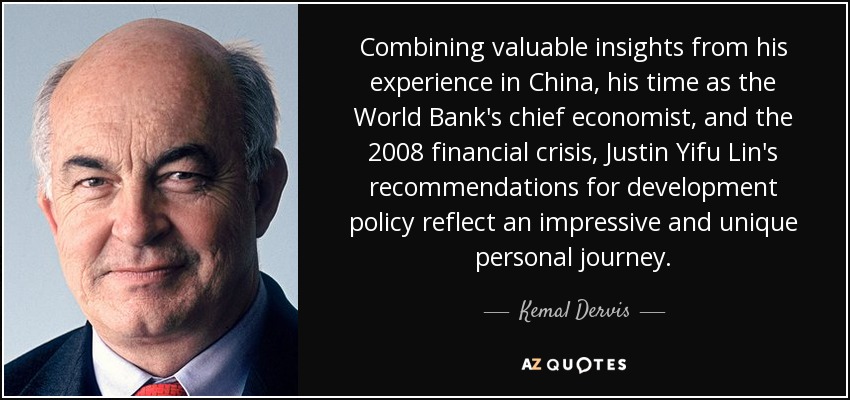
Combining valuable insights from his experience in China, his time as the World Bank's chief economist, and the 2008 financial crisis, Justin Yifu Lin's recommendations for development policy reflect an impressive and unique personal journey.
The future will be less predictable, forecast rises will shrink, company lifetimes will shrink, new entrants will proliferate and it’s going to just get more unpredictable. If you thought financial crises came and went, just count on them – another economic collapse, it’s almost going to be like not news any more. But for startups this is great, because it’s a perpetual driver of disruption.
As the United States continues its slow but steady recovery from the depths of the financial crisis, nobody actually wants a massive austerity package to shock the economy back into recession, and so the odds have always been high that the game of budgetary chicken will stop short of disaster. Looming past the cliff, however, is a deep chasm that poses a much greater challenge -- the retooling of the country's economy, society, and government necessary for the United States to perform effectively in the twenty-first century.
These two entities Fannie Mae and Freddie Mac are not facing any kind of financial crisis. The more people exaggerate these problems, the more pressure there is on these companies, the less we will see in terms of affordable housing.
The rich believe that they're different and that it is their right to pay a much lower tax rate. The response that you see from people on Wall Street, their dismissal and their almost contempt for the concerns about their culpability in the financial crisis, about the income inequality, shows that they are completely out of touch.
It's just very hard to teach a class of students about what has happened in the Global Financial Crisis, how we ended up there and how we got to where we are today, without having some basic, non-trivial understanding of the financial sector, credit, and the banking system.
The global financial crisis is a great opportunity to showcase and propagate both causal and moral institutional analysis. The crisis shows major flaws in the way the US financial system is regulated and, more importantly, in our political system, which is essentially a bazaar of legalized bribery where financial institutions can buy themselves the governmental regulations they want, along with the regulators who routinely receive lucrative jobs in the industry whose oversight had formerly been their responsibility, the so-called revolving-door practice.
In the financial system we have today, with less risk concentrated in banks, the probability of systemic financial crises may be lower than in traditional bank-centered financial systems
Edward Conard provides a provocative interpretation of the causes of the global financial crisis and the policies needed to return to rapid growth. Whether you agree or not, this analysis is well worth reading.
At present, financial crises occur, chiefly because the paper currency is redeemable in gold only.
I think we will have continuing danger from these markets and that we will have repeats of the financial crisis - [they] may differ in details but there will be significant financial downturns and disasters attributed to this regulatory gap, over and over, until we learn from experience
The Tea Party was born out of the disgust many Americans felt early in the financial crisis upon learning that the federal government was even contemplating reducing the principal on some troubled mortgages.
During the financial crisis and bailouts of 2008, it probably occurred to very few average people that we were entering a period of hardship for billionaires.
If you look at what happened, I came in the middle of the worst financial crisis since the Great Depression. And unlike Franklin Delano Roosevelt who waited, well, didn't take office until about three years into the Great Depression, it was happening just as I was elected.
Although the financial crisis, you know, receded a while ago, we kind of never picked up on it.
The President [Barack Obama], I think if you look at it from his shoes, you know, was facing a very difficult situation where he had to own Washington, tame New York, save a collapsing economy, with a collapsed financial system. He moved, I think, to a team that he felt was tried and true, in terms of dealing with financial crisis. That was his decision.
At a Texas college, a football field that was turned into a farm. The Tigers of Paul Quinn College lost more football games than they won on this field. So, years ago, when the historically black college on the South Side of Dallas was in financial crisis and had a 1 percent graduation rate, a new president turned everything over, including the football field.
We've learned our lesson with finance because they made a huge goddamn explosion that almost shut down the world. But the thing I realized is that there might never be an explosion on the scale of the financial crisis happening with big data.
I think likelier targets are [Steve] Mnuchin, the Treasury pick. When you look at his dealings during the financial crisis, that's going to be a target rich environment, and [Rex] Tillerson.
When I was in government, the South African economy was growing at 4.5% - 5%. But then came the global financial crisis of 2008/2009, and so the global economy shrunk. That hit South Africa very hard, because then the export markets shrunk, and that includes China, which has become one of the main trade partners with South Africa. Also, the slowdown in the Chinese economy affected South Africa. The result was that during that whole period, South Africa lost something like a million jobs because of external factors.
We have already seen some instances of systemic risk in recent times in the Asian financial crisis. But what sparked off the Asian financial crisis? Automated trading programmes!
For me, the Asian financial crisis of 1998 and the war in Kosovo in 1999 are the prelude to the integral accident.
Beside the two wars he inherited in Iraq and Afghanistan, and promised to end, a financial crisis at home had pushed the United States to the brink of another Great Depression. When we spoke with the new president in March of 2009, the economy was losing 800,000 jobs a month, the government was throwing hundreds of billions of dollars at failing banks, and the auto industry was on the verge of collapse. Politically pummeled from all sides, Obama did his best to keep a sense of humor.
Here's Hillary Clinton getting away with tying the Republicans to rich people. She's tying the Republican Party to Wall Street, to the big banks. She's tying the Republican Party to the financial crisis in 2008. It's all their fault. She's tying herself as with the low-income crowd - and the average, ordinary middle class American - as their champion, as their defender. They don't know that it's not the Republicans in bed with banks. They don't know that it's the banks that are practically paying for and underwriting the Democrat Party and Hillary Clinton today.
It is no exaggeration to say that rising inequality has driven many of the 99 percent into a financial ditch. It also helped spawn the housing bubble that gave us the financial crisis of 2008, the lingering effects of which have forced many OWS protesters to try to launch their careers in by far the most inhospitable labor market we've seen since the Great Depression. Even those recent graduates who manage to find jobs will suffer a lifelong penalty in reduced wages.
Follow AzQuotes on Facebook, Twitter and Google+. Every day we present the best quotes! Improve yourself, find your inspiration, share with friends
or simply: