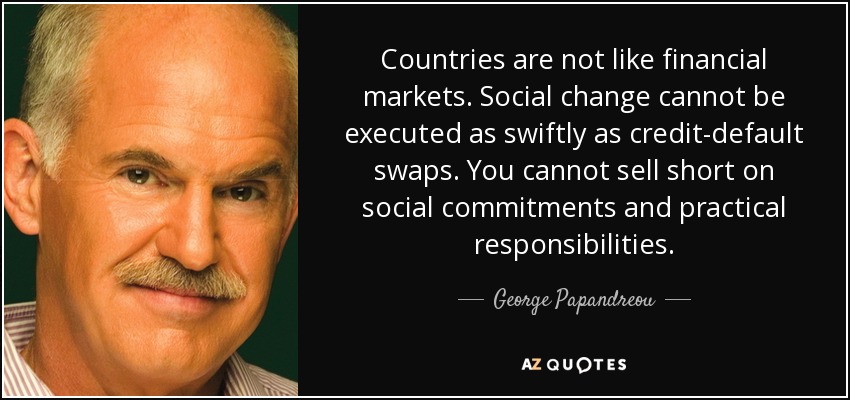
Countries are not like financial markets. Social change cannot be executed as swiftly as credit-default swaps. You cannot sell short on social commitments and practical responsibilities.
One cannot see any world leader who has got a grip on the financial markets these days. They're too big, too fast. I think that's quite scary.
The government can always rescue the markets or interfere with contract law whenever it deems convenient with little or no apparent cost. (Investors believe this now and, worse still, the government believes it as well. We are probably doomed to a lasting legacy of government tampering with financial markets and the economy, which is likely to create the mother of all moral hazards. The government is blissfully unaware of the wisdom of Friedrich Hayek: "The curious task of economics is to demonstrate to men how little they really know about what they imagine they can design.")
It seems to me that at least as far as the financial markets are concerned, there is increasing evidence against rational expectations, even at the macro level.
Developments in financial markets can have broad economic effects felt by many outside the markets.
The middle and working classes are paying the debt that the financial markets created.
As an anonymous participant in financial markets, I never had to weigh the social consequences of my actions ... I felt justified in ignoring them on the grounds that I was playing by the rules.
Do not trust financial market risk models. Despite the predilection of some analysts to model the financial markets using sophisticated mathematics, the markets are governed by behavioral science, not physical science.
A second reason why science cannot replace judgement is the behavior of financial markets.
The generally accepted theory is that financial markets tend towards equilibrium, and...discount the future correctly. I operate using a different theory, according to which financial markets cannot possibly discount the future correctly because the do not merely discount the future; they help to shape it.
Workers are on the streets today with a clear message to Europe's leaders. There is a great danger that workers are going to pay the price for the reckless speculation that took place in financial markets.
If the EU and the US can cooperate successfully on regulating financial markets, everyone else will follow.
But our system of regulation must keep up with this. If it fails to keep up, it will hold back economic expansion. We need financial market regulation that works at national and European level.
It is vital for officials and regulators to have input from people within our businesses who understand the intricacies of how financial markets operate and the consequences of certain policy decisions.
I think it could have real changing effects on the financial markets of our country, it could cause investors to think more about real rates of return and that in turn could spawn new kinds of products.
Kevin Freeman has been warning America’s leadership of the dangers of financial terrorism for the last three years. It is happening now and Kevin provides the evidence in his book Secret Weapon. Every American needs to understand how our financial markets have been manipulated by people who want to destroy the nation and how they can do even greater damage in the future. This book is a critical read for everyone.
Below, we itemize some of the quite different lessons investors seem to have learned as of late 2009 - false lessons, we believe. To not only learn but also effectively implement investment lessons requires a disciplined, often contrary, and long-term-oriented investment approach. It requires a resolute focus on risk aversion rather than maximizing immediate returns, as well as an understanding of history, a sense of financial market cycles, and, at times, extraordinary patience.
The government - the ultimate short-term-oriented player - cannot withstand much pain in the economy or the financial markets. Bailouts and rescues are likely to occur, though not with sufficient predictability for investors to comfortably take advantage. The government will take enormous risks in such interventions, especially if the expenses can be conveniently deferred to the future. Some of the price-tag is in the form of back- stops and guarantees, whose cost is almost impossible to determine.
In certain circumstances, financial markets can affect the so-called fundamentals which they are supposed to reflect. When that happens, markets enter into a state of dynamic disequilibrium and behave quite differently from what would be considered normal by the theory of efficient markets. Such boom/bust sequences do not arise very often, but when they do, they can be very disruptive, exactly because they affect the fundamentals of the economy.
But in the financial markets, without proper institutional rules, there's the law of the jungle - because there's greed! There's nothing wrong with greed, per se. It's not that people are more greedy now than they were 20 years ago. But greed has to be tempered, first, by fear of losses. So if you bail people out, there's less fear. And second, b prudential regulation and supervision to avoid certain excesses.
As value investors, our business is to buy bargains that financial market theory says do not exist. We've delivered great returns to our clients for a quarter century-a dollar invested at inception in our largest fund is now worth over 94 dollars, a 20% net compound return. We have achieved this not by incurring high risk as financial theory would suggest, but by deliberately avoiding or hedging the risks that we identified.
The insurance companies do not refer to the key policy rate when they send their statements. We can only control that rate. Long-term interest rates are determined largely by global financial markets.
The dark comes before dawn. The financial markets are under great pressure because of the lack of leadership during the transition period.
This decade is strewn with examples of bright people who thought they built a better mousetrap that could consistently extract abnormal returns from the financial markets. Some succeed for a time. But while there may occasionally be mis-configurations among market prices that allow abnormal returns, they do not persist.
The world economy is more stable than for a generation ... Our hugely sophisticated financial markets match funds with ideas better than ever before.
Follow AzQuotes on Facebook, Twitter and Google+. Every day we present the best quotes! Improve yourself, find your inspiration, share with friends
or simply: