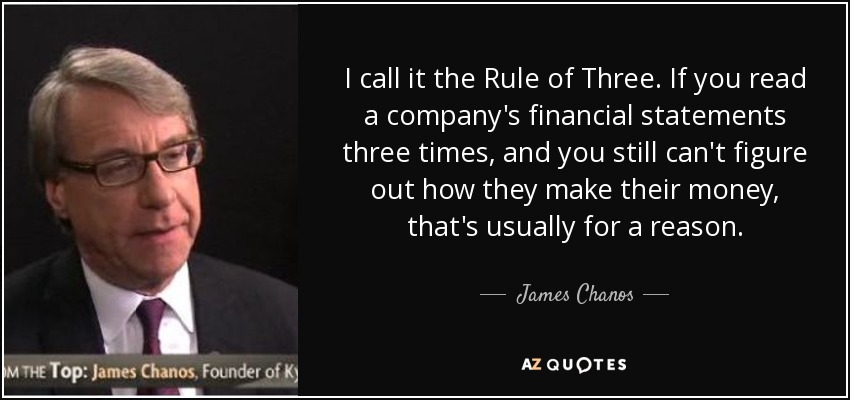
I call it the Rule of Three. If you read a company's financial statements three times, and you still can't figure out how they make their money, that's usually for a reason.
I called for a consumer protection financial bureau before it was created. And I think the best evidence that the Wall Street people at least know where I stand and where I have always stood is because they are trying to beat me in this primary.
Supporting a family and financial necessity aside, what I want is to read it and just have that feeling in your chest that you know you need to do it and you understand how you could get there, even if it scares you.
Dubai was brilliant, they looked around the world. They saw Hong Kong, Singapore, New York, Chicago, Sydney, London all ran British common law. British common law is much better for commerce than is French common law or sharia law. So they took 110 acres of Dubai soil, put British common law with a British judge in charge, and they went from an empty piece of soil to the 16th most powerful financial center in [the] world in eight years.
I don't think the idea of requiring these to be only sold to people who have already own the bonds, in other words, this naked position that the Germans have recently put into their financial regulation and has been discussed here. I don't think that makes any sense.
The government - the ultimate short-term-oriented player - cannot withstand much pain in the economy or the financial markets. Bailouts and rescues are likely to occur, though not with sufficient predictability for investors to comfortably take advantage. The government will take enormous risks in such interventions, especially if the expenses can be conveniently deferred to the future. Some of the price-tag is in the form of back- stops and guarantees, whose cost is almost impossible to determine.
None of us always make the best financial decisions.
Financial independence is about having more choices.
When large companies take on risk, then they impose risks on the rest of the system. And these are systemic risks and these systemic risks we never used to think were really that important, but as soon as we recognize how the financial sector - the risks the financial sector takes on can impact the entire global economy, we realize that those risks needed to be controlled for the social good.
People make mistakes and I'm certainly not saying Bernie Sanders did it for any kind of financial advantage. What we've got to do as Democrats - what we've got to do as Democrats is to be united to actually solve these problems. And what I believe is that I have a better track record and a better opportunity to actually get that job done.
Nowhere does it say that investors should strive to make every last dollar of potential profit; consideration of risk must never take a backseat to return. Conservative positioning entering a crisis is crucial: it enables one to maintain long-term oriented, clear thinking, and to focus on new opportunities while others are distracted or even forced to sell. Portfolio hedges must be in place before a crisis hits. One cannot reliably or affordably increase or replace hedges that are rolling off during a financial crisis.
The process of globalization has now interconnected almost everything ranging from financial markets to transport networks to communication systems in a huge system that no one really understands.
Women look at their bodies, and they're never thin enough. The financial advisors that I've talked to say they ask their clients, "How much money do you need in order to feel secure?" "X amount." Then, as soon as the client got the amount, it would double automatically.
With or without horse slaughter, horse rescues need our help and support. That can involve financial donations, volunteering, or even donating items like brushes and blankets. Horse rescues operate with little money, so every little thing you can do to help goes a long way.
I mean, we've always had gold bugs, but now we sort of realize that Treasure Bills might be in the same category. And we have derivatives like credit default swaps which are in this category, and we have derivatives like volatilities that are actually an asset class that we can invest in which are now - would out perform if we have another financial crisis.
She [Carolyn Maloney] has there day in and day out for us and for women of this country and of the world, but she also never forgets the citizens of New York, and she's been, as you know a trailblazer for 9/11, commission for, you know, the financial district, etc.
That's the problem with the financial sector. Banks and the financial sector live in the short run, not the long run. In principle the government is supposed to make regulations that help the economy over time. But once it's taken over by the financial sector, the government lives in the short run too.
Since there are a wide range of entrepreneurs fundraising at any given time, I looked at each opportunity as it has arisen and on its own merits. Then I've sat down with my financial advisers, we've looked at the numbers and gone for the businesses I believe have real potential.
Taking one step, doing one thing every day that will get you closer to your own financial dream.
The beauty of a financial institution is that there are a lot of ways to go to hell in a bucket. You can push credit too far, do a dumb acquisition, leverage yourself excessively - it's not just derivatives [that can bring about your downfall].
There are financial bankruptcies in many parts of the church. No question about that. But we see the possibility of reimagining and revitalizing the church.
The other dynamic keeping the stock market up - both for technology stocks and others - is that companies are using a lot of their income for stock buybacks and to pay out higher dividends, not make new investment,. So to the extent that companies use financial engineering rather than industrial engineering to increase the price of their stock you're going to have a bubble. But it's not considered a bubble, because the government is behind it, and it hasn't burst yet.
I think for a lot of people, the financial barrier is the biggest leap (that) you have to take. A lot of people don't want to stick their necks out and take that risk which is totally understandable. Until you are ready to totally bet on yourself and put all of your chips on the table, it doesn't happen.
She [Carolyn Maloney] understands the whole picture. She is comfortable with these issues 'cause she is chair of the committee, and she's dogged and will make sure the average woman and man is represented as well as making sure that our financial system stays afloat. In other words, she gets it and she has represented the financial district, but she also represents the average person and definitely the average woman.
All of this is happening because there has still been no reckoning post the financial crisis. So governments have fallen, one bloke has been to prison, the banks have gone pretty well back to status quo, the rich are getting richer, and the poor are getting poorer. And it's fuelling anger. And somehow [Donald] Trump, who represents the worst aspects of capitalism, has persuaded people he can deal with that.
Follow AzQuotes on Facebook, Twitter and Google+. Every day we present the best quotes! Improve yourself, find your inspiration, share with friends
or simply: