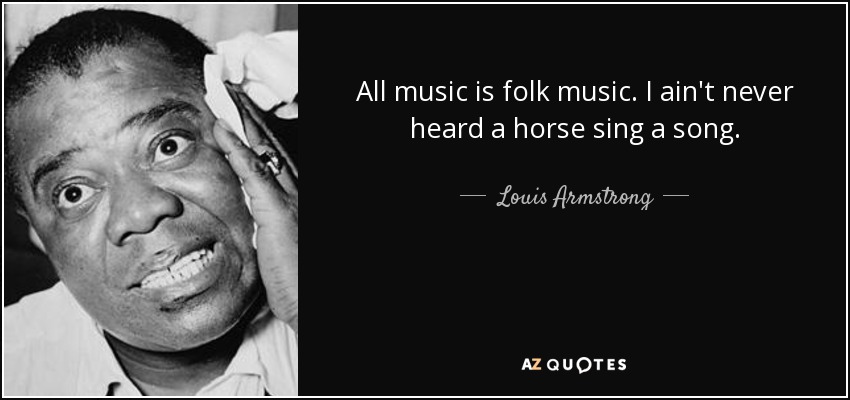
All music is folk music. I ain't never heard a horse sing a song.
If you want to understand a nation, look at its dances and listen to its folk songs - don't pay any attention to its politicians.
In a way it's the emotional feeling that you get in a good rock song or folk song, there's just nothing that rivals that.
I always knew Gordon Lightfoot was a really great songwriter, but his stuff even sounds better and better all the time. It's just so really good to me. It's just like that's what should be in a dictionary, you know, next to a really good contempory folk song, is a Gordon Lightfoot song.
When I do older folk songs, I'm not doing them because they're old. I have no interest in reviving or continuing a tradition. I'm just doing them because they're great songs.
A folk song is what's wrong and how to fix it or it could be who's hungry and where their mouth is or who's out of work and where the job is or who's broke and where the money is or who's carrying a gun and where the peace is.
We are the folk song army, every one of us cares. We all hate poverty, war, and injustice unlike the rest of you squares.
He [Alan Lomax] started right off trying to find people who could introduce folk songs to city people. He found a young actor named Burl Ives and said, "Burl, you know a lot of great country songs learned from your grandmother, don't you know people would love to hear them?" He put on radio programs. He persuaded CBS to dedicate "The School of the Air" for one year to American folk music. He'd get some old sailor to sing an old sea shanty with a cracked voice. Then he'd get me to sing it with my banjo.
The term 'popular culture' always used to mean what the people do - pop songs, folk songs, music in general used to live because people would sing these songs and tell these stories together. Then all of these new technologies came out and it became the work of professionals.
Alan Lomax is the person who I think should be given major credit for what has been called the "Folk Song Revival." My father participated with him because my father was a musicologist and urged trained musicians to learn about "the vernacular."
A professional entertainer who allows himself to become known as a singer of folk songs is bound to have trouble with his conscience provided, of course, that he possesses one. As a performing artist, he will pride himself on timing and other techniques designed to keep the audience in his control ... his respect for genuine folklore reminds him that these changes, and these techniques, may give the audience a false picture of folk music.
But in my imagination this whole thing developed and I started mixing up old folk songs with the Beatles beat and taking them down to Greenwich Village and playing them for the people there.
The whole trouble with a folk song is that once you have played it through there is nothing much you can do except play it over again and play it rather louder. Most Russian music, indeed, consists in ringing changes on this device, skilfully disguised though the fact may be.
I was working for Alan Lomax in the Library of Congress folk song archive, and starting to realize what a wealth of different kinds of music there was in this country that you never heard on the radio.
My dad took me for an audition once, to show me, OK, you want to be a child actor, this is what its like. I sang a folk song about donkeys on this West End stage with this big director, and there was a queue of 200 girls all singing Memory. I was terrible. Terrible.
If it was never new and it never gets old, then it's a folk song
The chief contribution made by white men of the Americas to the folk songs of the world ——- the cowboy songs of Texas and the West ——- are rhythmed to the walk, the trot, and the gallop of horses.
We had various kinds of tape-recorded concerts and popular music. But by the end of the flight what we listened to most was Russian folk songs. We also had recordings of nature sounds: thunder, rain, the singing of birds. We switched them on most frequently of all, and we never grew tired of them. It was as if they returned us to Earth.
There are no bridges in folk songs because the peasants died building them.
Gershwin's melodic gift was phenomenal. His songs contain the essence of New York in the 1920s and have deservedly become classics of their kind, part of the 20th-century folk-song tradition in the sense that they are popular music which has been spread by oral tradition (for many must have sung a Gershwin song without having any idea who wrote it).
Robert Burns enriched Scottish song with his genius and is mainly responsible for the rich treasure house of song that we enjoy today. He collected folk songs, retained the melodic line, kept what words were usable and rewrote the rest. He didn't claim ownership.
I am a firm believer in playing the type of music that compliments the song the best. If it's a folk song make it sound like one. If it's a rock song make it sound like one, if it's a rap song take it off the record.
some genius of the South With blood-hot eyes and cane-lipped scented mouth, Surprised in making folk-songs from soul sounds.
Folk songs are evasive-the truth about life, and life is more or less a lie, but then again that's exactly the way we want it to be. We wouldn't be comfortable with it any other way. A folk song has over a thousand faces and you must meet them all if you want to play this stuff. A folk song might vary in meaning and it might not appear the same from one moment to the next. It depends on who's playing and who's listening.
My older brother was involved in the folk movement. We would gather every weekend in Washington Park. The folk songs were so important to my reality.
Follow AzQuotes on Facebook, Twitter and Google+. Every day we present the best quotes! Improve yourself, find your inspiration, share with friends
or simply: