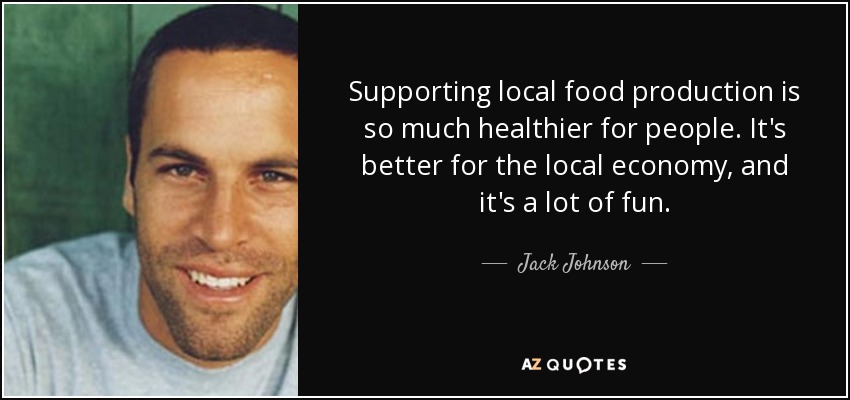
Supporting local food production is so much healthier for people. It's better for the local economy, and it's a lot of fun.
To be interested in food but not in food production is clearly absurd.
We wouldn't think of going to our doctor and saying 'Treat me the way doctors treated people in the 19th Century', and yet that's what we're demanding in food production.
The only truly dependable production technologies are those that are sustainable over the long term. By that very definition, they must avoid erosion, pollution, environmental degradation, and resource waste. Any rational food-production system will emphasize the well-being of the soil-air-water biosphere, the creatures which inhabit it, and the human beings who depend upon it.
There can be no permanent progress in the battle against hunger until the agencies that fight for increased food production and those that fight for population control unite in a common effort.
If we do not change our negative habits toward climate change, we can count on worldwide disruptions in food production, resulting in mass migration, refugee crises and increased conflict over scarce natural resources like water and farm land. This is a recipe for major security problems.
Increasing food production to feed an increased population results in yet another increase in population.
With climate change and health crises rightfully receiving international attention, the time has come to focus on hunger as a top priority. WHO regards hunger and malnutrition as the gravest threat to public health, and climate change threatens to further destabilise already fragile food-production systems.
It's a moral imperative, it's an economic imperative, and it is a security imperative. For we've seen how spikes in food prices can plunge millions into poverty, which, in turn, can spark riots that cost lives, and can lead to instability. And this danger will only grow if a surging global population isn't matched by surging food production. So reducing malnutrition and hunger around the world advances international peace and security - and that includes the national security of the United States.
Anybody interested in solving, rather than profiting from, the problems of food production and distribution will see that in the long run the safest food supply is a local food supply, not a supply that is dependent on a global economy. Nations and regions within nations must be left free and should be encouraged to develop the local food economies that best suit local needs and local conditions.
From the standpoint of food production, storage, handling, and the Lord's counsel, wheat should have high priority. Water, of course, is essential. Other basics could include honey or sugar, legumes, milk products or substitutes, and salt or its equivalent.
Global food insecurity is increasing...the slim excess of growth in food production over population is narrowing.
Permaculture offers a radical approach to food production and urban renewal, water, energy and pollution. It integrates ecology, landscape, organic gardening, architecture and agro-forestry in creating a rich and sustainable way of living. It uses appropriate technology giving high yields for low energy inputs, achieving a resource of great diversity and stability. The design principles are equally applicable to both urban and rural dwellers
Forced to choose between limiting population or trying to increase food production, we chose the latter and ended up with starvation, warfare, and tyranny.
The international community must offer short-term emergency measures to meet critical needs. But it must also make longer-term investments to promote food production and agricultural development, enhance food security and maintain and accelerate momentum towards the MDGs.
Switching to all organic food production is the single most critical (and most doable) action we can take right now to stop our climate crisis.
We also call for a healthy food system that prioritizes sustainable healthy local food production.
Rising oil prices have focused the world's attention on the depletion of oil reserves. But the depletion of underground water resources from overpumping is a far more serious issue. Excessive pumping for irrigation to satisfy food needs today almost guarantees a decline in food production tomorrow.
Climate change will affect the basic elements of life for people around the world - access to water, food production, health, and the environment. Hundreds of millions of people could suffer hunger, water shortages and coastal flooding as the world warms.
I believe we can create a truly humane, sustainable, and health food production system without killing any animals. I imagine a revolution in veganic agriculture in which small farmers grow a variety of vegetables, fruits, grains, and legumes, all fertilized with vegetable sources.
I was concerned with something like the notion of 'language speaking the subject,' and with the transformation of the woman herself into a sign in a system of signs that represent a system of food production, a system of harnessed subjectivity.
I think it’s the right moment to talk about it because it is part of a revolutionary perspective - how can we not only discover more compassionate relations with human beings but how can we develop compassionate relations with the other creatures with whom we share this planet and that would mean challenging the whole capitalist industrial form of food production.
We are living as if we had three planets' worth of resources to live with rather than just one. We need to cut by about two-thirds our ecological footprint. For that we need one planet farming as well as one planet living - one planet farming which minimises the impact on the environment of food production and consumption, and which maximises its contribution to renewal of the natural environment
We might hope that the law as a profession does not vanish, because justice may vanish with it - but we could probably do with far fewer lawyers. Since I think agriculture will come back closer to the center of life, I think there will be many vocational opportunities there - especially with the so-called 'value-added' activities associated with food production. That's a windy way to say more local wine and cheese-makers - and probably fewer giant factories producing cheez doodles and Pepsi Cola.
Urban conservationists may feel entitled to be unconcerned about food production because they are not farmers. But they can't be let off so easily, for they are all farming by proxy.
Follow AzQuotes on Facebook, Twitter and Google+. Every day we present the best quotes! Improve yourself, find your inspiration, share with friends
or simply: