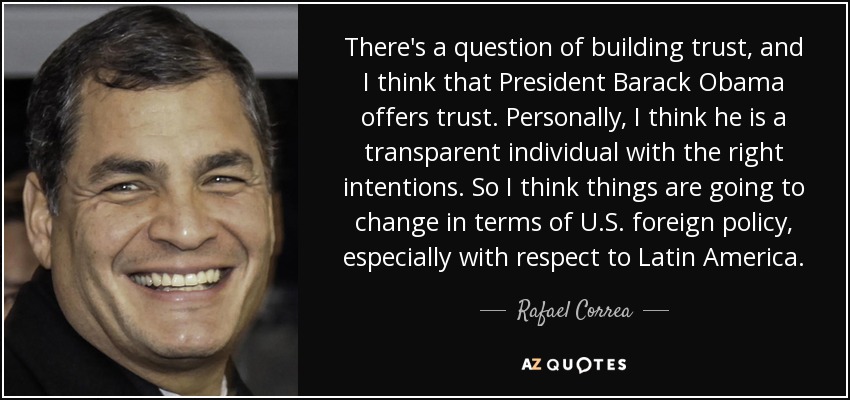
There's a question of building trust, and I think that President Barack Obama offers trust. Personally, I think he is a transparent individual with the right intentions. So I think things are going to change in terms of U.S. foreign policy, especially with respect to Latin America.
The military sensed weakness, exploited it and played Barack Obama. Obama's foreign policy has been consistently hawkish despite this reluctant warrior schtick that he pulls. But at the end of the day a reluctant warrior is still a warrior. Look at the drone strikes, the tripling of the war in Afghanistan, and now Libya. I'm convinced that had Obama been in the Senate in 2003 he would have voted for the Iraq war. He's clearly easily convinced by his advisers and the Pentagon.
As the wealthiest country with all the blessings that we have, do we have an obligation to help the outside world? I think we do, as we have an obligation to help everyone within our own borders. The problem is that this automatically gets translated into: "What's the point of having a huge military if we can't bomb people?" That's the problem that I have. Our foreign policy is essentially our defense policy.
Russia, despite its heavy flirtation with capitalism and some quite unsavory oligarchs, is still building its foreign policy on the Soviet ideals of internationalism, solidarity and logic. And even domestically, President [Vladin]Putin is slowly, step-by-step, restoring many important Soviet achievements that were torpedoed by a nitwit, and one gangster - [Mikhail] Gorbachev and [Boris] Yeltsin.
What often happens with these Islamist regimes, there are differing philosophies in terms of how fast to go in getting to where everybody wants to end up, which is Sharia. That is the ultimate objective for all of these places. But they have different strategies on the speed with which they’re going to get there, and the strategies involve foreign policy.
We need to recognize that although terrorism is real, there are many other dangers out there. And terrorism should not be the only driver or necessarily the leading driver of our foreign policy and especially of our domestic politics.
They [Republican voters] believe in a foreign policy that puts America first: Give me a break. And so a lot of our drift within our party has gotten away from that.
Donald Trump foreign policy speech got good reviews, and it says we're going to defeat the people who are direct threats to us, but we're going to be a lot more cautious about getting involved in long-term, Wilsonian adventures.
Kissinger-type foreign policy is clearly, in my view, the proper tilt for us in the future, and he [Donald Trump] gets it. And some of our members, I guess, have been so deeply committed to the [George W.] Bush agenda, the neo-conservative agenda, that it's harder for them to acknowledge that. But I acknowledge it.
I liked Donald's Trump speech on foreign policy. What he's showing is that his fundamental views are solid, and that there's an intellectual basis for this, an economic basis for what he's saying, and that can lead him to victory.
I went to a girls high school and I went to a women's college and when I first started teaching at Georgetown it had been a single sex school and so they wanted to have some women professors when they went co-ed, and so I originally was hired to start a program there, and really encourage women to go into foreign policy. I always have done that, and I really do think that things are better when women are involved.
I travel a lot on foreign policy, as you know. I'm in Europe a lot. I travelled over a million miles as vice president. They didn't do stimulus. Look where they are. Come on. I mean, this is like, I just get so frustrated. Like come on.
I didn't have a perfect model, but I wanted to try to blend my own personal reflections and experiences with this broader canvas to see how a lot of the narratives we have about economy and foreign policy got stuck. Because we have these categories of liberal, conservative, free marketer, open government - all these stereotypes about our politics and the categories we try to put things in are inadequate to this sort of complex, ambiguous, sometimes contradictory experience we have as ordinary people and that I have as an elected official.
Since populists never miss an opportunity to create a lot of noise about anti-Europe stance. However, the repercussions of the British referendum could quickly put a stop to such crass rabble-rousing, as it should soon become clear that the UK was better off inside the EU - economically, socially and in foreign policy terms.
The organizing principle of the United States defensive foreign policy had been opposition to the Soviet Union. There is no more Soviet Union.
My view always is that we should learn the lessons, both of the last sort of 50 years of policy-making and it is possible to get to a foreign policy that is engaged and active without going back to where we were in the post-9/11 world.
I think, there is a possibility - I would say it's more than that - that we will come to a view of foreign policy going forward that learns from the past but doesn't get captured by it.
The only way you can be comfortable about Donald Trump's foreign policy, is to think he doesn't really mean anything he says.
The point is that in any country, including the United States, may be in the United States even more often than in any other country, foreign policy is used for internal political struggle.
I firmly believe that the reputation of any country which is capable of defending the life and dignity of its citizens, and can conduct independent foreign policy will only improve in mid- and long-term perspective.
The reputation of those countries which cater to the foreign policy interests of other states at the expense of their own national interests will go down regardless of how they explain their actions.
If European countries want to cater to U.S. foreign policy interests, I don't think that they stand to gain anything.
I have criticized foreign policy, but that does not mean that we should agree with everything. Indeed, we criticize a lot of things, we think that our partners make many mistakes [may be we make mistakes too, no one is immune to making mistakes], but as for the economy, I repeat that, in my opinion, the European Commission and the leading European economies are acting very pragmatically and are on the right path.
I believe that the G20 should not interfere [foreign policy], because there are other platforms for that.
We're in a mess in America, and it's because of what you think. We're in a mess because of your party. We're in a mess, Mrs. Clinton, because you've been there. You were responsible for this economy. You're responsible our foreign policy. You're responsible for the massive illegal immigration.
Follow AzQuotes on Facebook, Twitter and Google+. Every day we present the best quotes! Improve yourself, find your inspiration, share with friends
or simply: