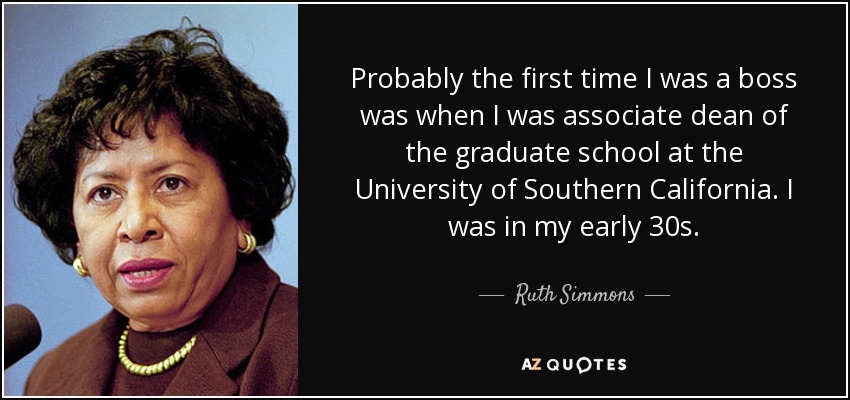
Probably the first time I was a boss was when I was associate dean of the graduate school at the University of Southern California. I was in my early 30s.
You don't go to school to become the best chef in the world right after you graduate. School is always a starting point so what people forget is that you go to school to build a foundation, and you want to build a foundation that's not going to crumble.
In a lot of ways, work was my graduate school.
Talking to all those great writers and artists for the magazine was a form of graduate school for me.
When I was in graduate school in consumer science and math, all of the big companies had labs, all doing blue sky research.
The main purpose of advertising is to undermine markets. If you go to graduate school and you take a course in economics, you learn that markets are systems in which informed consumers make rational choices. That's what's so wonderful about it. But that's the last thing that the state corporate system wants. It is spending huge sums to prevent that.
All I really need to know about how to live and what to do and how to be, I learned in kindergarten. Wisdom was not at the top of the graduate-school mountain, but there in the sand pile at Sunday School.
The venerable emeritus professors still at Yale when I entered graduate school [in the 1960s] may have been reserved, puritanical WASPs, but they were men of honor who had given their lives to scholarship. Today in the elite schools, honor and ethics are gone.
Through high school, college, graduate school and beyond, I had a number of relationships that were wonderful.
In poetry, and in my study in graduate school, I was drawn to a particular poet, Theodore Roethke. I did a dissertation on "The Evolution of Matter and Spirit in the Poetry of Theodore Roethke" for my Ph.D.
In the advanced practice, the relationship between the Zen master and the student becomes very terse. The Zen master will expect things of the student because the student is in graduate school.
Most of my training at graduate school was geared towards drama, so I feel good about it, and I can do it, but it requires a lot more work from me. I feel like with drama... well, with all acting, really, you need to honor the truth of the situation.
I did ... learn an important distinction in graduate school: a speculation about who had syphilis when is gossip if it's about your friends, a plot element if it's about a character in a novel, and scholarship if it's about John Keats.
I am quite international. My background, born in Turkey. My family is a Jewish family from Iran, so I went from Turkey to Iran to Israel, and then grew up in Italy and ended up in U.S. for graduate school. So I tend to look at things from an international perspective, and I think that gives you a little bit of a broader view of what's going on.
When I turned fifty, I decided to quit the mill and go to graduate school.
Graduate school is a really supportive environment, but in a way, it was only when that support vanished that I flourished.
When I was in graduate school in Princeton, I was told to take three courses. One of them to work on really hard, another to work on moderately hard, and the third one just to absorb. In my case, I never showed up to the latter class, taught by Robert Gunning, on Several Complex Variables. Several Complex Variables (Cn) was starting to get vary fashionable then, but I decided to specialize in n=1/2.
Sure, some [teachers] could give the standard limit definitions, but they [the students] clearly did not understand the definitions - and it would be a remarkable student who did, since it took mathematicians a couple of thousand years to sort out the notion of a limit, and I think most of us who call ourselves professional mathematicians really only understand it when we start to teach the stuff, either in graduate school or beyond.
The most important steps that I followed were studying math and science in school. I was always interested in physics and astronomy and chemistry and I continued to study those subjects through high school and college on into graduate school. That's what prepared me for being an astronaut; it actually gave me the qualifications to be selected to be an astronaut.
Over the past decade I have watched many friends go through graduate school and write dissertations. Through that process, I have seen how they are guided by mentors to understand particular norms within their disciplines and to learn about what they can and cannot, should and should not say, and which ideas can go together and which cannot. I never went through this process.
I did not intend to be a writer. I first wanted to be a lawyer, like my father. Then I got bit by the bug of philosophy and wanted to be a philosophy professor. I went to graduate school and quickly discovered it was impossible for a woman in those days - this was the early fifties - to be a philosopher, so I gave that up.
Too many Christians are fighting graduate school sins with a grammar school knowledge of God.
I decided early in graduate school that I needed to do something about my moods. It quickly came down to a choice between seeing a psychiatrist or buying a horse. Since almost everyone I knew was seeing a psychiatrist, and since I had an absolute belief that I should be able to handle my own problems, I naturally bought a horse.
'One Hundred Years of Solitude' convinced me to drop out of Harvard graduate school. The novel reminded me of everything my Ph.D. program was trying to make me forget. Thank you, Gabriel Garcia Marquez.
Follow AzQuotes on Facebook, Twitter and Google+. Every day we present the best quotes! Improve yourself, find your inspiration, share with friends
or simply: