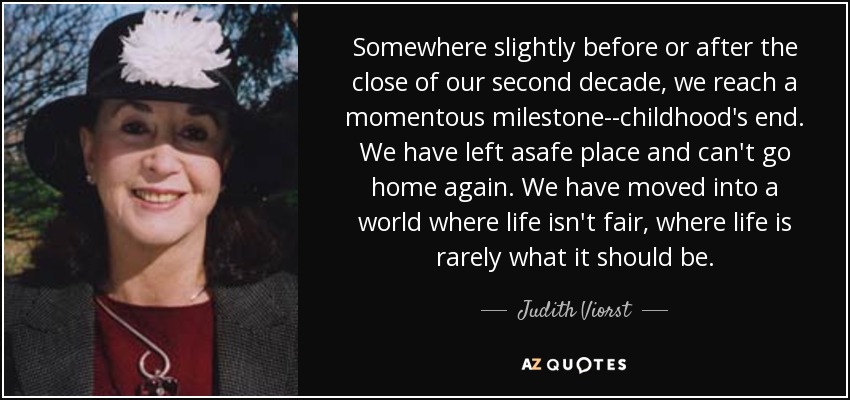
Somewhere slightly before or after the close of our second decade, we reach a momentous milestone--childhood's end. We have left asafe place and can't go home again. We have moved into a world where life isn't fair, where life is rarely what it should be.
Some children have the most disagreeable way of getting grown-up
Our ego ideal is precious to us because it repairs a loss of our earlier childhood, the loss of our image of self as perfect and whole, the loss of a major portion of our infantile, limitless, ain't-I-wonderful narcissism which we had to give up in the face of compelling reality. Modified and reshaped into ethical goals and moral standards and a vision of what at our finest we might be, our dream of perfection lives on--our lost narcissism lives on--in our ego ideal.
... God allows the wheat and the tares to grow up together, andthe tares frequently get the start of the wheat and kill it out. The only difference between the wheat and human beings is that the latter have intellect and ought to combine and pull out the tares, root and branch.
We must be willing to change chairs if we want to grow. There is no permanent compatibility between a chair and a person. And there is no one right chair. What is right at one stage may be restricting at another or too soft. During the passage from one stage to another, we will be between two chairs. Wobbling no doubt, but developing.
Every little kid wants to grow up to be a cowboy, and I did.
Most parents of adolescent girls have the goal of keeping their daughters safe while they grow up and explore the world. The parents' job is to protect, the daughter's job is to explore.
We never really are the adults we pretend to be. We wear the mask and perhaps the clothes and posture of grown-ups, but inside ourskin we are never as wise or as sure or as strong as we want to convince ourselves and others we are. We may fool all the rest of the people all of the time, but we never fool our parents. They can see behind the mask of adulthood. To her mommy and daddy, the empress never has on any clothes--and knows it.
The child who would be an adult must give up any lingering childlike sense of parental power, either the magical ability to solveyour problems for you or the dreaded ability to make you turn back into a child. When you are no longer hiding from your parents, or clinging to them, and can accept them as fellow human beings, then they may do the same for you.
Extreme patience and persistence are required, Yet everybody succeeds at this before being handed The surprise box lunch of the rest of his life.
The goal in raising one's child is to enable him, first, to discover who he wants to be, and then to become a person who can be satisfied with himself and his way of life. Eventually he ought to be able to do in his life whatever seems important, desirable, and worthwhile to him to do; to develop relations with other people that are constructive, satisfying, mutually enriching; and to bear up well under the stresses and hardships he will unavoidably encounter during his life.
I played soccer growing up, and then high school came along and the football coach came out one day and was like, 'Hey, do you want to kick for us?' I was like, 'Sure, I'll come out and kick one day.' I got moved up to varsity and that's how the story began.
The roots of a child's ability to cope and thrive, regardless of circumstance, lie in that child's having had at least a small, safe place (an apartment? a room? a lap?) in which, in the companionship of a loving person, that child could discover that he or she was lovable and capable of loving in return. If a child finds this during the first years of life, he or she can grow up to be a competent, healthy person.
For me, heaven would be a lack of alienation. The whole time I was growing up, I felt comfort was inherently evil. I think that for me heaven isn't about couches and milk shakes and never having a troubling thought again.
All in all, the communally reared children of Israel are far from the emotional disasters that psychoanalytic theory predicted. Neither have they been saved from all personality problems, as the founders of the kibbutz movement had hoped when they freed children from their parents. In any reasonable environment, children seem to grow up to be themselves. There is no evidence that communal rearing with stimulating, caring adults is either the ruination or the salvation of children.
There is more danger of numerical sequences continued indefinitely than of trees growing up to heaven. Each will some time reach its greatest height.
Most people don't grow up. It's too damn difficult. What happens is most people get older.
Belonging to a group can provide the child with a variety of resources that an individual friendship often cannot--a sense of collective participation, experience with organizational roles, and group support in the enterprise of growing up. Groups also pose for the child some of the most acute problems of social life--of inclusion and exclusion, conformity and independence.
I loved growing up in Canada. It’s a great place to grow up, because - well, at least where I grew up -it’s very multicultural. There’s also good health care and a good education system.
When I was growing up in the mid-'50s, the Roaring Twenties were a huge part of the culture. There were a number of films and a bunch of television shows that dealt with the mythology of the underworld from that period.
Growing up in Middlesbrough [in England], I listened to artists like Chuck Berry, Little Richard, and Howlin' Wolf. It was like another world. Something happened to me when I heard that music. It leapt out of the speakers and went straight into my heart. And I thought, "Right, that's what I'm doing."
I've been very lucky to have a family who has welcomed me and not been hung up on anything racial, almost overlooking the fact that there was a racial difference. But I can honestly say I do feel like I missed out on some lessons of what the African-American experience is like growing up.
Grief diminishes when it has nothing to grow upon.
I'm not religious. It's an issue, 'cause I've got two little kids, and I feel you can't grow up without knowledge of religion.
I've definitely been in relationships with friends where I wanted to do something different than I know a friend has. It's that complicated balance between wanting to do what you know is right for you and not wanting to hurt someone's feelings. I think that's a part of growing up.
Follow AzQuotes on Facebook, Twitter and Google+. Every day we present the best quotes! Improve yourself, find your inspiration, share with friends
or simply: