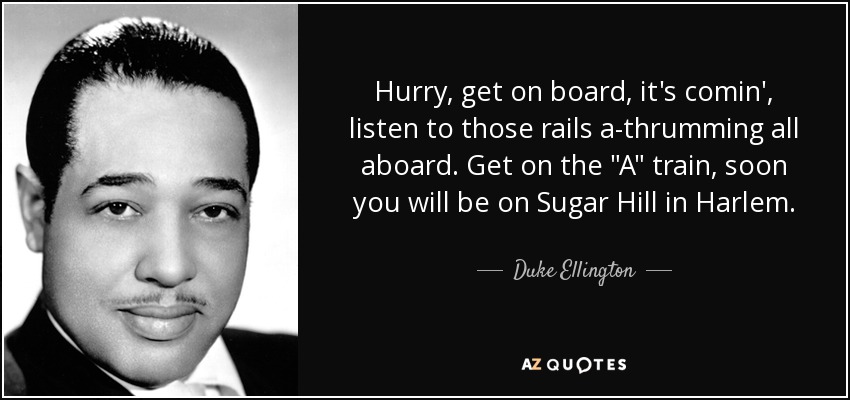
Hurry, get on board, it's comin', listen to those rails a-thrumming all aboard. Get on the "A" train, soon you will be on Sugar Hill in Harlem.
I am particularly conscious of my connection to the poets of the Harlem Renaissance because I, too, am a Black poet, born into, and shaped by, the very community in which those poets of the past produced so much of the work we associate with the Harlem Renaissance. We speak from the same place, both literally and metaphorically.
The world has white people and black people in it. Even in Harlem.
My peers at the time: you know, young black kids from off the streets of Harlem, having these conversations with me in my small, dirty little studio up in Harlem.
The police can go to downtown Harlem and pick up a kid with a joint in the streets. But they can't go into the elegant apartments and get a stockbroker who's sniffing cocaine.
I started reading. I read everything I could get my hands on...By the time I was thirteen I had read myself out of Harlem. I had read every book in two libraries and had a card for the Forty-Second Street branch.
We both grew up in the atmosphere of struggle, both Ossie and me, ... I come out of Harlem and Harlem comes out of me - wailing police sirens and street parties, rumors and landlords, that cultural, spiritual scene. And Ossie came up from the South, where struggle and dying were part of everyday life. That is who we are.
Old New York City is a friendly old town From Washington Heights to Harlem on down There's a-mighty many people all millin' all around They'll kick you when you're up and knock you when you're down It's hard times in the city Livin' down in New York town
I don't write police stories, per se, but I usually write about areas that are very panoramic, like Harlem, or the Lower East Side, or a small urban city like Jersey City.
A long time ago, I took a walk down a street in Harlem in New York City. I came upon a man who asked me for a dollar. He had asked a few other people before me, but they only passed him by without glancing his way. I stopped and handed the man some money. As I began to turn away, he reached out and shook my hand. He looked me in the eyes and said, "I will bless you." Now, I'm not saying that was God Himself. But how do we know that it wasn't someone working for him, walking around in disguise, just to see what we would do?
You can never tell what's in a woman's mind, And if she's from Harlem, there's no use o' tryin
The thing that surprised me the most is just how much money women that weren't rich were paying for their hair. When you're in a beauty parlor in Harlem next to abandoned buildings and somebody's paying five grand for a weave, that's a bit much. I think this is, in a weird way, part of the health care debate. It's like, hmm, there's people with $2000 weaves that could have bought health care with that weave money.
The one thing you'll notice when you're walking through Harlem is every single passing car is playing different music and there's also music that's being played out of windows.
When you look at Harlem - and I lived there almost five years - most of the people who live in Harlem are transplants. They migrate to Harlem from another place. A lot of them are from the south, so they bring those southern influences with them.
In my neighborhood - West 121st Street in New York, "white Harlem" - there were only two drugs: smack and marijuana. By the time I was 13, some friends and I were using marijuana fairly regularly. The Reefer Madness myth was still very strong then, but I'd been into jazz and those lyrics included so many casual references to pot that it was completely demystified for me.
The best of humanity's recorded history is a creative balance between horrors endured and victories achieved, and so it was during the Harlem Renaissance.
You see a lot of Baptist churches in Harlem, you see a lot of the same kind of cuisine, the soul food - there's a lot of places that remind you of its southern roots.
I'm not going to let Donald Trump take away from our community, something that Fannie Lou Hamer shed blood to give us. Something that Ella Jo Baker braved conditions in the South and sweatshops in Harlem to give us.
I am grateful to have been loved and to be loved now and to be able to love, because that liberates. Love liberates. It doesn't just hold - that's ego. Love liberates. It doesn't bind. Love says, 'I love you. I love you if you're in China. I love you if you're across town. I love you if you're in Harlem. I love you. I would like to be near you. I'd like to have your arms around me. I'd like to hear your voice in my ear. But that's not possible now, so I love you. Go.'
The other day I went to a school in Harlem to talk to some 7th graders [12-year-olds] and I said, ‘If I have to give you some advice, the most important thing is: the sooner you become your own best friend, the better your life will be,’
What do we call our Harlem Renaissance? Maybe in the future, it won't be just Latino, maybe it'll be more multi-multi, because, you know, people are such fusions now, of so many different cultures.
I grew up in Harlem, but I moved to the Lower East Side when I was a teenager and it was ... I feel like when I try to describe it, it doesn't sound believable. It just sounds like you're lying. And I see it on the faces of my younger friends.
I began working within the streets of Harlem, where, after graduating from Yale [University, New Haven, CT], I became the artist in residence at the Studio Museum in Harlem [New York, NY]. I wanted to know what that was about. I would actually pull people from off of the streets and ask them to come to my studio.
Here - at this final hour, Harlem has come to bid farewell to one of its brightest hopes - extinguished now, and gone from us forever.... Many will ask what Harlem finds to honor in this stormy, controversial and bold young captain - and we will smile. ...We will answer and say unto them, ‘Did you ever talk to Brother Malcolm? Did you ever really listen to him? ...For if you did you would know him. And if you knew him you would know why we must honor him.'
When I went to the Studio Museum in Harlem, there was a type of freedom that existed where I didn't have to think about professors, where I didn't have to think about much of anything other than my own practice.
Follow AzQuotes on Facebook, Twitter and Google+. Every day we present the best quotes! Improve yourself, find your inspiration, share with friends
or simply: