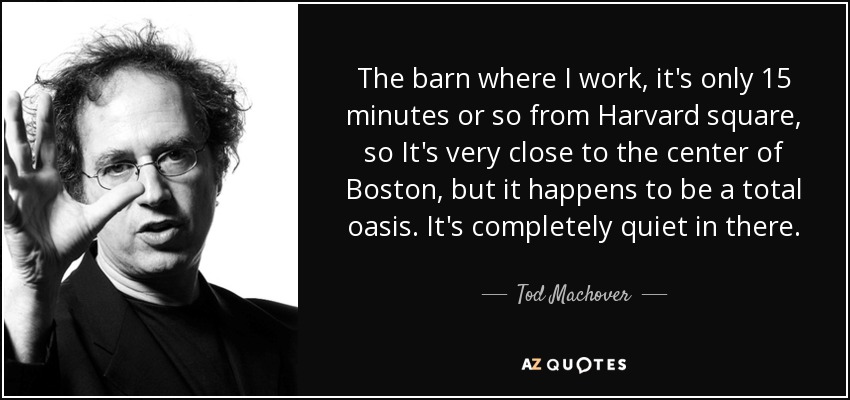
The barn where I work, it's only 15 minutes or so from Harvard square, so It's very close to the center of Boston, but it happens to be a total oasis. It's completely quiet in there.
We don't like to talk about that in America, but there are classes in America. And she [Julia Child] was of a class of women who were wealthy, privately educated, went to Smith, moved in that sort of circle. She was conscripted into the OSS, which is the early CIA, which was all filled with Yalies and Princeton and Harvard people and a few women who were typing mostly but also had something to do.
As Harvard developmental psychologist Robert Kegan, who has studied Bridgewater, says, in most work places everyone is working two jobs. The first is whatever their actual job is; the second consists of managing others' impressions of them, especially by hiding weaknesses and inadequacies - which is an enormous waste of energy.
The tyranny of Harvard and Yale is another thing that transcends this problem of the set point. But what's so striking about [Louis] Brandeis is he had this vision of cultural pluralism that completely gave the lie to the idea that there was any inconsistency between being Jewish or being a woman or being African American and being fully American.
In medicine, we have invented an entirely new healing paradigm. Now we no longer simply look to the doctor and to medicine to heal us. We now recognize what has been substantiated scientifically everywhere from Harvard to Duke to Stanford - that the power of the mental and spiritual consciousness of the patient is as significant in healing as physical factors are. If we apply that same paradigm to politics, we see that the mind and the spiritual consciousness of the citizen are every bit as important as anything that goes on in the government.
I actually went on lectures at Harvard, Stanford, Oxford and all the business schools eight years ago, explaining what the implications were and how the platforms could be powerful in creating the narrative of your brand and mobilizing your life so that you become humanized as well. I understood that and thought that was really empowering, not only to artists, but to brands as well and in general.
I've written about Powers Hapgood. He was a Harvard graduate, son of a wealthy family who owned a cannery out there. After leaving Harvard, he went to work in coal mines and then was a CIO executive when I met him there, in Indianapolis.
I would certainly make the attendance in college paid for, at least at a community college level or a state - you know, a sponsored university level so that if you wanted to go to college and if you had the grades - you might not go to Harvard - but you went to college.
I went to Harvard and immediately fell into the theater gang, and I was already an experienced actor, so you go with the flow! I've already used the phrase "campus star."
The president of the University said that night, congratulations to you the students, you've won a great victory, now the war will end. And I'm certain that he believed it that night and I believed it and we went away happy. Four days later, Martin Luther King was assassinated. Two months after that, Kennedy was assassinated. Two months after that, Henry Kissinger emerged from the swamp he was living in at Harvard with a plan to expand the war.
Today, Iraq is Harvard for terrorism.
You want to be a terrorist, you go to Iraq. It's like Harvard.
I enjoyed [playing lawyer in From The Hip] as an ode to my dad. My dad went to Harvard and Harvard Law School, so he had some friends that practiced in Boston. So, there was a big law firm that he hooked me up with the senior partner, then the senior partner hooked me up with a young lawyer who worked in the firm. And the young lawyer was married to a public defender. So I would hang out with them, and I could see both sides of it, those that are corporate attorneys and those that help the poor and the disenfranchised.
I couldn't have gotten into Harvard with a crowbar.
The Harvard Lampoon itself, which had a pretty stellar run in the '60s.
I ask you, how would you like your mom, your wife, your daughter to spend $100,000 to go to Harvard or some state school, and go out into the workplace, and you know she's great, and men are getting paid $200 per week more than her? Would that piss you off? What if you lost your job and you stay home crippled while she goes out, and she thinks she's going to get a good job, but someone male with the same level of experience and the same level of education gets paid more than her? You're going to get pissed. Until you walk a mile in someone else's shoes, I don't want to hear it.
I was a Ph.D. student at a very reputable university, I was a Harvard research associate at one of the world's premier leadership institutions.
I was an academic and I lost my assignment at Harvard. Meanwhile, [David Petraeus] gets invited to Harvard to become a fellow.
I suspect most likely that more Nazis came to America. I was a student at Harvard during the early 1950s. There was practically no Jewish faculty there.
When Nazi emissaries came to the United States, they were welcomed at Harvard.
If you take a look at places like Harvard, it's striking. In the early ,50s, I think there were a handful of Jewish professors, three or four. But by the 1960s, there were Jewish deans and administrators. In fact, one of the reasons why MIT became a great university was because they admitted Jews whereas Harvard did not.
Back in Kansas City, I associated Harvard with sort of gnarly guys who wore capes for effect in a kind of Oscar Wilde scene. Even though I also knew there was such a thing as the Harvard-Yale game, I was still a little surprised that Harvard had a football team. I just assumed if there were such a thing as gay people, that they were nothing like us. Little did I know that probably half the swim team at Yale was gay.
For 35 years, Frank Cross held one of the most prestigious chairs in academia: the Hancock Professor of Hebrew and Other Oriental Languages at Harvard University. I believe that's the third oldest university chair in the country.
I think one percent of the population attended college when Wallace Stevens and Robert Frost and Gertrude Stein were at Harvard. Now I think forty percent of Americans have some college education. That's an astronomical change.
In 1984, Jean Vanier invited me me to visit L'Arche community in Trosly, France. He didn't say "We need a priest" or "We could use you." He said, "Maybe our community can offer you a home." I visited several times, then resigned from Harvard and went to live with the community for a year. I loved it! I didn't have much to do. I wasn't pastor or anything. I was just a friend of the Community.
Follow AzQuotes on Facebook, Twitter and Google+. Every day we present the best quotes! Improve yourself, find your inspiration, share with friends
or simply: