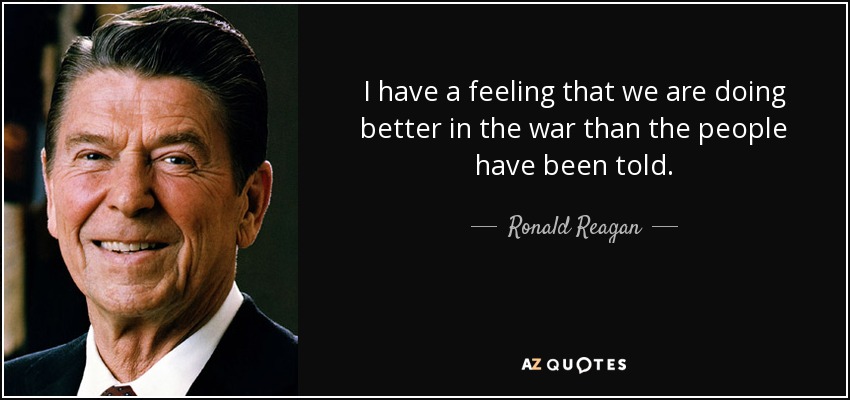
I have a feeling that we are doing better in the war than the people have been told.
Until now has there ever been a time in which so many of the prophecies are coming together? There have been times in the past when people thought the end of the world was coming, and so forth, but never anything like this.
My senses have been stripped, my hands can't feel to grip, my toes to numb to step, wait only for my boot heels to be wandering.
When you get down to the nitty gritty, isn't it a pity that in this big city not one little bitty man will admit that he could have been a little wrong.
When the Academy called, I panicked. I thought they might want their Oscars back and the pawn shop has been out of business for a while.
Experience hobbles progress and leads to abandonment of difficult problems; it encourages the initiated to walk on the shady side of the street in the direction of experiences that have been pleasant. Youth without experience attacks the unsolved problems which maturer age with experience avoids, and from the labors of youth comes progress. Youth has dreams and visions, and will not be denied.
For the Members of the Assembly having before their eyes so many fatal Instances of the errors and falshoods, in which the greatest part of mankind has so long wandred, because they rely'd upon the strength of humane Reason alone, have begun anew to correct all Hypotheses by sense, as Seamen do their dead Reckonings by Cœlestial Observations; and to this purpose it has been their principal indeavour to enlarge and strengthen the Senses by Medicine, and by such outward Instruments as are proper for their particular works.
The various systems of doctrine that have held dominion over man have been demonstrated to be true beyond all question by rationalists of such power-to name only a few-as Aquinas and Calvin and Hegel and Marx. Guided by these master hands the intellect has shown itself more deadly than cholera or bubonic plague and far more cruel. The incompatibility with one another of all the great systems of doctrine might surely be have expected to provoke some curiosity about their nature.
We see it [the as-yet unseen, probable new planet, Neptune] as Columbus saw America from the coast of Spain. Its movements have been felt, trembling along the far-reaching line of our analysis with a certainty hardly inferior to that of ocular demonstration.
It is often said that all the conditions for the first production of a living organism are now present, which could ever have been present. But if (and oh! what a big if!) we could conceive in some warm little pond, with all sorts of ammonia and phosphoric salts, light, heat, electricity, &c., present, that a proteine compound was chemically formed ready to undergo stillmore complex changes, at the present day such matter would be instantly devoured or absorbed, which would not have been the case before living creatures were formed.
Friendship, trust, honor, respect, admiration, this whole experience has been such a revelation.
I must have been through about a million girls, I'd love 'em and leave 'em alone. I didn't care how much they'd cry.
Civilization - and by this I do not mean talking cinemas and tinned food, nor even surgery and hygienic houses, but the whole moral and artistic organization of Europe - has not in itself the power of survival. It came into being through Christianity, and without it has no significance or power to command allegiance ... It is no longer possible, as it was in the time of Gibbon, to accept the benefits of civilization and at the same time deny the supernatural basis on which it rests ... Christianity ... is in greater need of combative strength than it has been for centuries.
My benefactor said that when a man embarks on the paths of sorcery he becomes aware, in a gradual manner, that ordinary life has been forever left behind; that knowledge is indeed a frightening affair; that the means of the ordinary world are no longer a buffer for him; and that he must adopt a new way of life if he is going to survive. The first thing he ought to do, at that point, is to want to become a warrior.
It is becoming plain that our liberal regime of equality and personal freedom depends, more than most theorists of liberalism have been willing to admit, on the existence and support of certain social assumptions and practices: the belief that each and every human being possesses great and inherent value, the willingness to respect the rights of others even at the cost of some disadvantages to one's self, the ability to defer some immediate benefits for the sake of long-range goals, and a regard for reason-giving and civility in public discourse.
The helium which we handle must have been put together at some time and some place. We do not argue with the critic who urges that the stars are not hot enough for this process; we tell him to go and find a hotter place.
It is the first time the burglar has been appointed as caretaker.
The very people who burst with proofs of exuberant vitality could easily be taken for prepared corpses, from whom the news of their not-quite-successful decease has been withheld for reasons of population policy. Underlying the prevalent health is death. All the movements of health resemble the reflex-movements of beings whose hearts have stopped beating.
We live fragmented, compartmentalized lives in which contradictions are carefully sealed off from each other. We have been taught to think linearly rather than comprehensively, and we do this not through conscious design or because we are not intelligent or capable, but because of the way in which deep cultural undercurrents structure life in subtle but highly consistent ways that are not consciously formulated.
The most important characteristic of an organism is that capacity for internal self-renewal known as health. There are two organisms whose processes of self-renewal have been subjected to human interference and control. One of these is man himself (medicine and public health). The other is land (agriculture and coservation). The effort to control the health of land has not been very successful.
For as long as I can remember the slogan has been ... the federal government ought to behave more like families, because families balance their budgets. It turns out that families looked around and said, "You know what? Let's behave more like the government!"
In the past six months, our federal government has devised a dozen strategies to save America's financial markets. Each plan has been more costly, more risky, and less aligned with the principles of our country's free market economy than the last. I am disappointed to say that this latest plan puts all the rest of them to shame.
The great crimes of the twentieth century were committed not by money-grubbing capitalists but by dedicated idealists. Lenin, Stalin, and Hitler were contemptuous of money. The passage from the nineteenth to the twentieth century has been a passage from considerations of money to considerations of power.
Some people don't mind a little constitutional sophistry in a good cause; and for liberals, centralizing all power in the federal government is always a good cause. Since most Americans don't know or care what the Constitution says, let alone what their ancestors thought it meant, the great liberal snow job has been very successful.
The fact is...I'm in love with you, and I have been for some time.
Follow AzQuotes on Facebook, Twitter and Google+. Every day we present the best quotes! Improve yourself, find your inspiration, share with friends
or simply: