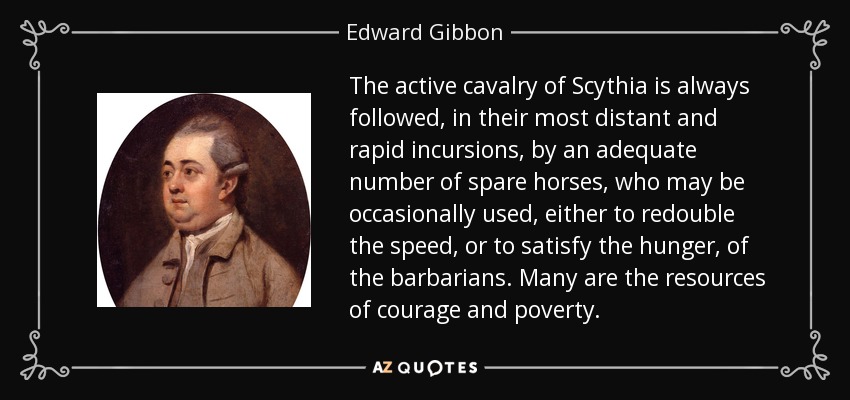
The active cavalry of Scythia is always followed, in their most distant and rapid incursions, by an adequate number of spare horses, who may be occasionally used, either to redouble the speed, or to satisfy the hunger, of the barbarians. Many are the resources of courage and poverty.
The most successful of the Tartar princes assumed the military command, to which he was entitled by the superiority either of merit or of power. He was raised to the throne by the acclamations of his equals; and the title of Khan expresses, in the language of the North of Asia, the full extent of the regal dignity. The right of hereditary succession was long confined to the blood of the founder of the monarchy; and at this moment all the Khans, who reign from Crimea to the wall of China, are the lineal descendants of the renowned Zingis.
To the love of pleasure we may therefore ascribe most of the agreeable, to the love of action we may attribute most of the useful and respectable, qualifications. The character in which both the one and the other should be united and harmonised would seem to constitute the most perfect idea of human nature.
Constantinople was the principal seat and fortress of Arianism; and, in a long interval of forty years, the faith of the princes and prelates who reigned in the capital of the East was rejected in the purer schools of Rome and Alexandria.
The archiepiscopal throne of Macedonius, which had been polluted with so much Christian blood, was successively filled by Eudoxus and Damophilus. Their diocese enjoyed a free importation of vice and error from every province of the empire; the eager pursuit of religious controversy afforded a new occupation to the busy idleness of the metropolis: and we may credit the assertion of an intelligent observer, who describes, with some pleasantry, the effects of their loquacious zeal.
The complaints of contemporary writes, who deplore the increase of luxury and deprevation of manners, are commonly expressive of their peculiar temper and situation. There are few observers who possess a clear and comprehensive view of the revolutions of society, and who are capable of discovering the nice and secret springs of action which impel, in the same uniform direction, the bland and capricious passions of a multitude of individuals.
A small number of temples was protected by the fears, the venality, the taste, or the prudence of the civil and ecclesiastical governors. The temple of the Celestial Venus at Carthage, whose sacred precincts formed a circumference of two miles, was judiciously converted into a Christian church; and a similar consecration has preserved inviolate the majestic dome of the Pantheon at Rome.
At that time the archiepiscopal throne of Alexandria was filled by Theophilus, the perpetual enemy of peace and virtue; a bold, bad man, whose hands were alternately polluted with gold and with blood.
Yet the people, and even the clergy, incapable of forming any rational judgment of the business of peace and war, presumed to arraign the policy of Stilicho, who so often vanquished, so often surrounded, and so often dismissed the implacable enemy of the republic. The first moment of the public safety is devoted to gratitude and joy; but the second is diligently occupied by envy and calumny.
The incapacity of a weak and distracted government may often assume the appearance and produce the effects of a treasonable correspondence with the public enemy. If Alaric himself had been introduced into the council of Ravenna, he would probably have advised the same measures which were actually pursued by the ministers of Honorius.
The ancients were destitute of many of the conveniences of life which have been invented or improved by the progress of industry; and the plenty of glass and linen has diffused more real comforts among the modern nations of Europe than the senators of Rome could derive from all the refinements of pompous or sensual luxury.
At the hour of midnight the Salerian gate was silently opened, and the inhabitants were awakened by the tremendous sound of the Gothic trumpet. Eleven hundred and sixty-three years after the foundation of Rome, the Imperial city, which had subdued and civilised so considerable a part of mankind, was delivered to the licentious fury of the tribes of Germany and Scythia.
The brutal soldiers satisfied their sensual appetites without consulting either the inclination or the duties of their female captives; and a nice question of casuistry was seriously agitated, Whether those tender victims, who had inflexibly refused their consent to the violation which they sustained, had lost, by their misfortune, the glorious crown of virginity. There were other losses indeed of a more substantial kind and more general concern.
In less than seven years the vestiges of the Gothic invasion were almost obliterated, and the city appeared to resume its former splendour and tranquillity. The venerable matron replaced her crown of laurel, which had been ruffled by the storms of war, and was still amused in the last moment of her decay with the prophecies of revenge, of victory, and of eternal dominion.
But the desire of obtaining the advantages, and of escaping the burthens, of political society, is a perpetual and inexhaustible source of discord; nor can it reasonably be presumed that the restoration of British freedom was exempt from tumult and faction. The pre-eminence of birth and fortune must have been frequently violated by bold and popular citizens; and the haughty nobles, who complained that they were become the subjects of their own servants, would sometimes regret the reign of an arbitrary monarch.
The union of the Roman empire was dissolved; its genius was humbled in the dust; and armies of unknown barbarians, issuing from the frozen regions of the North, had established their victorious reign over the fairest provinces of Europe and Africa.
The laws of war, that restrain the exercise of national rapine and murder, are founded on two principles of substantial interest: the knowledge of the permanent benefits which may be obtained by a moderate use of conquest, and a just apprehension lest the desolation which we inflict on the enemy's country may be retaliated on our own. But these considerations of hope and fear are almost unknown in the pastoral state of nations.
The imprudent Maximus disregarded these salutary considerations: he gratified his resentment and ambition; he saw the bleeding corpse of Valentinian at his feet; and he heard himself saluted Emperor by the unanimous voice of the senate and people. But the day of his inauguration was the last day of his happiness.
... the word "theory" ... was originally an Orphic word, which Cornford interprets as "passionate sympathetic contemplation" ... For Pythagoras, the "passionate sympathetic contemplation" was intellectual, and issued in mathematical knowledge ... To those who have reluctantly learnt a little mathematics in school this may seem strange; but to those who have experienced the intoxicating delight of sudden understanding that mathematics gives, from time to time, to those who love it, the Pythagorean view will seem completely natural.
Why waste words? Geometry existed before the Creation, is co-eternal with the mind of God, is God himself (what exists in God that is not God himself?): geometry provided God with a model for the Creation and was implanted into man, together with God's own likeness - and not merely conveyed to his mind through the eyes.
Now, as God the maker play'd he taught the game to Nature whom he created in his image; taught her the selfsame game which he played to her.
If a beach-head of cooperation may push back the jungle of suspicion, let both sides join in creating a new endeavor, not a new balance of power, but a new world of law, where the strong are just and the weak secure and the peace preserved. All this will not be finished in the first one hundred days. Nor will it be finished in the first one thousand days, nor in the life of this Administration, nor even perhaps in our lifetime on this planet. But let us begin.
History will not judge our endeavors--and a government cannot be selected--merely on the basis of color or creed or even party affiliation. Neither will competence and loyalty and stature, while essential to the utmost, suffice in times such as these.
Through searching out origins, one becomes a crab. The historian looks backwards, and finally he also believes backwards.
The use of history is to tell us what we are, for at our birth we are nearly empty vessels and we become what our tradition pours into us.
Follow AzQuotes on Facebook, Twitter and Google+. Every day we present the best quotes! Improve yourself, find your inspiration, share with friends
or simply: