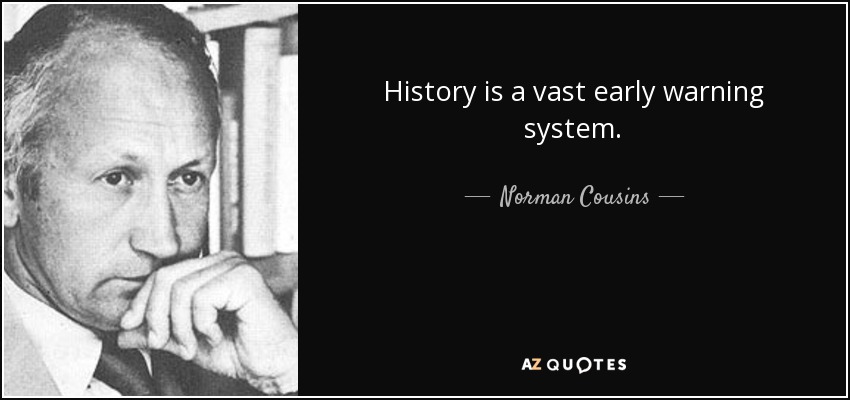
History is a vast early warning system.
There is a history in all men's lives.
History, like a vast river, propels logs, vegetation, rafts, and debris; it is full of live and dead things, some destined for resurrection; it mingles many waters and holds in solution invisible substances stolen from distant soils.
In history, a great volume is unrolled for our instruction, drawing the materials of future wisdom from the past errors and infirmities of mankind.
Oh, God. The Sixties are coming back. Well I've got a 12-gauge double-barreled duck gun chambered for three-inch Magnum shells. And - speaking strictly for this retired hippie and former pinko beatnik - if the Sixties head my way, they won't get past the porch steps. They will be history. Which, for chrissakes, is what they're supposed to be.
It is hard to think of anything which more tragically and clearly exemplifies the phenomenon of good political intentions achieving the precise opposite of their aim.
World War II proved a hypothesis that Alexis de Tocqueville advanced a century before: the war-fighting potential of a democracy is at its greatest when war is most intense; at its weakest when war is most limited. This is a lesson with enduring relevance to our own times - and our own wars.
The public history of all countries, and all ages, is but a sort of mask, richly colored. The interior working of the machinery must be foul.
When we skim along the surface of history we see little but the rough barren rocks that rise out of it.
For what is history, but... huge libel on human nature, to which we industriously add page after page, volume after volume, as if we were holding up a monument to the honor, rather than the infamy of our species.
Rather an end in horror, than horror without end. He could not condemn principles he might need to invoke and apply later. The wolf cannot help having been created by God as he is, but we shoot him all the same if we have to. The great player in diplomacy, as in chess, asks the question,Does this improve me?, not look at the possible fringe benefits If you can't have what you like, you must like what you have.
I don’t know much about history, and I wouldn’t give a nickel for all the history in the world. It means nothing to me. History is more or less bunk. It's tradition. We don't want tradition. We want to live in the present and the only history that is worth a tinker's damn is the history we make today.
The day before yesterday has always been a day of glamor, of gilt and glory. The present is sordid and prosaic. Time colors history as it does a meerschaum pipe.
The future is dark, the present burdensome. Only the past, dead and buried, bears contemplation.
By law of periodical repetition, everything which has happened once must happen again and again -- and not capriciously, but at regular periods, and each thing in its own period, not another's and each obeying its own law.
The Dutch must be understood as they really are, the Middle Persons in Trade, the Factors and Brokers of Europe... they buy to sell again, take in to send out again, and the greatest Part of their vast Commerce consists in being supply'd from All Parts of the World, that they may supply All th World Again.
The effects of human wickedness are written on the page of history in characters of blood: but the impression soon fades away; so more blood must be shed to renew it.
Vichy proves one thing: if you don't want to know how low your fellow citizens can fall, and crawl, don't lose a war.
Histories are a kind of distilled newspapers.
I wonder why we hate the past so.
What finally scuppered Napoleon's Europe was of course the fatal combination of the English Channel and the Russian winter; the same unlikely partnership that also did for Hitler's Europe.
For me, in fact, the mark of the historic is the nonchalance with which it picks up an individual and deposits him in a trend, like a house playfully moved by a tornado.
History is the invention of historians.
In our wildest aberrations we dream of an equilibrium we have left behind and which we naively expect to find at the end of our errors. Childish presumption which justifies the fact that child-nations, inheriting our follies, are now directing our history.
The best portraits are perhaps those in which there is a slight mixture of caricature; and we are not certain that the best histories are not those in which a little of the exaggeration of fictitious narrative is judiciously employed. Something is lost in accuracy; but much is gained in effect. The fainter lines are neglected; but the great characteristic features are imprinted on the mind forever.
Follow AzQuotes on Facebook, Twitter and Google+. Every day we present the best quotes! Improve yourself, find your inspiration, share with friends
or simply: