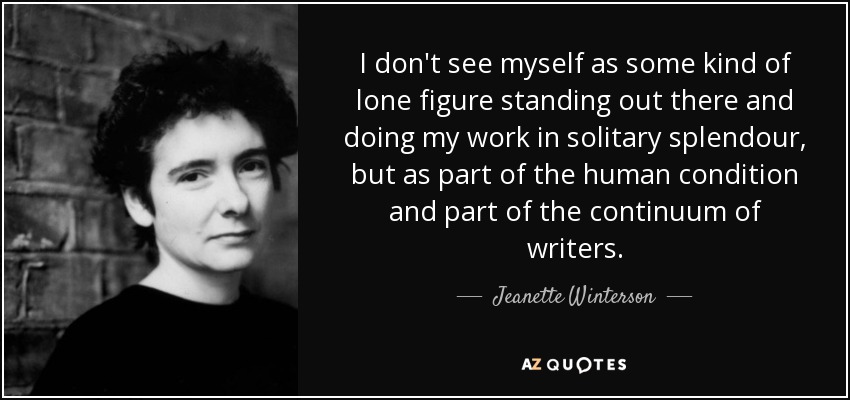
I don't see myself as some kind of lone figure standing out there and doing my work in solitary splendour, but as part of the human condition and part of the continuum of writers.
Religion to me is when man gets ahold of spirituality: "My god is right, yours is wrong." Religion to me is the human condition. "If you're a Muslim, you can't be a Christian." That to me is religion.
Maybe we're about to radically change the operating system of the human condition. If so, then this would be a really good time to make backups of our civilization.
The shuffle only demonstrated people's fatuous belief in a political cure for a human condition.
Moreover, the human condition, if that is what it is, has been getting steadily worse in the Corporate State; more and more life-denying just as life should be opening up.
What interests me is love, sex, death, cruelty, compassion and the desire for meaning in an apparently godless universe. In other words the human condition.
If we can sympathise only with the utterly blameless, then we can sympathise with no one, for all of us have contributed to our own misfortunes - it is a consequence of the human condition that we should. But it does nobody any favours to disguise from him the origins of his misfortunes, and pretend that they are all external to him in circumstances in which they are not.
It's (the lack of communication between the people in his paintings, ed.) probably a reflection of my own, if I may say, loneliness. I don't know. It could be the whole human condition.
The destination of the soul: this is what I, led on by Nils Holgersson, came to seek in the literature of Western Europe. I fervently hope that my pursuit, as a Japanese, of literature and culture will, in some small measure, repay Western Europe for the light it has shed upon the human condition.
You treat violence as an aberration ... when in truth it is the norm. It is the very essence of the human condition.
The world is, was, will always be filled with good and evil, because good and evil is the yin and yang of the human condition.
Art is the lens through which I experience the world. Art is the medium to present the human condition... love, fear, bewilderment, pleasure, distaste, brotherhood and all the subtleties that we all know.
The broader unquestioned premises upon which my own culture founded its view of the human condition, such as the one that Unhappiness is as legitimate a part of experience as happiness and necessary in order to render happiness appreciable, or that it is more advantageous to be young than to be old: those still took me a long time to pry loose for reexamination.
TV has taken reflection out of the human condition. People didn't use to have a ready answer for everything, whether they knew something about it or not. People think they have to have an answer for everything because the guys on TV have an answer for everything. But it's bullsh**t! Reflection is crucial.
Trusting people to be creative and constructive when given more freedom does not imply an overly optimistic belief in the perfectibility of human nature. It is, rather, belief that the inevitable errors and sins of the human condition are far better overcome by individuals working together in an environment of trust and freedom and mutual respect than by individuals working under a multitude of rules, regulations, and restraints imposed upon them by another group of imperfect individuals.
Fancy what a game of chess would be if all the chessmen had passions and intellects, more or less small and cunning; if you were not only uncertain about your adversary's men, but a little uncertain also about your own. You would be especially likely to be beaten, if you depended arrogantly on your mathematical imagination, and regarded your passionate pieces with contempt. Yet this imaginary chess is easy compared with a game a man has to play against his fellow-men with other fellow-men for instruments.
If a man hasn't found anything worth dying for, he hasn't anything worth living for.
In every age the wisest have passed the identical judgment on life: it is worthless.
If we lived forever, if the dews of Adashino never vanished, if the crematory smoke on Toribeyama never faded, men would hardly feel the pity of things. The beauty of life is in its impermanence. Man lives the longest of all living things... and even one year lived peacefully seems very long. Yet for such as love the world, a thousand years would fade like the dream of one night.
The sympathies of a well-adjusted person can easily be aroused by the plight of strangers. Indeed, the skillful writer of a novel, a play, or an opera can engage our emotions on behalf of people who are not only strangers to us, but who do not even exist! And a person whose emotions cannot be so aroused is not behaving normally.
The changes in the human condition are uncertain and frequent. Many, on whom fortune has bestowed her favours, may trace their family to a more unprosperous station; and many who are now in obscurity, may look back upon the affluence and exalted rank of their ancestors.
The very acceptance of the limited means of the human condition makes for endless creativity.
I'm somebody who believes in funny things, and laughing, but I do like for them to come from a place that addresses the human condition.
Space-ships and time machines are no escape from the human condition.
In these days of high-tech video games, it's remarkable that kids once got incredibly thrilled while pushing little metal racing cars around a cardboard track: The toy car was yours, and you invested it with importance and enhanced it with fantasy and pitied it because it was small, like you were. Such games were weapons against the ennui of endless Saturdays.
Follow AzQuotes on Facebook, Twitter and Google+. Every day we present the best quotes! Improve yourself, find your inspiration, share with friends
or simply: