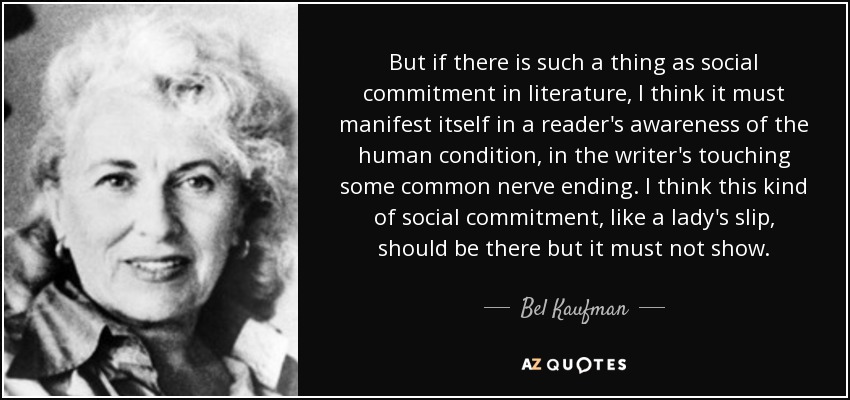
But if there is such a thing as social commitment in literature, I think it must manifest itself in a reader's awareness of the human condition, in the writer's touching some common nerve ending. I think this kind of social commitment, like a lady's slip, should be there but it must not show.
In many patriarchies, language, as well as cultural tradition, reserve the human condition for the male. With the Indo-European languages this is a nearly inescapable habit of mind, for despite all the customary pretense that 'man' and 'humanity' are terms which apply equally to both sexes, the fact is hardly obscured that in practice, general application favors the male far more often than the female as referent, or even sole referent, for such designations.
Life is atrocious, we know. But precisely because I expect little of the human condition, man's periods of felicity, his partial progress, his efforts to begin over again and continue, all seem to me like so many prodigies which nearly compensate for the monstrous mass of ills and defeats, of indifference and error. Catastrophe and ruin will come; disorder will triumph, but order will too, from time to time.
Dachau has been my own lifelong point of no return. Between the moment when I walked through the gate of that prison, with its infamous motto, 'Arbeit Macht Frei,' and when I walked out at the end of a day that had no ordinary scale of hours, I was changed, and how I looked at the human condition, the world we live in, changed ... Years of war had taught me a great deal, but war was nothing like Dachau. Compared to Dachau, war was clean.
My pessimism (which, by the way, is far from absolute) originated with my despair in the lack of perfection to be found in human nature. I was attempting in my successive books to show the inevitable handicap of the human condition.
I utterly reject the view that the Third World is doomed to poverty and starvation. Not only is this wrong, I think this attitude verges on the immoral, like thinking that slavery is an unalterable facet of the human condition so why bother doing anything about it?
Our own peculiar human condition is that we are as fit to be laughed at as able to laugh.
Give to these children, new from the world, Rest far from men. Is anything better, anything better? Tell us it then.
The king is but a man, as I am; the violet smells to him as it doth to me; the element shows to him as it doth to me; all his senses have but human conditions; his ceremonies laid by, in his nakedness he appears but a man; and though his affections are higher mounted than ours, yet, when they stoop, they stoop with the like wing.
We're either nothing or a God's regret.
We have imagined ourselves a special creation, set apart from other humans. In the last twentieth century, we see that our povertyis as absolute as that of the poorest nations. We have attempted to deny the human condition in our quest for power after power. It would be well for us to rejoin the human race, to accept our essential poverty as a gift, and to share our material wealth with those in need.
The human condition means that we can zone out and forget what the hell we're doing.
There is something about the human condition. I don't think dogs are like "If only I was a poodle instead of a golden retriever, I'd be totally happy." Dogs are happy with who they are.
Could we know what men are most apt to remember, we might know what they are most apt to do.
Men that cannot entertain themselves want somebody, though they care for nobody.
Surely knowledge of the natural world, knowledge of the human condition, knowledge of the nature and dynamics of society, knowledge of the past so that one may use it in experiencing the present and aspiring to the future--all of these, it would seem reasonable to suppose, are essential to an educated man. To these must be added another--knowledge of the products of our artistic heritage that mark the history of our esthetic wonder and delight.
Every man beholds his human condition with a degree of melancholy. As a ship aground is battered by the waves, so man, imprisonedin mortal life, lies open to the mercy of coming events.
With compassion, we see benevolently our own human condition and the condition of our fellow beings. We drop prejudice. We withhold judgment.
For Jesus, it is clear, poverty is not the problem; it is the solution. Until human beings learn to live in naked contact and direct simplicity and equality with each other, sharing all resources, there can be no solution to the misery of the human condition and no establishment of God's kingdom. Jesus' radical and paradoxical sense of who could and who could not enter the Kingdom is even more clearly illustrated by his famous praise of children.
An exacting account of the processes by which things fall apart. The scope is breathtaking...the clarity and lyricism of the writing itself left me with repeated gasps of recognition about the human condition. I believe it will be a classic.
We are naïve and moralistic women. We are human beings. Who find politics a blight upon the human condition. And do not know how one copes with it except through politics.
You can have a team of unconventional thinkers, as well as conventional thinkers. If you don't have the support of others you cannot achieve anything altogether on your own. It's like a cry in the wilderness. In each instance there were others who could see the same thing, and there were others who could not. It's an obvious difference we see in those who you might say have a bird's eye view, and those who have a worm's eye view. I've come to realize that we all have a different mind set, we all see things differently, and that's what the human condition is really all about.
My primary motivation for writing is to communicate my perceptions and insights into the human condition, in a way that may provide understanding, comfort, and company to others.
Don't it always seem to go, that you don't know what you've got till it's gone.
The New Testament is a brutal destroyer of human illusions. If you follow Jesus and don't end up dead, it appears you have some explaining to do. The stark signifier of the human condition is one who spoke up for love and justice and was done to death for his pains. The traumatic truth of human history is a mutilated body.
Follow AzQuotes on Facebook, Twitter and Google+. Every day we present the best quotes! Improve yourself, find your inspiration, share with friends
or simply: