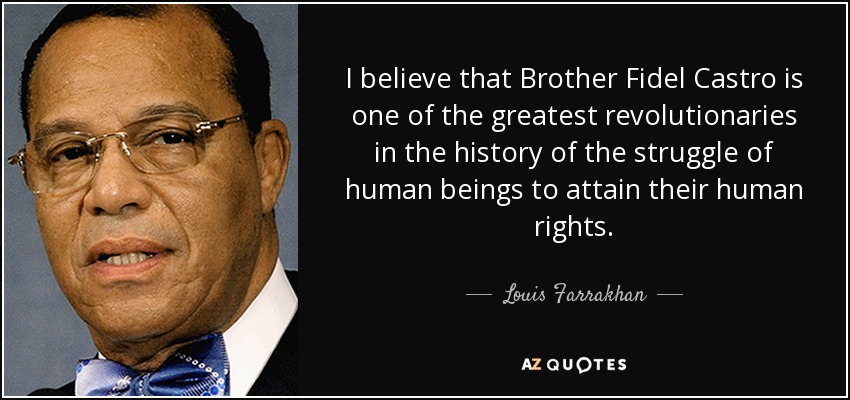
I believe that Brother Fidel Castro is one of the greatest revolutionaries in the history of the struggle of human beings to attain their human rights.
I'm not interested in scoring points or being over-critical of the US administration. I want to find the entry points to try and get it back on track so that the United States can get out of the present disastrous situation it's in, and back into being a constructive force for human rights in the world.
I agree with those who argue that it is possible to distil from the religions of the world their common values and relevance. As far as I'm concerned I am involved in a complementary process with people who have a moral or spiritual commitment to human rights.
No state or society can claim to have established human rights once and for all.
Foreign policy that is obviously guided by interests, but that is very much also committed to shared values, so we have a platform, democracy, freedom, respect of human rights that we would like to see respected all over the world and also, a peaceful world order.
Even the worst dictator, there is not a single one of them who would say "Oh yes, I violate human rights." They all claim "oh no, we respect human rights" even when they are doing the most egregious things.
We live in the age of communication. Write letters to the editor. Speak to your congressman, to your senator. If you are young, especially young people are taken by this human rights activities. They should organize the universities.
I will not call myself a pacifist for the very simple reason that if something like a [Francisco] Franco should arise in Spain again, or, for that matter, in America, and tried to take away whatever dwindling civil liberties and human rights we retain, I would resist them with a club if I had to. But my admiration for pacifism as an outlook and a sensibility is enormous. I just find that it gets me into contradictions, as it often gets many pacifists into contradictory positions and strategies.
I'm a human rights person. I don't think people should be unfair to men or women.
I've always been passionate about human rights in general. I think anyone who knows me can attest to that. I really wasn't given a voice until very recently, but I've always spoken out about the bullshit that's going on since the beginning of having a platform.
I want to take human rights out of their box. I want to show the relevance of the universal principles of human rights to the basic needs of health, security, education and equality.
Using human rights commitments more effectively, either as part of negotiations in the WTO or as part of the trade policy review process, poses issues of equality in a practical venue.
Vladimir Putin is a human rights abuser, responsible for deaths in Ukraine, Georgia and Syria, not to mention curious murders of his political opponents and journalists.
The international human rights framework is a vital component and engine for promoting global values. Governments have signed up to this international legal framework and we should hold them accountable, in all circumstances from environmental or labour standards, to trade talks, arms control and security issues as well as other international legal codes.
The term 'human rights' has been too often associated with conditionality, and with concerns of developing countries that in order to benefit from open trade they would be required to implement immediately labour and environmental standards of a comparable level to those applied in industrialised countries. At the same time, debates about the primacy of trade as against human rights legal codes have contributed to maintaining the unfortunate impression that the two bodies of law are pursuing incompatible aims.
In human rights theory it is very important that governments still have the primary responsibility for the standards and provision of such services even if they no longer deliver them. They must insist that the private sector delivers without discrimination. So governments still have responsibility, including the need to influence business.
China is at a different stage of development, human rights are violated here much more often. And still, we see improvements even here.
When you torture a person for long periods you might get a very passionate human rights defender but most probably you will get a beast whose only concern is to seek his revenge in the best way possible.
Following World War II, the U.S. was the architect of the UN system, and the world financial system, and the Human Rights Declaration, and of course the United Nations is based here in New York City. But, unfortunately, especially in the last decade, the U.S. really has been turning its back on international agreements and the set of agencies and procedures that they create as a means for governing the world.
Often, we take stability - peace in terms of security and economic activity - to mean a country is doing well. We forget the third and important pillar of rule of law and respect for human rights, because no country can long remain prosperous without that third pillar.
You wouldn't know that if you talked to Human Rights Watch or Amnesty International or some of the international activist organizations. Certainly you wouldn't know that if you were talking to some of the writers who criticize our drone policy. But I've actually told my staff it's probably good that they stay critical of this policy, even though I think right now we're doing the best that we can in a dangerous world with terrorists who would gladly blow up a school bus full of American kids if they could.
[Transsexual surgery] could be likened to political psychiatry in the Soviet Union. I suggest that transsexualism should best be seen in this light, as directly political, medical abuse of human rights. The mutilation of healthy bodies and the subjection of such bodies to dangerous and life-threatening continuing treatment violates such people's rights to live with dignity in the body into which they were born.
If [Western] relations with Russia are to be friendly, they must be open and sincere, otherwise there can be no friendship at all. That means one should be able to speak openly about everything at meetings and conferences. It shouldn't be that we can't discuss the killing of journalists in Russia, or the suppression of human rights, or all the warning signs surfacing in Russia because of oil and gas or other economic reasons. It's a big problem, but it's the same in Western relations with Arab states.
The slightest sign of stability is used by local authoritarian leaders to bargain for the sympathies of Western countries that are, for the sake of a balanced relationship, bound to turn a blind eye to obvious, blatant violations of human rights and the deconstruction of democratic institutions in these countries.
There's a dilemma over how to balance concrete economic interests with critical opinions on the state of human rights. It's the human rights that suffer, and that's a great price to pay.
Follow AzQuotes on Facebook, Twitter and Google+. Every day we present the best quotes! Improve yourself, find your inspiration, share with friends
or simply: