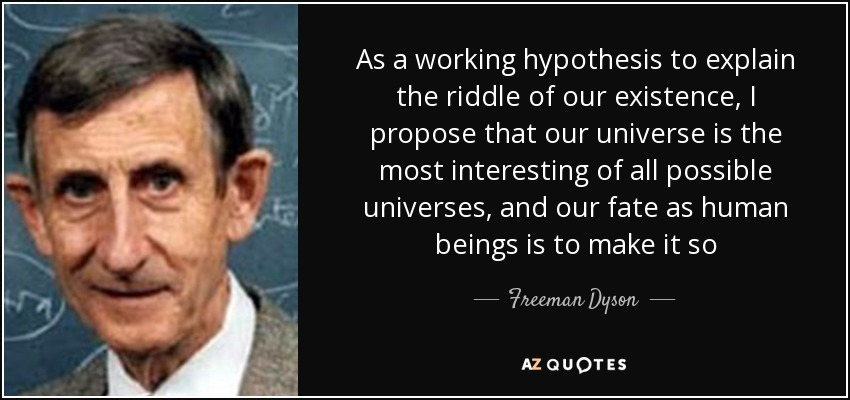
As a working hypothesis to explain the riddle of our existence, I propose that our universe is the most interesting of all possible universes, and our fate as human beings is to make it so
There is a philosophy that says that if something is unobservable -- unobservable in principle -- it is not part of science. If there is no way to falsify or confirm a hypothesis, it belongs to the realm of metaphysical speculation, together with astrology and spiritualism. By that standard, most of the universe has no scientific reality -- it's just a figment of our imaginations.
Have the models been successful in predicting anything? They, of course, predict substantial global warming. This is not surprising given the expressed belief of some of the model builders in the global warming Hypothesis and the many parameters in the model that need to be introduced. However, the models also predict unambiguously that the atmosphere is warming faster than the surface of the earth; but all the available observational data unambiguously shows the opposite!
The weapons-violence hypothesis is far too simplistic a basis on which to base sound public policy.
Hypotheses like professors, when they are seen not to work any longer in the laboratory, should disappear.
It is the simple hypotheses of which one must be most wary; because these are the ones that have the most chances of passing unnoticed.
Don't just read it; fight it! Ask your own question, look for your own examples, discover your own proofs. Is the hypothesis necessary? Is the converse true? ... Where does the proof use the hypothesis?
Scientists actively approach the door to knowledge—the boundary of the domain of what we know. We question and explore and we change our views when facts and logic force us to do so. We are confident only in what we can verify through experiments or in what we can deduce from experimentally confirmed hypotheses.
Think for yourself, and believe in yourself. Keep your skeptical antennae tuned in and in good working order at all times. We are free to develop our own hypotheses, which should be based in available evidence. When it comes to faith, have faith in yourself. And don't forget to love, laugh, be kind to each other. Don't take things so seriously, especially yourself. If the universe is a cosmic joke, remember to giggle. And remember to be astonished.
Man, surrounded by facts, permitting himself no surprise, no intuitive flash, no great hypothesis, no risk, is in a locked cell. Ignorance cannot seal the mind and imagination more securely.
And as this is the obvious appearance of things, it must be admitted, till some hypothesis be discovered, which by penetrating deeper into human nature, may prove the former affections to be nothing but modifications of the latter. All attempts of this kind have hitherto proved fruitless, and seem to have proceeded entirely from that love of simplicity which has been the source of much false reasoning in philosophy.
Economists and workplace consultants regard it as almost unquestioned dogma that people are motivated by rewards, so they don't feel the need to test this. It has the status more of religious truth than scientific hypothesis. The facts are absolutely clear. There is no question that in virtually all circumstances in which people are doing things in order to get rewards, extrinsic tangible rewards undermine intrinsic motivation.The bonus myth: How paying for results can backfire The world is a dangerous place, not because of those who do evil, but because of those who look on and do nothing.
Any theory, hypothesis, philosophy, sect, creed or institution that fears investigation, openly manifests its own error.
World War II proved a hypothesis that Alexis de Tocqueville advanced a century before: the war-fighting potential of a democracy is at its greatest when war is most intense; at its weakest when war is most limited. This is a lesson with enduring relevance to our own times - and our own wars.
How can you communicate your thoughts or demonstrate your hypotheses by conventional means when all the values and standards that you want to challenge are built into those means? Science and new technology today like to declare that they encourage 'lateral thinking,' new ways of seeing and putting data together - but all systems have an inbuilt resistance to what has not been programmed into them through the premises on which their rules are based.
The novel is a territory where one does not make assertions; it is a territory of play and of hypotheses.
Science, at its core, is simply a method of practical logic that tests hypotheses against experience. Scientism, by contrast, is the worldview and value system that insists that the questions the scientific method can answer are the most important questions human beings can ask, and that the picture of the world yielded by science is a better approximation to reality than any other.
From the almost total absence of fossil evidence relative to the origin of the phyla, it follows that any explanation of the mechanism in the creative evolution of the fundamental structural plans is heavily burdened with hypothesis. This should appear as an epigraph to every book on evolution. The lack of direct evidence leads to the formulation of pure conjecture as to the genesis of the phyla; we do not even have a basis to determine the extent to which these opinions are correct.
This general tendency to eliminate, by means of unverifiable speculations, the limits of the categories nature presents to us is the inheritance of biology from The Origin of Species. To establish the continuity required by theory, historical arguments are invoked, even though historical evidence is lacking. Thus are engendered those fragile towers of hypothesis based on hypothesis, where fact and fiction intermingle in an inextricable confusion.
Taken with the archaeological data, we can say that the old hypothesis of an invasion of people - not merely their language - from the steppe appears to be true.
My real bottom-line hypothesis is that nobody has a sweet clue what they’re doing. Therefore you better be trying stuff at an insanely rapid pace. You want to be screwing around with nearly everything. Relentless experimentation was probably important in the 1970s-now it’s do or die.
Faith is the choice of the nobler hypothesis.' Not the noblest, one never knows what that is. But the nobler, the best one can see when the choice is made.
Christian apologists who argue that a story about an empty tomb is convincing evidence of a resurrected body are likely unfamiliar with Occam’s razor, which states that among competing hypotheses, the hypothesis with the fewest assumptions should be selected. They assume that the most likely explanation is miraculous resurrection through some unproven divine connection, but more likely scenarios include a stolen body, a mismarked grave, a planned removal, faulty reports, creative storytelling, edited scriptures, etc. No magic required.
With every passing year we discover more evidence to support Darwin's revolutionary hypothesis that the cognitive and emotional lives of animals differ only by degree, from the fishes to the birds to the monkeys to humans.
We physicists know that a beautiful postulate is more likely to be correct than an ugly one. Why not adopt this Postulate of Eternal Life, at least as a working hypothesis?
Follow AzQuotes on Facebook, Twitter and Google+. Every day we present the best quotes! Improve yourself, find your inspiration, share with friends
or simply: