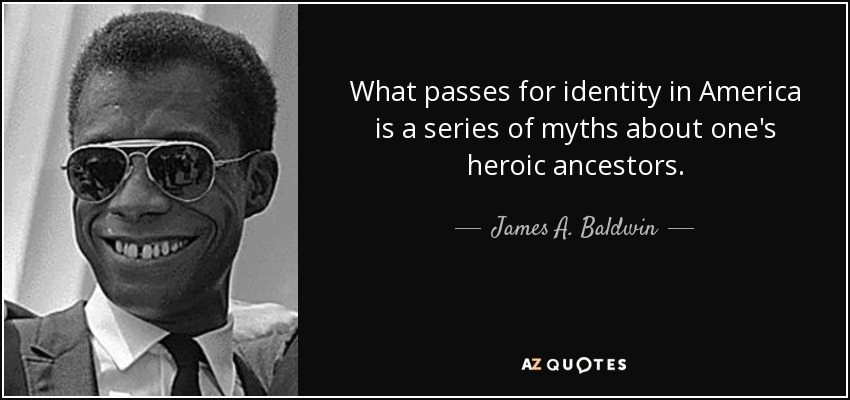
What passes for identity in America is a series of myths about one's heroic ancestors.
You see in others who you are.
I'd really love to meet the guy I'm supposed to be. I'd hire him in a second.
Labor is work that leaves no trace behind it when it is finished, or if it does, as in the case of the tilled field, this product of human activity requires still more labor, incessant, tireless labor, to maintain its identity as a 'work' of man.
Not one of us can lie or pretend. We're all fixed in good faith in a certain concept of ourselves.
Literature is one of the few areas left where black and white feel some identity of purpose; we all struggle under censorship.
The individual in the ordinary circumstances of living may feel more unreal than real; in a literal sense, more dead than alive; precariously differentiated from the rest of the world, so that his identity and autonomy are always in question.... He may not possess an over-riding sense of personal consistency or cohesiveness. He may feel more insubstantial than substantial, and unable to assume that the stuff he is made of is genuine, good, valuable. And he may feel his self as partially divorced from his body.
The world is an illusion. Why is it unreal? Because none of the knowledge is going to remain permanent, as real knowledge. I had a number of identities; I was a child, I was a boy, I was a teenager, I was a middle-aged man, I was an old man. Like other identities I thought would remain constant, they never remained so. Finally, I became very old. . . So which identity remained honest with me?
In a culture of technique, we often confuse authority with power, but the two are not the same. Power works from the outside in, but authority works from the inside out. . . . I am painfully aware of the times in my own teaching when I lose touch with my inner teacher and therefore with my own authority. In those times I try to gain power by barricading myself behind the podium and my status while wielding the threat of grades. . . . Authority comes as I reclaim my identity and integrity, remembering my selfhood and my sense of vocation.
Telling others about oneself is...no simple matter. It depends on what we think they think we ought to be like
I'm not surprised, but I am disappointed that Katharine Carr Esters claims that she was 'tricked' into divulging her true feelings about Oprah and that she now denies that she revealed to me the identity of Oprah's biological father.
My interest lies in my self-expression -- what's inside of me -- not what I'm in.
I came to believe that my true identity goes beyond the outer roles I play. It transcends the ego. I came to understand that there is an Authentic 'I' within - an 'I Am,' or divine spark within the soul.
I do have two data identities. I have my name, Bruce Sterling, which is my public name under which I write novels. I also have my other name, which is my legal name under which I own property and vote.
I suppose I have a highly developed capacity for self-delusion, so it's no problem for me to believe that I'm somebody else.
The thing is that, they all had real strong personalities and real distinct identities, and I don't find most of the groups that are coming out now really do.
When you are in a band for a number of years you loose your identity in a way. You become a part of that band and then all of a sudden you are not part of that band. You are still the band without the other two members.
When I was 18 I went to college for two years and didn't work for a year which was essential for me, because my identity had been so influenced by my being an actor and I think I just needed to discover what it was to be myself, divorced from all that responsibility.
I don't know what issues concerning identity have helped contemporary fiction evolve to what it is now. All I know is that the range of voices that are being heard and published is a lot more diverse than when I was coming up.
Regimes are modes of self-discipline, but are not solely constituted by the orderings of convention in day-to-day life; they are personal habits, organised in some part according to social conventions, but also formed by personal inclinations and dispositions. Regimes are of central importance to self-identity precisely because they connect habits with aspects of the visible appearance of the body.
Lifestyles are routined practices, the routines incorporated into habits of dress, eating, modes of acting and favoured milieux for encountering others; but the routines followed are reflexively open to change in the light of the mobile nature of self-identity.
[C]ultivated risk-taking represents an 'experiment with trust' (in the sense of basic trust) which consequently has implications for an individual's self-identity. (...) In cultivated risk-taking, the encounter with danger and its resolution are bound up in the same activity, whereas in other consequential settings the payoff of chosen strategies may not be seen for years afterwards.
If you meet a woman in a burqa, she can't reply to your smile. It's a denial of identity.
Melissa McCarthy just opened this new movie, “Identity Thief,” and Rex Reed, who’s a known critic, wrote a scathing commentary on her weight. I think that weight designation is one of the last frontiers of bullying. I don’t know what the right “ism” for it is, but I think that there’s a level of that that’s happening that’s certainly not okay.
American cinema tends to express a patriotic relationship to national identity on a regular basis.
Follow AzQuotes on Facebook, Twitter and Google+. Every day we present the best quotes! Improve yourself, find your inspiration, share with friends
or simply: