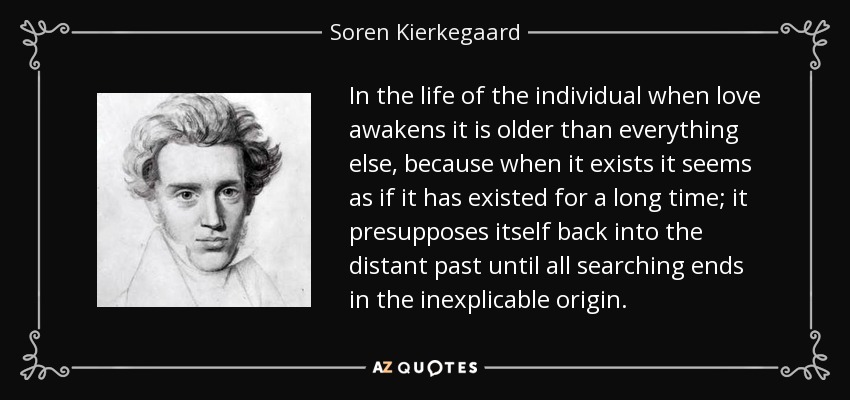
In the life of the individual when love awakens it is older than everything else, because when it exists it seems as if it has existed for a long time; it presupposes itself back into the distant past until all searching ends in the inexplicable origin.
I’ve had that kind of experience myself: I’m looking at a map and I see someplace that makes me think, ‘I absolutely have to go to this place, no matter what’. And most of the time, for some reason, the place is far away and hard to get to. I feel this overwhelming desire to know what kind of scenery the place has, or what people are doing there. It’s like measles - you can’t show other people exactly where the passion comes from. It’s curiosity in the purest sense. An inexplicable inspiration.
What frustrated me was the thought that with three thousand years of history someone in China, some monk in a monastery halfway up a mountain, must have developed a magic kata, a physical expression of formae. Or at least have got close enough to explain all those legendary swordsmen and their inexplicable desire to roost on the tops of bamboo trees.
The further on we go, the more meaning there is, but the less articulable. You live your life and the older you get- the more specifically you harvest- the more precious becomes every ounce and spasm. Your life and times don’t drain of meaning because they become more contradictory, ornamented by paradox, inexplicable. The less explicable, the more meaning. The less like a mathematics equation (a sum game); the more like music (significant secret).
When the coherence of the parts of a stone, or even that composition of parts which renders it extended; when these familiar objects, I say, are so inexplicable, and contain circumstances so repugnant and contradictory; with what assurance can we decide concerning the origin of worlds, or trace their history from eternity to eternity?
I think I have never yet done any work with the aim of symbolizing a particular idea, but the fact that a symbol is sometimes discovered or remarked upon is valuable for me because it makes it easier to accept the inexplicable nature of my hobbies, which constantly preoccupy me.
The echoes of childhood torments have great power, even when not brought to mind in such an inexplicable and horrifying way.
You can never underestimate that moment of somebody explaining your life to you, something you thought was inexplicable, through music. That was the way out of loneliness.
Nature is always mysterious and secret in her use of means; and art is always likest her when it is most inexplicable.
What intrigued me more than anything else was finding out the way in which everything, all of creation - all of it! - was held together by invisible chemical bonds, and I found a strange, inexplicable comfort in knowing that somewhere, even though we couldn't see it in our own world, there was a real stability.
There is, in fact, no reason to believe that any given natural phenomenon, however marvelous it may seem today, will remain forever inexplicable. Soon or late the laws governing the production of life itself will be discovered in the laboratory, and man may set up business as a creator on his own account. The thing, indeed, is not only conceivable; it is even highly probable.
And yet the world we live in-its divisions and conflicts, its widening gap between rich and poor, its seemingly inexplicable outbursts of violence-is shaped far less by what we celebrate and mythologize than by the painful events we try to forget. Leopold's Congo is but one of those silences of history.
The whole is a riddle, an enigma, an inexplicable mystery. Doubt, uncertainty, suspence of judgment appear the only result of ourmost accurate scrutiny, concerning this subject. But such is the frailty of human reason, and such the irresistible contagion of opinion, that even this deliberate doubt could scarcely be upheld; did we not enlarge our view, and opposing one species of superstition to another, set them a quarrelling; while we ourselves, during their fury and contention, happily make our escape into the calm, though obscure, regions of philosophy.
God's love is so extravagant and so inexplicable that he loved us before we were us. He loved us before we existed. He knew many of us would reject him, hate him, curse him, rebel against him. Yet he chose to love us. God loves us because he is love.
St. Andrews provided a gentle forgetfulness over the preceding painful years of my life. It remains a haunting and lovely time to me, a marrow experience. For one who during her undergraduate years was trying to escape an inexplicable weariness and despair, St. Andrews was an amulet against all manner of longing and loss, a year of gravely held but joyous remembrances.
If I am lucky, something new and inexplicable often appears in front of my lens. I am always surprised by the mystery of how my best images appear. That excitement and shock of discovery makes my life at these moments a gift.
It seems that everyone has their own inexplicable fear to have nightmares about. We need nightmares to keep ourselves entertained, and fend off the contentment that we all fear and abhor so much.
Life itself is the real and most miraculous miracle of all. If one had never before seen a human hand and were suddenly presented for the first time with this strange and wonderful thing, what a miracle, what a magnificently shocking and inexplicable and mysterious thing it would be.
The inexplicable happens all the time. It makes more sense to simply accept things we observe but cannot understand. It is really more scientific to keep an open mind. Until we can understand and explain the things we now label miracles, let us accept them and try to create more of them.
Once we perceive that it is Judaism which is the root cause of antisemitism, otherwise irrational or inexplicable aspects of antisemitism become rationally explicable...Only something representing a threat to the core values, allegiances and beliefs of others could cause such universal, deep and lasting hatred. This Judaism has done.
This is in the end the only kind of courage that is required of us: the courage to face the strangest, most unusual, most inexplicable experiences that can meet us.
The fact is, Scripture is filled with divine actions that don't fit our human standards of logic or morality. But they don't need to, because we are the clay and He is the Potter. We need to stop trying to domesticate God or confine Him to tidy categories and compartments that reflect our human sentiments rather than His inexplicable ways.
The classicist, and the naturalist who has much in common with him, refuse to see in the highest works of art anything but the exercise of judgement, sensibility, and skill. The romanticist cannot be satisfied with such a normal standard; for him art is essentially irrational - an experience beyond normality, sometimes destructive of normality, and at the very least evocative of that state of wonder which is the state of mind induced by the immediately inexplicable.
We normally think of history as one catastrophe after another, war followed by war, outrage by outrage - almost as if history were nothing more than all the narratives of human pain, assembled in sequence. And surely this is, often enough, an adequate description. But history is also the narratives of grace, the recountings of those blessed and inexplicable moments when someone did something for someone else, saved a life, bestowed a gift, gave something beyond what was required by circumstance.
Being an artist and being a teacher are two conflicting things. When I paint, my work manifests the unexpected... In teaching it's just the opposite. I must account for every line, shape and colour and I am forced to give an explanation of the inexplicable and account for the variety of styles the students present.
Follow AzQuotes on Facebook, Twitter and Google+. Every day we present the best quotes! Improve yourself, find your inspiration, share with friends
or simply: