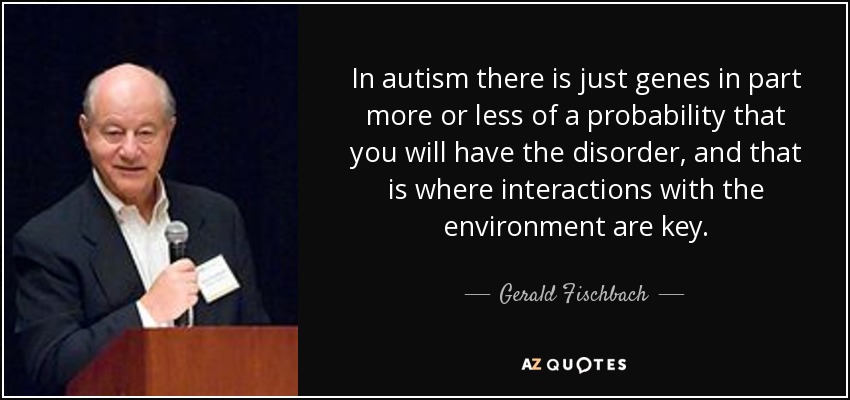
In autism there is just genes in part more or less of a probability that you will have the disorder, and that is where interactions with the environment are key.
You should not be too much of a purist in your way of life, for you need to be able to accept all that is foul. You should not be too clear in making distinctions in social interactions, for you need to accept everyone whether they are good or bad, wise or foolish.
One reason patients are reluctant to work in a therapy group is they fear that things will go too far, that the powerful therapist or the collective group might coerce them to lose control--to say or think or feel things that will be catastrophic. The therapist can make the group feel safer by allowing each patient to set his or her limits and by emphasizing the patient's control over every interaction.
One thing most of us agree on is that the universe exists (people who deny that usually follow some trade other than science), so if some theoretical particle interaction would lead ultimately to the nonexistence of the universe, then you can save a lot of electricity by not trying to demonstrate it.
Central to Jungian psychology is the concept of "individuation," the process whereby a person discovers and evolves his Self, as opposed to his ego. The ego is a persona, a mask created and demanded by everyday social interaction, and, as such, it constitutes the center of our conscious life, our understanding of ourselves through the eyes of others. The Self, on the other hand, is our true center, our awareness of ourselves without outside interference, and it is developed by bringing the conscious and unconscious parts of our minds into harmony.
I think we all have experiences when we were young where we either had an interaction with someone we admired or you know, had a vision of how they were and found out that they weren't necessarily that and that it tends to be a big let down sometimes.
I don't really get a lot of clarity in my everyday life and my interactions with people. Most things that happen to me aren't very straightforward. They're either vastly confusing, or I realize that I'm inventing whatever meaning I'm deriving from whatever happens and it's filtering through my own indulgent perspective.
Whereas children can learn from their interactions with their parents how to get along in one sort of social hierarchy--that of the family--it is from their interactions with peers that they can best learn how to survive among equals in a wide range of social situations.
Children, then, acquire social skills not so much from adults as from their interactions with one another. They are likely to discover through trial and error which strategies work and which do not, and later to reflect consciously on what they have learned.
I've always enjoyed mixing and mingling with the Tasmanian community and that's, if you like, the bread and butter of politics. And from my perspective, it's meant more time at home, which I also enjoy and it's also meant the greater interaction with the Tasmanian community. And it's also given me freedom to speak out.
If you have depression, you are dramatically more likely to be sick. Now to say you don't need to treat depression because it's not a medical reality - when in fact it clearly affects your interaction with the entire world around you - is just frankly reactionary.
Is it ok to sometimes be shy?Yes, of course. The point is,that being that way all the time and using it as an excuse to never be the opposite of shy,it's not good. It's not good for your life, your interactions,strenght of character and how diverse and interesting you can be. You are MORE than shy. Don't be labeled, be what you wanna be in any given moment. And DO what WORKS, not what you think you are.
In my regular life, I am very involved in commissions for cities and sometimes countries. And I think of public art as a team sport. The outcome is only possible with the interaction of all the players.
The primary place where most people lose energy is in their relationships with others. That means you lose your energy in your interactions with the people you know best.
Nations are like people. Once you understand the interactions between nations, it's easy to understand why things are done, in terms of foreign policy, in a certain way. But nations are not like people in the sense that we are cumulatively represented by others - and their interpretations of what our interests are may not be the same as what they really are. And that's what's dangerous, even in a democracy.
People are social beings and want interaction and social learning is the primary form of learning, just as word of mouth advertising is the highest form of advertising.
When you're talking to a person, it only matters what they are perceiving. You only need them to perceive you as a loving husband. You don't necessarily need to be one. That's always a good road, if you actually are one. But what people are perceiving will dictate what their life is, and ultimately what your interaction is.
Energy and consciousness are in a continual state of interaction: energy is shaped and directed by consciousness which is itself driven by energy.
Continuing to create music and perform is so important to me for many reasons. I love the interaction and connection I get with people when we perform live. Nothing is more rewarding for me.
A powerful tool in the early stages of developing scenarios is to pretend the interface is magic. If your persona has goals and the product has magical powers to meet them, how simple could the interaction be? This kind of thinking is useful to help designers look outside the box.
I feel like with our shows it always feels weird to be performers on stage and not engaging in audience interaction in some way - that exchange of energy is very much a part of the sound.
[The integrative system] deals with such matters as respect, legitimacy, community, friendship, affection, love, and of course their opposites, across a broad scale of human relationships and interactions.
The critic is actually describing a conscious representation of their interaction with the wine, and therefore the score of rating is a property of that interaction and not the wine itself
And also, that's the kind of wonderful thing about film culture, is the interaction between films and who works on what, where they were before, and now what they're doing now, and that inevitably informs how people view a film.
We commit not only theoretical error but also moral wrong in objectifying ourselves or other rational beings, ignoring their capacities for free action and communicative interaction with us.
Follow AzQuotes on Facebook, Twitter and Google+. Every day we present the best quotes! Improve yourself, find your inspiration, share with friends
or simply: