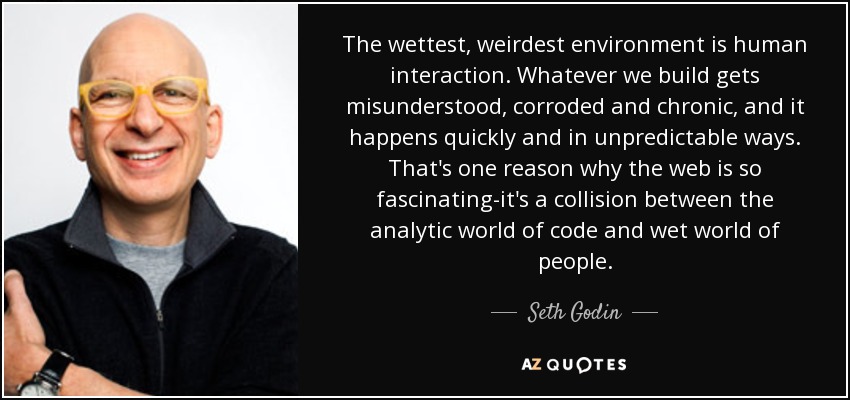
The wettest, weirdest environment is human interaction. Whatever we build gets misunderstood, corroded and chronic, and it happens quickly and in unpredictable ways. That's one reason why the web is so fascinating-it's a collision between the analytic world of code and wet world of people.
I am interested in the interaction of a group of people who have a common goal, or a common obsession, each contributing something unique to make something greater than the sum of its parts. I don't know why, but from day one, that has interested me.
The only meaningful contact is one that involves a genuine, giving personal interaction. You may want another person to help you in business, but you must also be willing to help him and to spend time getting to know his interests and needs... It has to be real and heartfelt, or it's best not to try to establish the relationship at all.
I had very low self-esteem. Books saved me. I found friends in stories like The Chronicles of Narnia and A Tree Grows in Brooklyn. During lunch hour at school I'd avoid social interactions by sitting on the bathroom sink and reading. My mother worked in my school cafeteria. When my anxiety got really bad, I'd put a coat on, grab my book and a flashlight, and hide in the freezer with the mac and cheese.
Isolated material particles are abstractions, their properties being definable and observable only through their interaction with other systems .
Computer scientists have so far worked on developing powerful programming languages that make it possible to solve the technical problems of computation. Little effort has gone toward devising the languages of interaction.
No such individual would find the Golden Rule surprising in any way because at its base lies the foundation of most human interactions and exchanges and it can be found in countless texts throughout recorded history and from around the world - a testimony to its universality.
Complex organisms cannot be construed as the sum of their genes, nor do genes alone build particular items of anatomy or behavior by themselves. Most genes influence several aspects of anatomy and behavior as they operate through complex interactions with other genes and their products, and with environmental factors both within and outside the developing organism. We fall into a deep error, not just a harmful oversimplification, when we speak of genes "for" particular items of anatomy or behavior.
Very little comes easily to our poor, benighted species (the first creature, after all, to experiment with the novel evolutionary inventions of self-conscious philosophy and art). Even the most "obvious," "accurate," and "natural" style of thinking or drawing must be regulated by history and won by struggle. Solutions must therefore arise within a social context and record the complex interactions of mind and environment that define the possibility of human improvement.
If you're paying attention to human interactions - to the gap between who we are and who we think we are, or the gap between what happened and what we remember - you're going to end up thinking (obliquely or otherwise) about what it means to act ethically, and I think that's all to the good.
I do think that I have a more flexible view of the interactions between people, and between human and non-human protagonists, humans and their landscapes.
"Race." I really can't understand it as anything other than something people say. The people who have said that you and I are both "black" and therefore deserve a certain kind of interaction with the world, they make race. I can't take them seriously.
Ugh, puppy mills. These commercial breeding facilities are horrendous. The animals are kept in tiny wire cages, with little to no human interaction throughout their lives. They are rarely, if ever, seen medically and are forced to breed over and over again and watch as their babies are taken away from them and sold to pet stores. It is a supply-and-demand business, so the more people stop going to pet stores and choose to adopt instead, the quicker we can put an end to these puppy mills.
Of course I love when people are quiet, but I also love when people are comfortable. I love when people emote. The flip side of having a totally silent audience is that they're less likely to react to you in the space, and I think that's one of the great things about performing live: you get energy from the audience, and you give energy back to them. There's interaction.
One reason patients are reluctant to work in a therapy group is they fear that things will go too far, that the powerful therapist or the collective group might coerce them to lose control--to say or think or feel things that will be catastrophic. The therapist can make the group feel safer by allowing each patient to set his or her limits and by emphasizing the patient's control over every interaction.
One thing most of us agree on is that the universe exists (people who deny that usually follow some trade other than science), so if some theoretical particle interaction would lead ultimately to the nonexistence of the universe, then you can save a lot of electricity by not trying to demonstrate it.
When you think of a social network, you have these two-way interactions: "Are you my friend? Yes? No? Yes?" Like LinkedIn, it's business oriented, but it's all about establishing connections. You connect to me through my other connections, and that sort of thing, and you sort of define who your friends are. Twitter doesn't have that.
A powerful tool in the early stages of developing scenarios is to pretend the interface is magic. If your persona has goals and the product has magical powers to meet them, how simple could the interaction be? This kind of thinking is useful to help designers look outside the box.
Me writing the book and the subsequent interactions that we had were actually the cap on that experience. We were still in this weird purgatory about it when I published the book. When I gave them the galleys and what ensued after that, then I understood a lot more about our relationships and what the experience meant to them. I'd never wanted to know what they thought about it at all.
As for not getting things right: I constantly rerun social situations/conversations I experience/have throughout my head, and I'm always writing them down in notebooks or in word documents/the Internet. I feel like these habits and a generally good memory of people/the interactions I have with them (due to studying people having always been my main interest in life) have lead me to being very accurate in things I write in stories/essays.
Music videos are very concrete and rigid. They don't allow for emotional interaction.
You want to belong, you want to be here. In interactions with others you're constantly waiting to see that they recognize that you're a human being. That they can feel your heartbeat and you can feel theirs. And that together you will live - you will live together.
I am who I am and I am what I am. And it's beautiful. And it's okay even if it doesn't look like the sexiest Victoria Secret model. It also boils down to my interactions with people.
I think most people come toward things assuming everybody is going to be a good person. When you have an interaction where it doesn't go that way, it's very problematic and interesting and weird.
And in this relentlessly unfolding series of interactions, the U.S. has played a very distinctive role, which most Americans have been either shielded from or simply unaware of.
Follow AzQuotes on Facebook, Twitter and Google+. Every day we present the best quotes! Improve yourself, find your inspiration, share with friends
or simply: