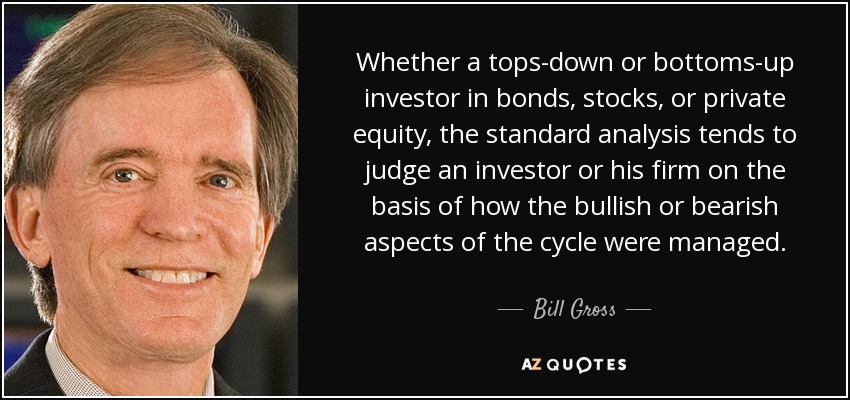
Whether a tops-down or bottoms-up investor in bonds, stocks, or private equity, the standard analysis tends to judge an investor or his firm on the basis of how the bullish or bearish aspects of the cycle were managed.
I find the parallels between how some investors refuse to recognise the trends and our reaction to some of our environmental challenges very powerful. There is an unwillingness to process unpleasant data.
Market timing, by the way, is a tag some buy-and-hold investors use to put down anything that involves using your brain. These are the same people who like to watch the locomotive coming and get run down in the name of discipline.
I've learned there's a big difference between a long-focused value investor and a good short-seller. That difference is psychological and I think it falls into the realm of behavioral finance.
Being a successful investor & winning in the stock market is a matter of skill & discipline and not luck alone
There is always a critical job to be done. There is a sales door to be opened, a credit line to be established, a new important employee to be found, or a business technique to be learned. The venture investor must always be on call to advise, to persuade, to dissuade, to encourage, but always to help build. Then venture capital becomes true creative capital - creating growth for the company and financial success for the investing organization
The sillier the market's behavior, the greater the opportunity for the business like investor.
Investors aren't willing to accept the idea that we're in an era of lower returns.
We do all that [ represent companies], because we have a lot of research in Japanese companies, and that research educates investors around the world. It allows us to sell stocks and bonds in Japanese companies.
NAFTA and GATT are quite similar. They both have highly protectionist elements. They're kind of a mixture of liberalization and protection designed to expand the power of transnational corporations. They're very basically investor's rights agreements. One crucial part in both is the "intellectual property right," which is a funny way of saying that corporations, like pharmaceutical companies, will have near-monopolistic rule over future technology. This now includes product as well as process rights.
If you were at Lehman, the same thing happened. If you were at AIG, the shareholders are getting creamed on these things. And those shareholders are not just a bunch of big shots in Wall Street. Those are pension funds, and those are investors all over the country. I wouldn't worry too much about that. Justice won't be perfect on it.
I've - that I regret. That was stupid and ignorant on my part. I went to a party as a guest of a friend of mine, a lawyer. And he had a client who I didn't know, except - maybe I'm pretending I didn't know, but he was a big investor in The New Yorker. And as I found out later in a book about The New Yorker, this guy was very unhappy about [Bill] Shawn.He thought Shawn was spending out - spending too much money on writers.
I told [a big investor in The New Yorker] - I was complaining the way writers complain.I said`[Bill Shawn] pays very well, but a lot of my pieces don't get in,' and that was true of most of the writers there.But he pays you for them, that was very nice of him. This guy didn't think it was very nice. He figured, `Oh, my God, that's more of my investment gone,' and paying money to writers for not printing them. That became, apparently, one of his weapons against Shawn when he - in the corporate skirmishes that went on. It was a bad mistake on my part.
My hope is that more and more investors around the world see an opportunity to do business in Greece.
Follow AzQuotes on Facebook, Twitter and Google+. Every day we present the best quotes! Improve yourself, find your inspiration, share with friends
or simply: