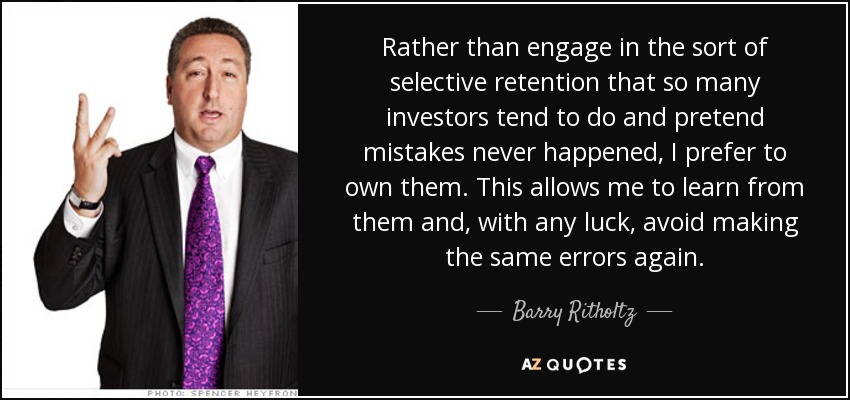
Rather than engage in the sort of selective retention that so many investors tend to do and pretend mistakes never happened, I prefer to own them. This allows me to learn from them and, with any luck, avoid making the same errors again.
Too often, investors are the target of fraudulent schemes disguised as investment opportunities. As you know, if the balance is tipped to the point where investors are not confident that there are appropriate protections, investors will lose confidence in our markets, and capital formation will ultimately be made more difficult and expensive.
A good investor in this new world knows to always expect the unexpected.
A global financial cabal engineered a fraudulent housing and debt bubble [2008], illegally shifted vast amounts of capital out of the US; and used 'privatization' as a form of piracy - a pretext to move government assets to private investors at below-market prices and then shift private liabilities back to government at no cost to the private liability holder Clearly, there was a global financial coup d'etat underway.
The lingo used in the space is so arcane and out of date that investors have no context for the discussions. The failure to establish a clear, effective communication system has been the biggest sin private equity has committed.
The companies I have traditionally seen do best over the long term had lead investors for their seed rounds
It's important to choose initial investors who are not twitchy and rushing for an exit. Wall Street's quarter-by-quarter lens may make the CEO make sub-optimal long-term decisions.
I had just been doing graffiti around New York and this real estate investor guy had walked through meat packing in New York and saw some of my graffiti. He was impressed and asked if I sold canvases. I really had not made any canvases of my graffiti work yet, but told him I could make one for him. He then commissioned me to make ten paintings and put on my first art show. Between the sold out show and the cops chasing after me it created a lot of media and I've been doing really well since then.
The United States has given frequent and enthusiastic support to the overthrow of democracy in favor of "investor friendly" regimes. The World Bank, IMF, and private banks have consistently lavished huge sums on terror regimes, following their displacement of democratic governments, and a number of quantitative studies have shown a systematic positive relationship between U.S. and IMF / World Bank aid to countries and their violations of human rights.
The list of qualities (an investor should have) include patience, self-reliance, common sense, a tolerance for pain, open-mindedness, detachment, persistence, humility, flexibility, a willingness to do independent research, an equal willingness to admit mistakes, and the ability to ignore general panic.
J.P. Morgan once had a friend who was so worried about his stock holdings that he could not sleep at night. The friend asked, 'What should I do about my stocks?' Morgan replied, 'Sell down to your sleeping point' Every investor must decide the trade-off he or she is willing to make between eating well and sleeping well. High investment rewards can only be achieved at the cost of substantial risk-taking. So what is your sleeping point? Finding the answer to this question is one of the most important investment steps you must take.
Bond investors are the vampires of the investment world. They love decay, recession - anything that leads to low inflation and the protection of the real value of their loans.
Investors believe in the best possible outcome.
Seeds not planted or tended by choice tend to be weeds, so at least for me, it's very helpful to consciously and periodically choose which seeds I want to water, and to think through what I expect to happen from that watering. Investors can spend a lot of time and energy reacting to the latest bits of news and trying to predict the next surprise, rather than choosing a consistent set of daily actions that they can carry out as things develop, regardless of how they develop.
My best advice to individual investors can readily be summed up into two closely linked precepts. Be patient and don't be greedy.
I am truly an angel investor and I'am not a passive investor.As a passive investor, I am awful because I can not put funding into a company and leave it to other people.
I think it's a mistake to rely too much on any one economic factor. It's why investors try to spread their portfolio round.
Whether it's watching a $4,000 laptop fall off the conveyor belt at airport security, contending with a software conflict that corrupted your file management system, or begging your family to stop opening those virus-carrying 'greeting cards' attached to emails, all computer owners are highly leveraged and highly vulnerable technology investors.
Technology tends toward avoidance of risks by investors. Uncertainty is ruled out if possible. People generally prefer the predictable. Few recognize how destructive this can be, how it imposes severe limits on variability and thus makes whole populations fatally vulnerable to the shocking ways our universe can throw the dice.
Any money the government spends must be taxed, borrowed or conjured out of thin air by the Federal Reserve, and that will reduce sound private investment. Obama has no real wealth to inject into the economy. He can only move around existing money while inflation robs us of purchasing power. Meanwhile, private investors who might have produced a better engine, battery, computer, cancer treatment or other wealth-creating and life-enhancing innovations hold back for fear that big government will undermine productive efforts.
Investors repeatedly jump ship on a good strategy just because it hasn't worked so well lately, and, almost invariably, abandon it at precisely the wrong time.
A good portfolio is more than a long list of good stocks and bonds. It is a balanced whole, providing the investor with protections and opportunities with respect to a wide range of contingencies.
You are in the field to defend the public interest, the financial truth for investors and the funds that should support the widow and the orphan.
The most important thing you can have is a good strategic asset allocation mix. So, what the investor needs to do is have a balanced, structured portfolio – a portfolio that does well in different environments…. we don't know that we're going to win. We have to have diversified bets.
Never forget that you only have one opportunity to make a first impression - with investors, with customers, with PR, and with marketing.
Follow AzQuotes on Facebook, Twitter and Google+. Every day we present the best quotes! Improve yourself, find your inspiration, share with friends
or simply: