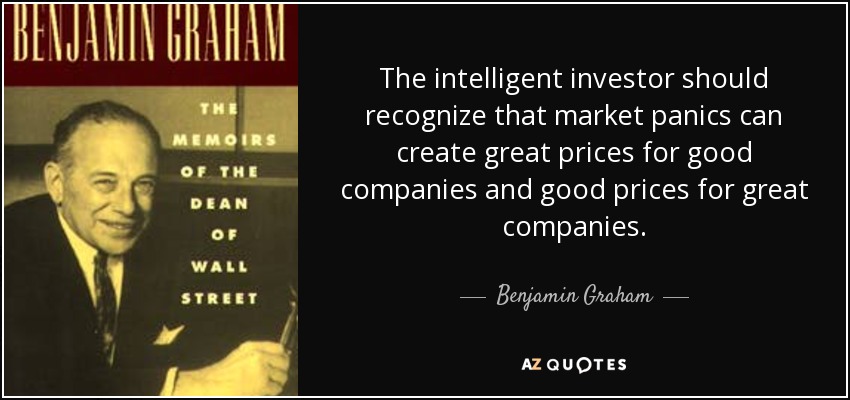
The intelligent investor should recognize that market panics can create great prices for good companies and good prices for great companies.
Losing some money is an inevitable part of investing, and there's nothing you can do to prevent it. But to be an intelligent investor, you must take responsibility for ensuring that you never lose most or all of your money.
In the end, alchemy, whether it is metallurgical or financial, fails. A base business can not be transformed into a golden business by tricks of accounting or capital structure. The man claiming to be a financial alchemist may become rich. But gullible investors rather than business achievements will usually be the source of his wealth.
In the financial markets, however, the connection between a marketable security and the underlying business is not as clear-cut. For investors in a marketable security the gain or loss associated with the various outcomes is not totally inherent in the underlying business; it also depends on the price paid, which is established by the marketplace. The view that risk is dependent on both the nature of investments and on their market price is very different from that described by beta.
Rather, risk is a perception in each investor's mind that results from analysis of the probability and amount of potential loss from an investment. If an exploratory oil well proves to be a dry hole, it is called risky. If a bond defaults or a stock plunges in price, they are called risky. But if the well is a gusher, the bond matures on schedule, and the stock rallies strongly, can we say they weren't risky when the investment after it is concluded than was known when it was made.
There are only a few things investors can do to counteract risk: diversify adequately, hedge when appropriate, and invest with a margin of safety. It is a precisely because we do not and cannot know all the risks of an investment that we strive to invest at a discount. The bargain element helps to provide a cushion for when things go wrong.
It is the long term investor who will in practice come in for the most criticism. For it is the essence of his behaviour that he should be eccentric, unconventional and rash in the eyes of the average opinion. If he is successful, that will only confirm the general belief in his rashness; and if in the short run he is unsuccessful, which is very likely, he will not receive much mercy. Worldly wisdom teaches that it is better for reputation to fail conventionally than to succeed unconventionally.
We are convinced that the intelligent investor can derive satisfactory results from pricing of either type (market timing or fundamental analysis via price). We are equally sure that if he places his emphasis on timing, in the sense of forecasting, he will end up as a speculator and with a speculator's financial results." And "The speculator's primary interest lies in anticipating and profiting from market fluctuations. The investor's primary interest lies in acquiring and holding suitable securities at suitable prices.
One of the ironies of the stock market is the emphasis on activity. Brokers, using terms such as 'marketability' and 'liquidity,' sing the praises of companies with high share turnover... but investors should understand that what is good for the croupier is not good for the customer. A hyperactive stock market is the pick pocket of enterprise.
In a world in which most investors appear interested in figuring out how to make money every second and chase the idea du jour, there's also something validating about the message that it's okay to do nothing and wait for opportunities to present themselves or to pay off. That's lonely and contrary a lot of the time, but reminding yourself that that's what it takes is quite helpful.
It is the duty of the long-term investor to endure great losses with equanimity.
The art of investment has one characteristic that is not generally appreciated. A creditable, if unspectacular, result can be achieved by the lay investor with a minimum of effort and capability; but to improve this easily attainable standard requires much application and more than a trace of wisdom. If you merely try to bring just a little extra knowledge and cleverness to bear upon your investment program, instead of realizing a little better than normal results, you may well find that you have done worse.
Traditionally the investor has been the man with patience and the courage of his convictions who would buy when the harried or disheartened speculator was selling.
Smart tech investor thinks about: a) future product roadmap, b) bottoms-up market size & growth, c) talent and skill of team. Essentially you are valuing things that have not yet happened, and the likelihood of the CEO and team being able to make them happen. Finance people find this appalling, but investors who do this well can make a lot of money.
Of one thing the investor can be certain: A large company's need to bring in a new chief executive from the outside is a damning sign of something basically wrong with the existing management - no matter how good the surface signs may have been as indicated by the most recent earnings statement.
The companies I have traditionally seen do best over the long term had lead investors for their seed rounds
Suppose you were a real estate investor with a 1/3 interest in the best apartment complex in town, the best mall, and the best office building. Would you feel like a poor, undiversified investor? No! But as soon as you get into stocks, people feel this way. Partly, people need to justify their fees.
I'm a passive investor. There are people who are very aggressive; they try to buy companies.
In order to be a really good investor, you need to be a little bit of a philosopher as well.
Market-cap based indexing will never be driven from its deserved perch as core and deserved king of the investment world. It is what we should all own in theory and it has delivered low-cost equity returns to a great mass of investors... the now and forever king-of-the-hill.
Loyalty is dead, the experts proclaim, and the statistics seem to bear them out. On average, U.S. corporations now lose half their customers in five years, half their employees in four, and half their investors in less than one. We seem to face a future in which the only business relationships will be opportunistic transactions between virtual strangers.
As an investor I cannot tell that. We cannot predict the success or failure.
Avoid greed and fear. These are the investor's Achilles heels. Keeping all your money in the bank earning 3% interest is just as foolish as dumping your entire savings into the market thinking you'll make a quick buck.
The success of the stock connect program and the increased market volatility means investors are looking for more products to access China markets performance than exchange traded funds, and futures are feeding that rising demand.
Guys like me on the investor side are a dime a dozen.
Follow AzQuotes on Facebook, Twitter and Google+. Every day we present the best quotes! Improve yourself, find your inspiration, share with friends
or simply: