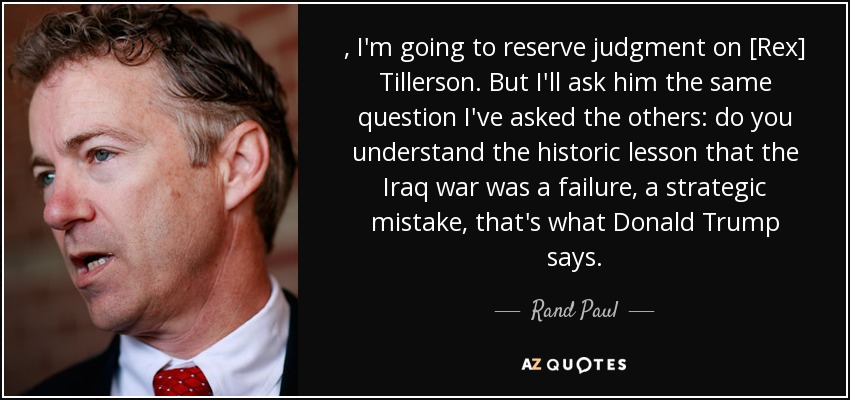
, I'm going to reserve judgment on [Rex] Tillerson. But I'll ask him the same question I've asked the others: do you understand the historic lesson that the Iraq war was a failure, a strategic mistake, that's what Donald Trump says.
I don't know about [Rex] Tillerson, but I do know that John Bolton doesn't get it. He still believes in regime change. He's still a big cheerleader for the Iraq war. He's promoted a nuclear attack by Israel on Iran. He wants to do regime change in Iran. So, I think John Bolton is so far out of it and has such a naive understanding of the world. If he were to be the assistant or the undersecretary for Tillerson, I'm an out automatic no on Bolton.
I think that there is a particular mindset that was on display in the run-up to the Iraq war that continues to this day. Some of the folks who were involved in that decision either don't remember what they said or are entirely unapologetic about the results, but that views the Middle East as a place where force and intimidation will deliver on the security interests that we have, and that it is not possible for us to at least test the possibility of diplomacy.
There is no question about the fact that we had very serious disagreements with my German, French, and Russian colleagues over the Iraq war. But I never stopped talking.
I think Britain needs to get out there on the world stage and make itself heard. And for much of my political career, there has been a sense of retreat from the world stage because of what happened in the Iraq War.
When you're making art, there's a lot of self-importance attached to that, but at the end of the day, you can always fall back on the fact that it's just a play. It's not like the Iraq War or something. We're not causing anybody any harm, other than a couple hours of a wasted evening.
By the time of Andi Parhamovich death, I had already grown skeptical of the Iraq war. What her death made me realize was what the actual price was. Going through that kind of loss and seeing how devastating it was on her family and friends made me decide that I was only going to write about things that I really believed in. I'm not going to compromise on that.
Inside the White House there were always extreme amounts of doubt about whether they should be escalating in Afghanistan. In fact, most of the president's advisers said, "This is probably not going to work." A lot of people in the military said, "This is probably not going to work." If the thumbnail version of the Iraq war was that George W.Bush lied about mass destruction weapons, the thumbnail version of Barack Obama's war in Afghanistan is that the generals pushed him into a war he didn't want to fight.
The military sensed weakness, exploited it and played Barack Obama. Obama's foreign policy has been consistently hawkish despite this reluctant warrior schtick that he pulls. But at the end of the day a reluctant warrior is still a warrior. Look at the drone strikes, the tripling of the war in Afghanistan, and now Libya. I'm convinced that had Obama been in the Senate in 2003 he would have voted for the Iraq war. He's clearly easily convinced by his advisers and the Pentagon.
I think it's better to be too early and disturb a few people - but have other people say it was necessary - than to do it way after the fact. We shouldn't forget that Charlie Chaplin did a movie about Hitler while Hitler was alive, and Peter Sellers in Stanley Kubrick's masterpiece Dr. Strangelove was during the McCarthy time, where everybody was a communist and McCarthy was flipping completely out. I think it's important to have a movie like Postal now, where we are on the peak of the Iraq War, on the peak of terrorist attacks, where everything is actually happening.
I'm writing from New Zealand - a country that decided from the beginning that the War was wrong, and chose not to participate in Iraq War.
There is a clear and strong link between the economy's present woes and the Iraq war. The war was at least one of the factors contributing to rising oil prices - which meant Americans were spending money on imported oil, rather than on things that would stimulate the american economy. Hiring Nepalese contractors in Iraq, moreover, doesn't stimulate the American economy in the way that building a school in America would do - and obviously doesn't have the long term benefits.
The country has large unfunded liabilities - social security, health care, and there will have to be some adjustments to these problems. What is scary though is how much worse things have gotten in the last eight years, and the Iraq war is one of the main factors.
Follow AzQuotes on Facebook, Twitter and Google+. Every day we present the best quotes! Improve yourself, find your inspiration, share with friends
or simply: