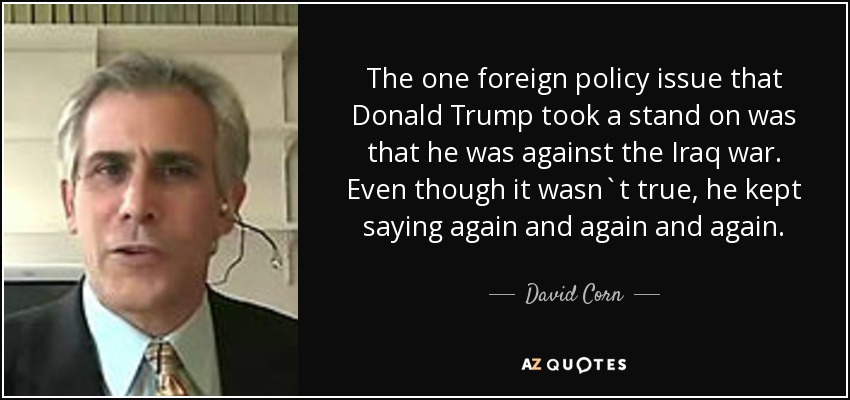
The one foreign policy issue that Donald Trump took a stand on was that he was against the Iraq war. Even though it wasn`t true, he kept saying again and again and again.
The national debt will have increased by approximately 50% in just eight years! We will have created a new unfunded entitlement - disability and health care benefits for the huge number of disabled veterans returning from the Iraq war.
In fact, for just about 1/6 of the cost of an Iraq War, we could have put the social security system on sound financial footings for the next 50 to 75 years. The problems can be managed - but not if we continue to fight this war for another 80 years.
I find it scandalous not only that there was so little discussion of the costs of the Iraq war before we went to war - this was, after all, a war of choice - but even five years into the war, the Administration has not provided a comprehensive accounting of the war.
I got involved as an activist when I was in high school, around the Iraq war. That's how I got involved. It seemed like, OK, we're going to go to war. It doesn't seem like a good idea. Someone should do something. I'm looking around and, like, I am someone, and I might not be able to do everything, but I can do something.
I think the problem with John Bolton is he disagrees with President Trump's foreign policy. He would be closer to John McCain's foreign policy. John Bolton still believes the Iraq war was a good idea. He still believes that regime change is a good idea. He still believes that nation-building is a good idea.
The two reasons that Bernie Sanders gave her fits was the Iraq War and her association with Wall Street. Wall Street owns Hillary Clinton. Wall Street has bought Hillary Clinton and whatever policy considerations she can give them if she gets elected. They have bought her already. That's what all the speech income is really all about.
Take the Iraq War,it's the second worst crime after the Second World War. It's the first time in history, in the history of imperialism, there were huge demonstrations, before the war was officially launched.
9/11 was a genuine trauma, and President George W. Bush rallied the country. I think the Iraq war was ill-considered, but there - it was done in the wake of a national trauma. And that the errors made under such circumstances are different than errors made in the cold.
Bill Russell, a famous philosopher from Boston Celtics once "When things go bad, things go bad." The [Iraq] war was terribly mismanaged-it was terribly mismanaged.
By accident of geography, the world's major oil resources are in Shi'ite-dominated areas. Iran's oil is concentrated right near the gulf, which happens to be an Arab area, not Persian. Khuzestan is Arab, has been loyal to Iran, fought with Iran not Iraq during the Iran-Iraq war. This is a potential source of dissension. I would be amazed if there isn't an attempt going on to stir up secessionist elements in Khuzestan.
The Iraq War is the first war in history, in which there were huge demonstrations before the war was launched, not beginning five years later and then being broken up. All of these are changes, and the people who are writing in journals today lived through these changes.
I was in the White House, probably the only administration I'll ever work for. The administration was not a success, neither at home nor abroad. The Iraq War was not a success. The condition of the average person was not enough better at the end of seven years of George Bush than it was at the beginning, and certainly it all ended in the collapse that was the Great Recession. So I feel a sense of karmic obligation to the universe because of that.
The frightening aspect is that it's part of a larger effort from the Pentagon to tear down the wall between public affairs and propaganda, and essentially say there is no difference between information operations, public affairs and psychological operations. They have a new name for that too, it's called Information Engagement. What I hope people take away from this is that it's a window into a larger phenomenon. After a decade of Iraq war you have this Pentagon-military apparatus run amok using resources that they shouldn't be to try to manipulate U.S. public opinion.
I should have voted for the first Iraq war. George Bush did that one very well. I had been skeptical. I was afraid that George Bush was going to treat the first Iraq war the way his son treated the second.
Iraq is sort of a situation where you've got a guy who drove the bus into the ditch. You obviously have to get the bus out of the ditch, and that's not easy to do, although you probably should fire the driver.
When it comes to the war in Iraq, the time for promises and assurances for waiting and for patience is over. Too many lives have been lost, too many billions of dollars have been spent for us to trust the president on another tired and failed policy that's opposed by generals and experts, Democrats and Republicans, Americans and many of the Iraqis themselves.
Yes, I did have to struggle very hard to get this [the vote on the Iraq war] through, but the reason I did it was because I thought it was the right thing to do. I didn't take this on myself... just because I thought, 'Let's give myself a really hard time for a couple of years!'
Will an Iraq war make our Al Qaeda problem worse? Not likely.
I took the position of organizing 126 Democrats who voted against the Iraq war resolution. And I happen to think it was the right position. Today we're faced with over 500 casualties, a cost of over $200 billion, and it could rise the casualties could go into the thousands and the costs could go over a half trillion if we stay there for years, as a number of people on this stage intend to see happen.
Brian Turner writes as only a soldier can, of terror and compassion, hurt and horror, sympathy and desire. He takes us into the truth and trauma of the Iraq war in language that is precise, delicate and beautiful, even as it tells of a suicide bomber, a skull shattered by a bullet, a blade in a bloodgroove.
The Democrats were in the majority in the U.S. Senate when we voted for the Iraq war and passed the U.S. Patriot Act. It's not enough to be in the majority, you have to stand for something.
When you're making art, there's a lot of self-importance attached to that, but at the end of the day, you can always fall back on the fact that it's just a play. It's not like the Iraq War or something. We're not causing anybody any harm, other than a couple hours of a wasted evening.
By the time of Andi Parhamovich death, I had already grown skeptical of the Iraq war. What her death made me realize was what the actual price was. Going through that kind of loss and seeing how devastating it was on her family and friends made me decide that I was only going to write about things that I really believed in. I'm not going to compromise on that.
Inside the White House there were always extreme amounts of doubt about whether they should be escalating in Afghanistan. In fact, most of the president's advisers said, "This is probably not going to work." A lot of people in the military said, "This is probably not going to work." If the thumbnail version of the Iraq war was that George W.Bush lied about mass destruction weapons, the thumbnail version of Barack Obama's war in Afghanistan is that the generals pushed him into a war he didn't want to fight.
Follow AzQuotes on Facebook, Twitter and Google+. Every day we present the best quotes! Improve yourself, find your inspiration, share with friends
or simply: